
Proposed framework for measuring India’s knowledge-based economy’s contribution to GDP | Current Affairs | Vision IAS

Upgrade to Premium Today

Start Now
MENU
Home
Quick Links

High-quality MCQs and Mains Answer Writing to sharpen skills and reinforce learning every day.

Watch explainer and thematic concept-building videos under initiatives like Deep Dive, Master Classes, etc., on important UPSC topics.

A short, intensive, and exam-focused programme, insights from the Economic Survey, Union Budget, and UPSC current affairs.

ESC

In Summary

  • A knowledge-based economy emphasizes human capital like information and skills over physical inputs, with codified and tacit knowledge types.
  • It drives increasing returns through innovation, transforms value creation via IPRs, and creates high-skill employment.
  • Examples include Digital India, Traditional Knowledge Digital Library, Ayush, and GI Tags.

In Summary

Released by the Ministry of Statistics and Programme Implementation, it seeks to measure the contribution through knowledge in capital, labour, innovation, and digital sectors.
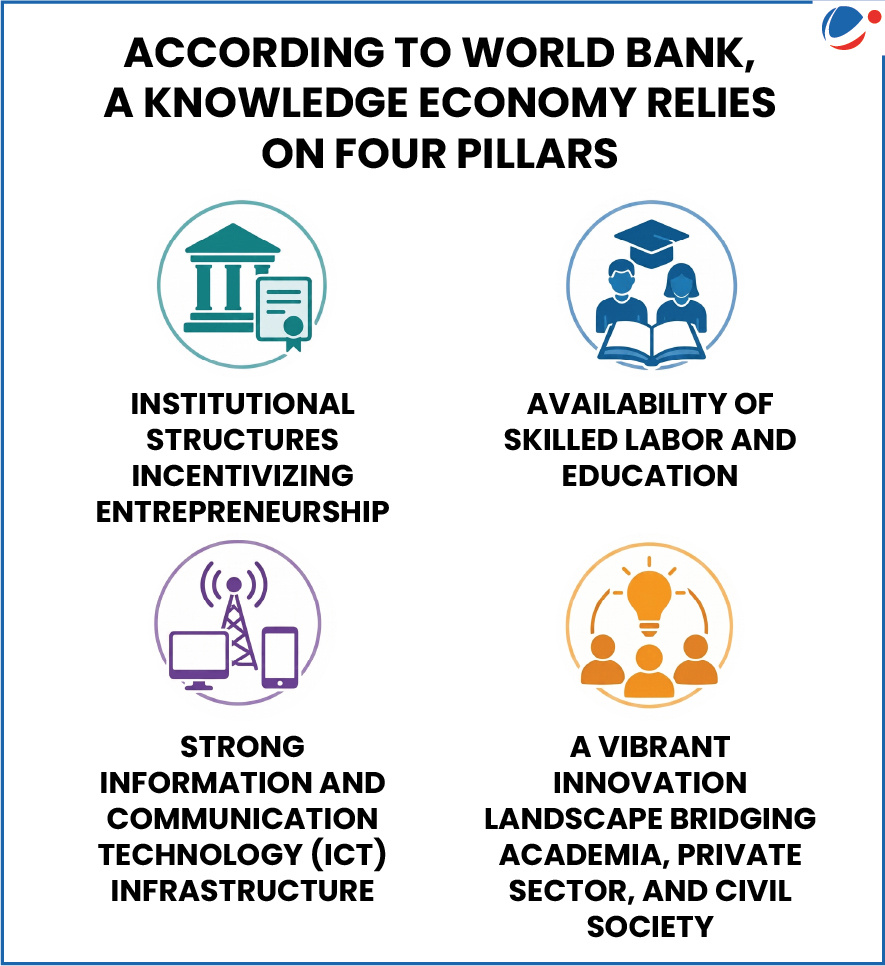
About Knowledge-based Economy 

  • Definition: It is a system of consumption and production that emphasizes the use of human capital like information, skills, technical expertise, and intellectual property over physical inputs and natural resources.
  • Types of Knowledge:
    • Codified Knowledge: Information that can be easily documented and transmitted digitally (e.g., know-what and know-why).
    • Tacit Knowledge: Experience-based skills and capabilities that are harder to codify and transfer (e.g., know-how and know-who).
  • Significance of a Knowledge-Based Economy
    • Driven by Increasing Returns: Generate increasing returns through innovation spillovers, repeated use, and sustained long-term economic growth.
    • Transformation of Value Creation: Commercializes science and innovation through IPRs like patents and copyrights, with knowledge-based activities contributing over 50% of GDP in major OECD economies.
    • High-Skill Employment: Creates high-wage jobs and increases demand for skilled “knowledge workers”.
    • National Innovation Systems: Relies on dynamic networks linking academia, government, and industry for interactive learning and innovation diffusion.
  • Examples: Digital India by MeitY, Traditional Knowledge Digital Library, Ayush, GI Tags, etc.
Watch Video News Today

Explore Related Content

Discover more articles, videos, and terms related to this topic

RELATED VIDEOS

2
News Today (Dec 28, 2024)

News Today (Dec 28, 2024)

YouTube HD
News Today (Jul 31, 2025)

News Today (Jul 31, 2025)

YouTube HD

RELATED TERMS

3

Digital India

A government initiative launched to transform India into a digitally empowered society and knowledge economy by improving online infrastructure, digital literacy, and government service delivery.

National Innovation Systems

A framework that describes the dynamic networks and institutions (academia, government, industry) that interact to generate, diffuse, and utilize knowledge and innovations within a country.

OECD

OECD का अर्थ है 'ऑर्गनाइजेशन फॉर इकोनॉमिक कोऑपरेशन एंड डेवलपमेंट' (आर्थिक सहयोग और विकास संगठन)। यह एक अंतर-सरकारी आर्थिक संगठन है जिसका गठन 1961 में हुआ था। इसके सदस्य देश एक बाजार अर्थव्यवस्था और लोकतांत्रिक बहुलवाद साझा करते हैं।

Title is required. Maximum 500 characters.

Search Notes

Filter Notes

Loading your notes...
Searching your notes...
Loading more notes...
You've reached the end of your notes

No notes yet

Create your first note to get started.

No notes found

Try adjusting your search criteria or clear the search.

Saving...
Saved

Please select a subject.

Referenced Articles

linked

No references added yet