


SC issued notice to Government seeking stricter child labour prohibition in entertainment and hospitality sectors.
Provisions Against Child Labour
- Constitutional
- Article 24: Prohibits employment of children below 14 years in factories, mines, or hazardous occupations.
- Article 39: It directs the State to ensure health and strength of workers and the tender age of children are not abused.
- Article 23: Prohibits traffic in human beings, begar (forced labour) etc.
- Legal
- The Child and Adolescent Labour (Prohibition and Regulation) Act, 1986 (amended in 2016): Prohibits employment of children below 14 years in all occupations and adolescents (14-18 years) in hazardous occupations.
- Juvenile Justice (Care and Protection of Children) Act, 2015
Article Sources
1 sourceThe Ministry of Statistics and Programme Implementation (MoSPI) released the Report of the Technical Advisory Committee on Base Year Revision of the All-India Index of Industrial Production (TAC-IIP).
About IIP
- Composite indicator that measures the short-term changes in the volume of production of a basket of industrial products during a period with respect to a base period.
- Released By: National Statistics Office (NSO) under MoSPI.
- Coverage: Three sectors- Manufacturing (77.63%), Mining (14.37%), Electricity (7.99%)
- Base Year: 2011-12 (in new series it will be 2022-23)
- Major Changes in New Series of IIP:
- Broadens coverage: Includes Minor Minerals, Rare Earth Minerals, Gas Supply, Water Supply, and Sewerage & Waste Management
- Separate indices for electricity generated from renewable and non-renewable sources.
- Mining and Quarrying sector is split into three sub-indices: Fuel Minerals, Metallic Minerals, and Non-Metallic Minerals.
Article Sources
1 sourcePAIMANA (Project Assessment Infrastructure Monitoring and Analytics for Nation-Building) Portal strengthens monitoring of Central Sector Infrastructure Projects
- The Portal Tracks 1,981 Infrastructure Projects worth ~ ₹43 lakh crore as of April 2026.
About PAIMANA Portal
- Purpose: A centralized web-based portal for monitoring of Central Sector Infrastructure Projects worth ₹150 crore and above.
- Operationalised by the Ministry of Statistics & Programme Implementation (MoSPI).
- Replaces the OCMS-2006 (Online Computerized Monitoring System).
- Key Feature: Operates on the “one data, one entry” principle for streamlined monitoring.
- Integration: Linked with DPIIT’s Integrated Project Monitoring Portal (IPMP/IIG-PMG) through APIs for automatic updation of over 70% project data.
- Significance: Serves as a national repository to standardize infrastructure monitoring and support informed decision-making.
Article Sources
1 sourceNorthern India has entered the hottest stretch of the season during the Nautapa.
About Nautapa
- It is a traditional nine-day weather phase in the Hindu calendar that marks the peak of the summer heatwave.
- Derived from the words Nau (nine) and Tapa (heat) that begins when the Sun enters Rohini Nakshatra in late May.
- This year, Nautapa is expected to last from May 25 to June 2 and coincides with the lingering effects of a strong El Niño.
- Nautapa are found in ancient astrological texts like Surya Siddhanta.
- El Nino refers to the warming of surface waters in the tropical Pacific Ocean, which often leads to hotter summers in India.
World Health Assembly recognizes stroke as a public health priority for the first time.
About Stroke
- Definition: Stroke is a medical emergency caused by interruption of blood flow to the brain due to blockage or bleeding, leading to brain cell death.
- Types: Includes ischemic stroke (blood clot), hemorrhagic stroke (bleeding in brain), and transient ischemic attack (temporary blockage).
- Symptoms: Sudden dizziness, vision loss, facial droop, arm weakness, and slurred speech.
- Treatment: Requires immediate CT/MRI diagnosis, thrombolytic therapy, and rehabilitation.
- Prevention: Lifestyle changes and effective management of high blood pressure can significantly reduce the risk of stroke.
The Union Finance Minister recently launched key SIDBI initiatives on its 37th Foundation Day to strengthen the MSME ecosystem.
- SIDBI is a statutory body that serves as the principal financial institution responsible for the promotion, financing, and development of the MSME sector.
About MachFin Mart
- This digital platform enables MSMEs to easily purchase modern machinery.
- It integrates equipment discovery with faster, digitized loan processing.
About The Modernization of Rural Enterprises (MoRE)
- The initiative provides targeted financial assistance to local grassroots businesses.
- Aims to modernize 10,000 rural and handicraft enterprises over the next three years.
India enters Wi-Fi 7 Era as TP-Link has started local manufacturing of Wi-Fi 7 devices.
About Wi-Fi 7
- Wi-Fi 7 (officially IEEE standard 802.11be) represents the next generation of wireless networking technology.
- Aim: Enhance performance, speed, and efficiency compared to its predecessors, Wi-Fi 6 and Wi-Fi 6E.
- Key Features of Wi-Fi 7:
- Speeds 4.8× faster than WiFi 6 (accelerates throughput up to 46 Gbps)
- Multi-Link Operation (MLO) across 2.4/5/6 GHz bands,
- 4× lower latency than Wi-Fi 6/6E,
- Wider channel bandwidth (more data transmitted simultaneously) and
- enhanced Target Wake Time (TWT) reducing power consumption and improving battery life,
- Advanced interference management: ‘Preamble Puncturing’ to keep traffic moving even when part of a channel has interference.
Article Sources
1 source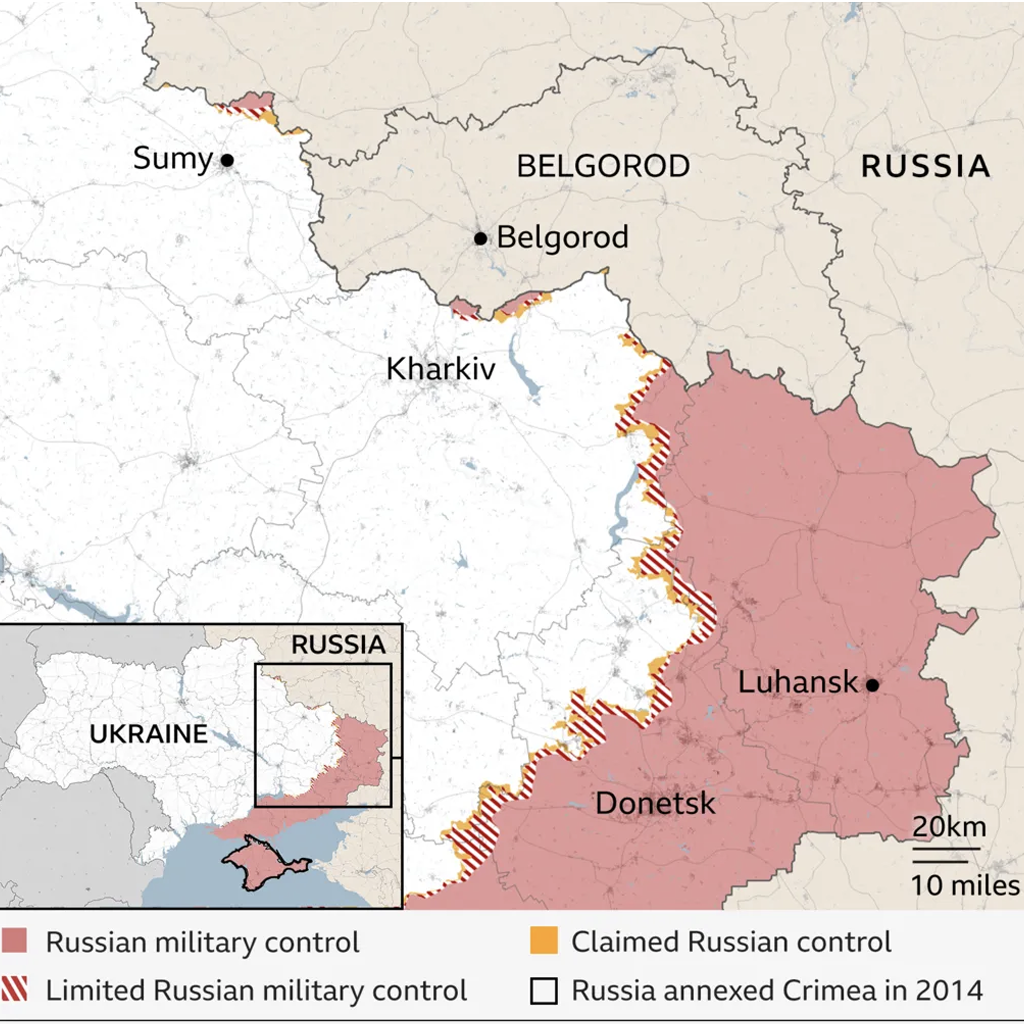
Missile and drone strike on Russia's Belgorod region caused casualties and damaged critical energy infrastructure.
About the Belgorod Region
- Established: 6 January 1954.
- Location: Situated in southwestern Russia, also shares a state border with Ukraine.
- lies along the upper Donets River and serves as the administrative capital of the Belgorod oblast.
- Climate: moderate continental climate.
- Economy: Industrial hub, it produces one-third of Russia's iron ore and leads in agriculture.
Heat dome over Europe scorches UK, France, Spain.
About Heat Dome
- It is a high-pressure atmospheric system that traps warm air near the Earth’s surface for prolonged periods, leading to extreme heat conditions.
- Because hot air expands, it creates a bulging dome that traps heat within it.
- Mechanism: Descending air gets compressed and heated, while high pressure prevents cloud formation and traps hot air near the surface.
- Impacts: Leads to heatwaves, droughts, wildfires, and severe health risks.

