The Framework on “Securing of Supply in the Mining and Processing of Critical Minerals and Rare Earths” builds on earlier India-US partnerships such as the U.S.-led Pax Silica and FORGE initiatives.
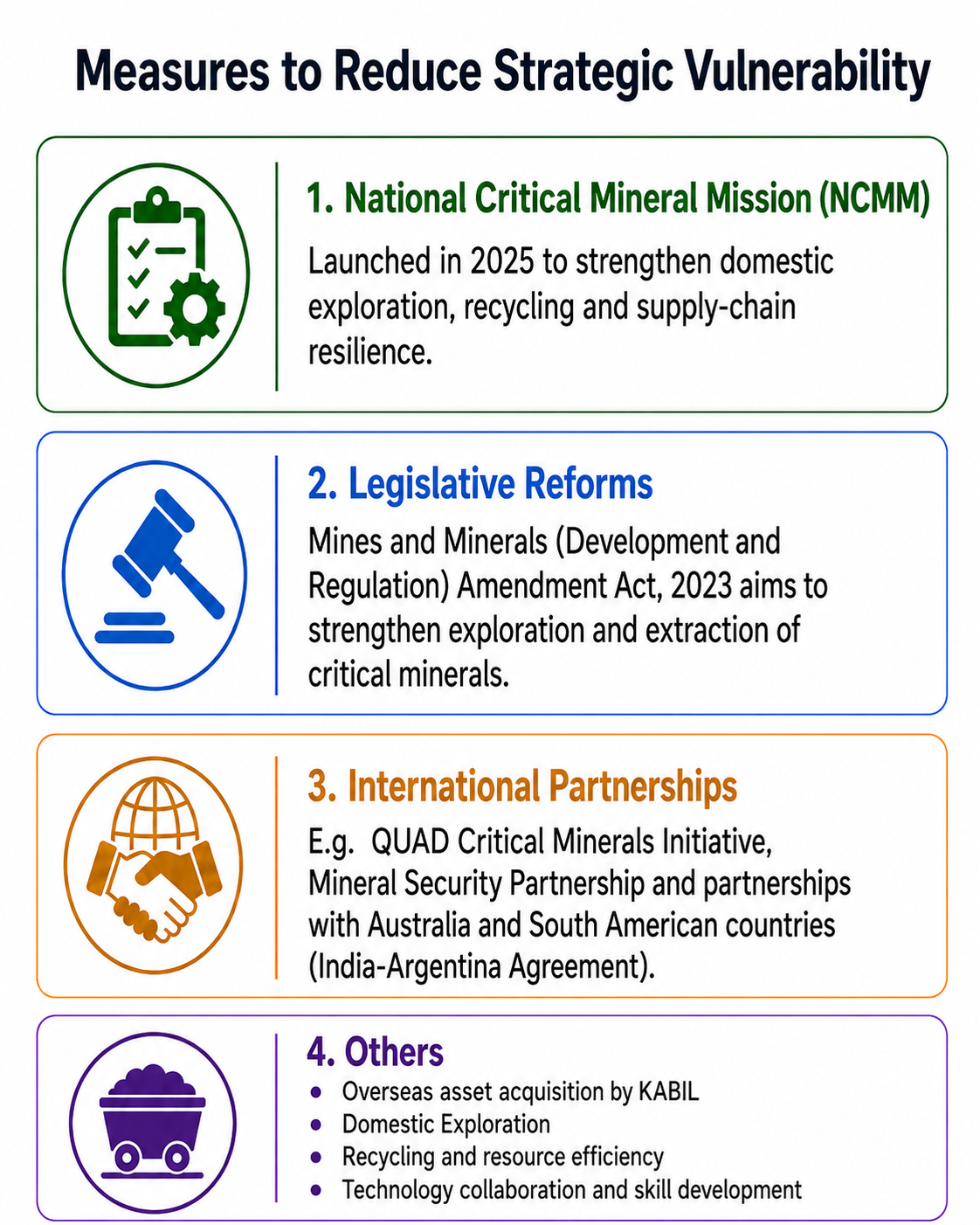
- It aims to strengthen cooperation on supply chains of critical minerals and rare earths, including financing, recycling, and supply diversification.
About Critical and Rare Earth Minerals
- Critical Minerals: Critical minerals are those that are essential to countries' economies or development, and their classification varies from country to country, depending on their level of access, usage, export value and national supply risks.
- Most countries' critical mineral lists include copper, lithium, nickel, cobalt, graphite and rare earth elements.
- All rare earth minerals are critical minerals, but not all critical minerals are rare earths.
- Most countries' critical mineral lists include copper, lithium, nickel, cobalt, graphite and rare earth elements.
- Rare Earth Elements: These are a group of 17 elements, comprising the elements scandium, yttrium and the 15 lanthanides, as defined by the International Union of Pure and Applied Chemistry.
- Application: Both Critical and Rare Earth Minerals are used in critical sectors such as the Defence sector (radars and others), electronics, clean energy technologies such as solar panels, AI, Robotics, Space exploration equipment etc.
- China’s dominance: According to IEA, China has 49% of the world’s rare earth reserves, produces 69% of rare earth minerals, and controls 90% of their processing and refining.
- In other critical minerals, China commands 99% of gallium refining, over 90% of graphite and manganese processing and 58% of global lithium refining.
How this New Framework Benefits India?
|