


The World Meteorological Organization (WMO) has warned of an 80% probability of El Niño developing in the coming months.
- El Niño and La Niña are opposite phases of the El Niño–Southern Oscillation (ENSO).
- Southern Oscillation is a coherent inter-annual fluctuation of atmospheric pressure over the tropical Indo-Pacific region.
El Niño
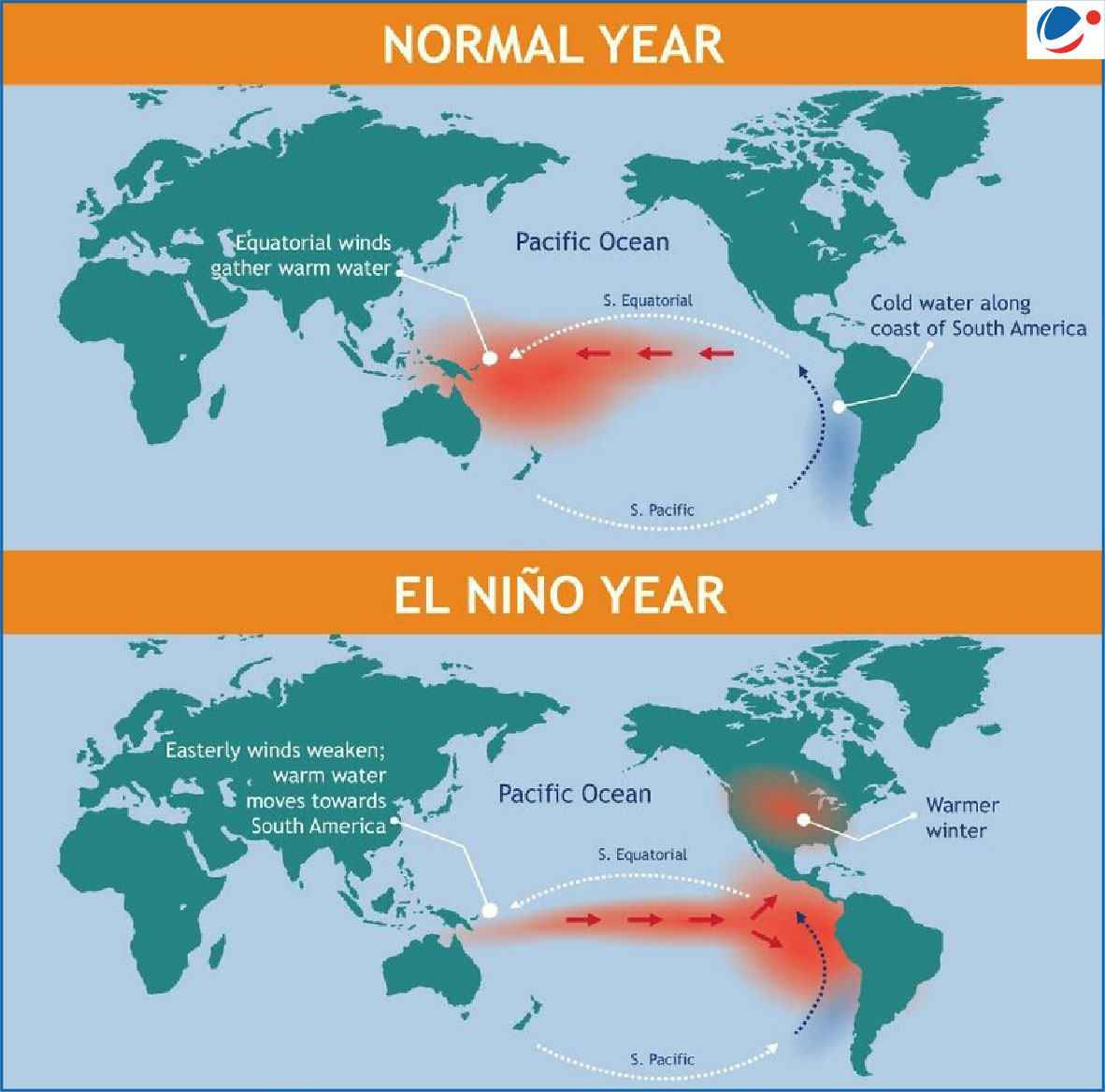
- El Niño means “Little Boy” in Spanish.
- Characterized by warming of sea surface temperatures in the central and eastern equatorial Pacific Ocean.
- Occurs every 2–7 years and typically lasts 9–12 months.
- Usually develops between March and June and peaks during November–February.
La Niña
- La Niña means “Little Girl” in Spanish.
- Characterized by cooling of sea surface temperatures in the central and east-central equatorial Pacific Ocean.
Impact of El Nino
- Global:
- Wetter conditions in parts of southern South America, the southern United States, etc.
- Drier conditions in northern South America, the Caribbean, Australia, and parts of South Asia.
- Weakened upwelling (off the coast of Peru) reduces the supply of cold, nutrient-rich water, leading to lower phytoplankton productivity and disruption of marine food chains.
- On India:
- It is associated with below-normal southwest monsoon rainfall, disrupting agriculture and water management.
- On the other hand, La Niña strengthens the Indian monsoon, resulting in above-normal rainfall.
- Increased risk of extreme weather events such as cyclones, wildfires etc., causing human and economic losses.
- It is associated with below-normal southwest monsoon rainfall, disrupting agriculture and water management.



