
Resolving the India–China Boundary Dispute | Current Affairs | Vision IAS

Upgrade to Premium Today

Start Now
MENU
Home
Quick Links

High-quality MCQs and Mains Answer Writing to sharpen skills and reinforce learning every day.

Watch explainer and thematic concept-building videos under initiatives like Deep Dive, Master Classes, etc., on important UPSC topics.

A short, intensive, and exam-focused programme, insights from the Economic Survey, Union Budget, and UPSC current affairs.

ESC

In Summary

  • The 35th WMCC meeting reviewed the India-China border situation, highlighting differing perceptions of the Line of Actual Control (LAC).
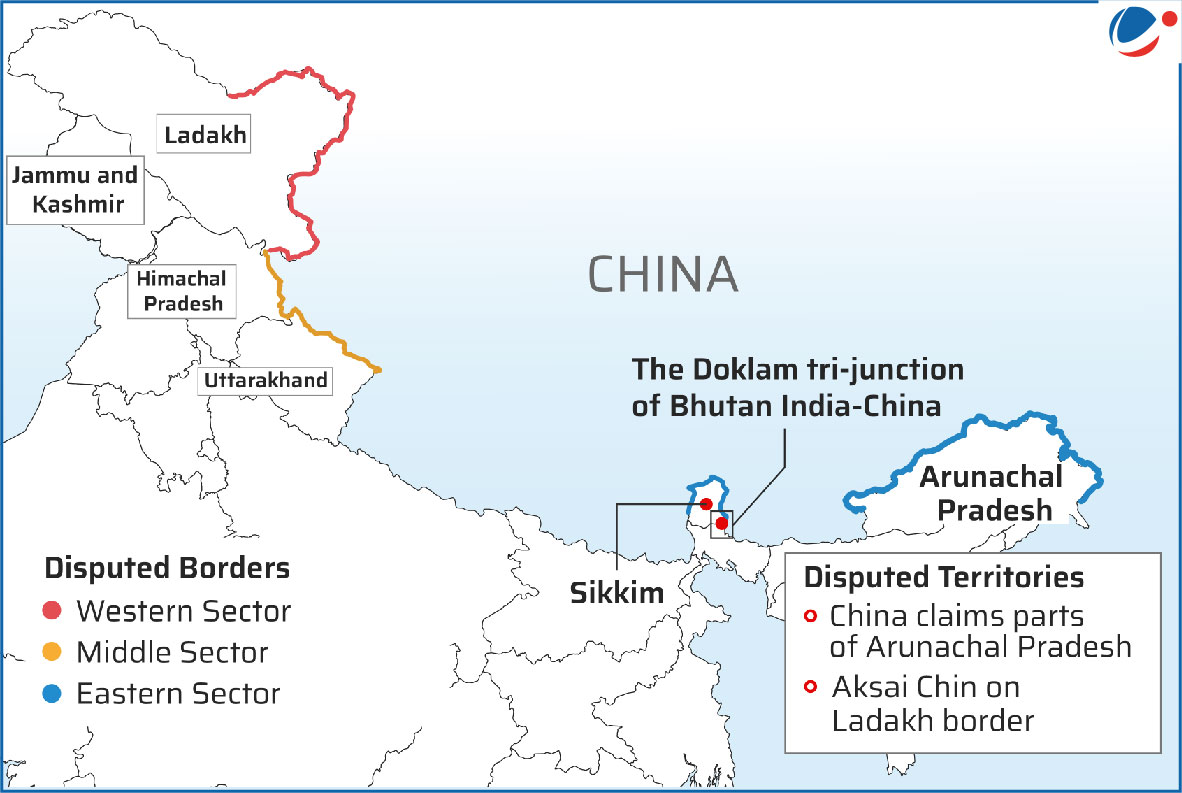
  • Key disputed areas include Aksai Chin (Western Sector), Bara Hoti (Middle Sector), Arunachal Pradesh (Eastern Sector), and Doklam Plateau (Sikkim Sector).
  • India advocates for preserving the 2005 Framework, focusing on LAC stability as a precondition for progress, and seeking a comprehensive political settlement.

In Summary

The 35th meeting of the Working Mechanism for Consultation & Coordination on India-China Border Affairs (WMCC) reviewed the situation in the India-China border areas.
About India-China Border Dispute

  • Origin: Different perceptions of the Line of Actual Control as India shares second longest land boundary with China (3488 km) only after Bangladesh (4096.7 km).
    • In 1865, when WH Johnson, a civil servant with the Survey of India, proposed the 'Johnson Line', which placed Aksai Chin within Jammu and Kashmir which Chinese dynasty refused.
    • In Simla meeting, 1914, between British India,Tibet and, China; proposed line from Bhutan to Burma (now Myanmar) (McMahon Line) but opposed by China.
  • Conflict: 1962 India–China War when China attacked India.
  • Disputed Areas: (Along three sectors)
    • Western Sector (Ladakh–Aksai Chin): China controls Aksai Chin, which India claims as part of Ladakh.
    • Middle Sector: Kauirik Lahaul and Spiti Valley (Himachal Pradesh), Bara Hoti and Nelang Valley (Uttarakhand).
    • Eastern Sector (Mainly Arunachal Pradesh): China claims Arunachal Pradesh, especially the Tawang region, as "South Tibet" (Zàng Nán).
      • Sikkim Sector: Nathu La pass, the Naku La sector, Cho La, Mount Gipmochi, Batang La, and the Doklam Plateau (Situated at the crucial tri-junction of India, China, and Bhutan) and adjoining Jampheri Ridge.

Principles India Should Follow for Dispute Settlement

  • Preserve the 2005 Framework: A package settlement through a three-step process: political parameters, a settlement framework, and final delineation and demarcation of the boundary.
  • Focus on LAC Stability: Make peace and tranquility on the LAC a precondition for progress; oppose unilateral changes and persistent buffer zones.
  • Seek a Comprehensive Political Settlement: Push for meaningful political negotiations on the entire boundary issue.
Watch Video News Today

Explore Related Content

Discover more articles, videos, and terms related to this topic

RELATED VIDEOS

3
Simplified | Global China: Geostrategic Ramifications and Policy Responses

Simplified | Global China: Geostrategic Ramifications and Policy Responses

YouTube HD
News Today (Jul 31, 2024)

News Today (Jul 31, 2024)

YouTube HD
News Today (Aug 20, 2025)

News Today (Aug 20, 2025)

YouTube HD

RELATED TERMS

3

2005 Framework

An agreement or understanding between India and China that outlines a three-step process for resolving the boundary dispute: political parameters, a settlement framework, and final delineation and demarcation.

Doklam Plateau

A strategic plateau situated at the tri-junction of India, China, and Bhutan, making it a sensitive area in the border dispute. It was the site of a significant military standoff between India and China in 2017.

Tawang region

A strategically important area in Arunachal Pradesh claimed by China as 'South Tibet' (Zàng Nán). Its control is a significant point of contention in the India-China border dispute.

Title is required. Maximum 500 characters.

Search Notes

Filter Notes

Loading your notes...
Searching your notes...
Loading more notes...
You've reached the end of your notes

No notes yet

Create your first note to get started.

No notes found

Try adjusting your search criteria or clear the search.

Saving...
Saved

Please select a subject.

Referenced Articles

linked

No references added yet
