


Published by National Tiger Conservation Authority (NTCA) and Wildlife Institute of India (WII), it outlines a scientific framework for restoring tiger populations in suitable landscapes.
About the Roadmap
- Structured approach to tiger reserve management based on ecological status and landscape priorities (Protected (core) area, Buffer zone and zone of influence) for source and sink landscapes.
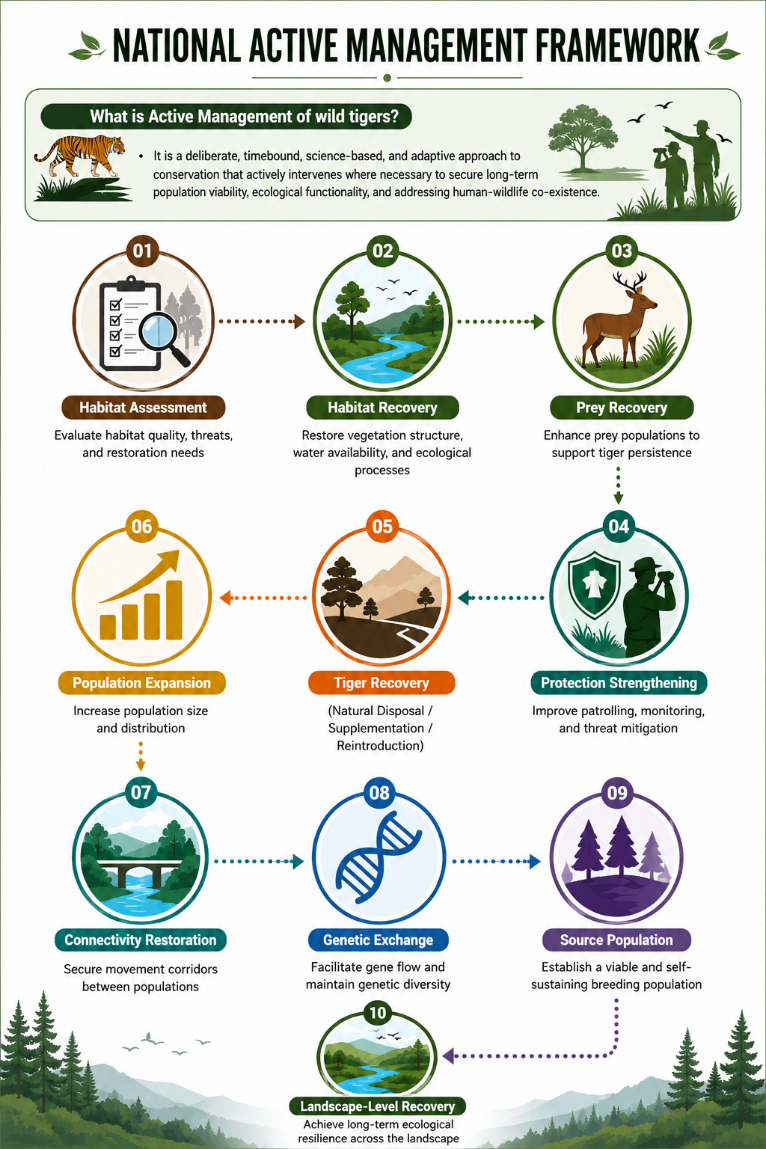
- Three-layered conservation architecture:
- Foundational Layer: Protection, Habitat security, Prey recovery, Law enforcement
- Active Management Layer (See infographic)
- Future Resilience Layer: Climate adaptation, Smart infrastructure, One Health, Nature-based economies, Community stewardship
Tiger Status in India
- 5 Major Landscapes: Shivalik Hills & Gangetic Plains, Central India & Eastern Ghats, Western Ghats, Northeastern Hills & Brahmaputra Floodplains, and the Sundarbans.
- Extent: India has 58 TRs across 18 states, covering ~2.6% of India's geographical area.
- Population: 3,682 (2022) (70% of global wild tiger population).
- Low Tiger Density Reserves: Buxa, Achanakmar, Udanti-Sitanadi, Indravati and Palamau.
- Challenges in Tiger Conservation: habitat fragmentation, loss of connectivity, human-tiger conflict, climate change, diseases, poaching, and developmental pressures.
Roadmap Recommendations
- Habitat Readiness: Enhancing prey populations (gaur, barasingha translocations), water availability, vegetation cover.
- Community Engagement: Awareness, conflict mitigation, livelihood diversification, responsible eco-tourism.
- Logistical: Protect and restore wildlife corridors, use GIS-based planning, mitigate impact of linear infrastructure.
- Others: Adequate funding, strengthening coordination between NTCA, states, scientific and conservation partners, Monitoring through radio telemetry, M-STrIPES, etc.


