
Place in News: Indonesia | Current Affairs | Vision IAS

Upgrade to Premium Today

Start Now
MENU
Home
Quick Links

High-quality MCQs and Mains Answer Writing to sharpen skills and reinforce learning every day.

Watch explainer and thematic concept-building videos under initiatives like Deep Dive, Master Classes, etc., on important UPSC topics.

A short, intensive, and exam-focused programme, insights from the Economic Survey, Union Budget, and UPSC current affairs.

ESC

In Summary

  • Magnitude 5.9 earthquake struck Indonesia's Flores region, located in the world's largest archipelago.
  • Indonesia, situated on the Ring of Fire, is highly disaster-prone due to its tectonic setting and over 100 active volcanoes.
  • The country's five main islands are Sumatra, Java, Kalimantan, Sulawesi, and Papua, sharing land borders with East Timor, Papua New Guinea, and Malaysia.

In Summary

Indonesia (Capital: Jakarta)
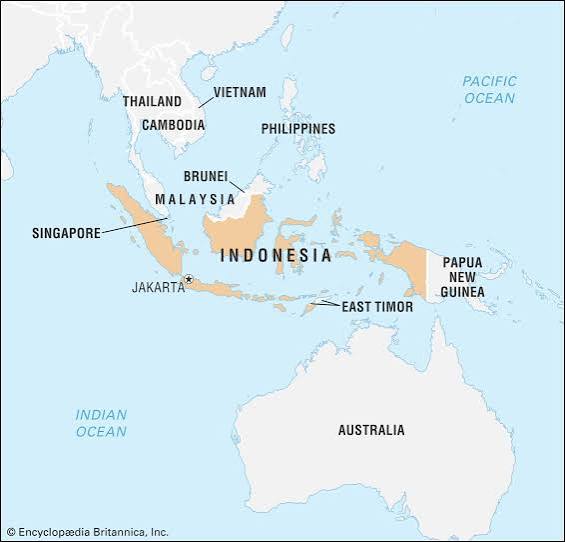
Description: Indonesia | History, Flag, Map, Capital, Language, Religion, & Facts | Britannica

An earthquake of ⁠magnitude ​5.9 struck Indonesia's ​Flores ​region.

Political Features

  • Location: World’s largest archipelago located off the coast of mainland Southeast Asia in the Indian and Pacific oceans.
  • Five main islands (West to East) are: Sumatra, Java, Kalimantan, Sulawesi and Papua.
  • Boundaries: country shares its land border with three countries i.e. East Timor, Papua New Guinea, and Malaysia.

Geographical Features

  • Tectonic Setting: Located at the convergence of tectonic plates, part of the Ring of Fire, making it highly disaster-prone (earthquakes and volcanic eruptions).
  • Volcanism: Presence of 100+ active volcanoes (e.g., Mount Merapi, Mount Krakatoa).
Watch Video News Today

Explore Related Content

Discover more articles, videos, and terms related to this topic

RELATED TERMS

3

Volcanism

The process by which magma, volcanic ash, and gases are erupted from a volcano. Indonesia's high number of active volcanoes is a direct result of its position on the Ring of Fire.

Tectonic Plates

Massive, irregularly shaped slabs of solid rock, composed of both continental and oceanic lithosphere, that form the Earth's outer shell. Their movement and interaction are responsible for earthquakes, volcanic activity, and mountain building.

Ring of Fire

A string of volcanoes and sites of seismic activity, or earthquakes, around the edges of the Pacific Ocean. Roughly 90% of all earthquakes occur here, and it is dotted with 75% of all active volcanoes, surrounding several major tectonic plates.

Title is required. Maximum 500 characters.

Search Notes

Filter Notes

Loading your notes...
Searching your notes...
Loading more notes...
You've reached the end of your notes

No notes yet

Create your first note to get started.

No notes found

Try adjusting your search criteria or clear the search.

Saving...
Saved

Please select a subject.

Referenced Articles

linked

No references added yet