
Parliamentary standing committee presented report on India’s Role and Presence in the Arctic and Antarctic Regions | Current Affairs | Vision IAS

Upgrade to Premium Today

Start Now
MENU
Home
Quick Links

High-quality MCQs and Mains Answer Writing to sharpen skills and reinforce learning every day.

Watch explainer and thematic concept-building videos under initiatives like Deep Dive, Master Classes, etc., on important UPSC topics.

A short, intensive, and exam-focused programme, insights from the Economic Survey, Union Budget, and UPSC current affairs.

ESC

In Summary

  • Polar regions are crucial for climate regulation, Indian monsoon, sea-level rise, critical minerals, shipping routes, and geopolitics.
  • India faces challenges like limited Arctic Council membership, weak partnerships, and research restrictions under the Svalbard Treaty.
  • Recommendations include appointing a Polar Ambassador, pursuing "Quasi-Global Commons" status for the Arctic, and expediting the Maitri-II construction.

In Summary

The Committee examined India’s presence in polar regions, and progress on scientific research.

Importance of Polar Regions  
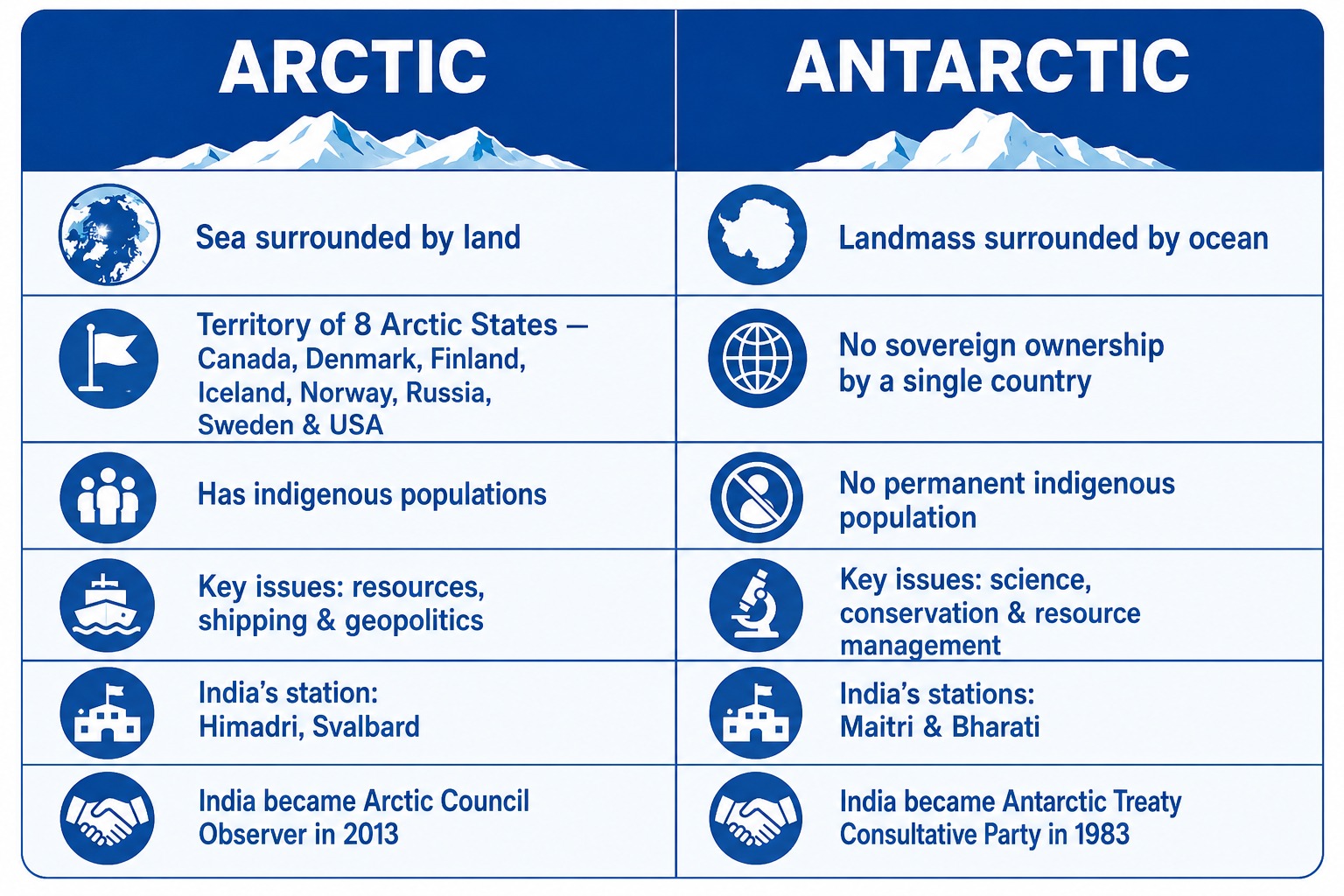
  • Climate Regulation: Polar Regions act as a global climate barometer.
  • Indian Monsoon: Arctic changes may influence monsoon and rainfall patterns.
  • Sea-level Rise: Polar ice melt threatens India’s coastal regions.
  • Critical Minerals: Arctic resources can support India’s supply-chain security.
  • Shipping: Melting sea ice is opening routes like the Northern Sea Route potentially improving connectivity between Asia and Europe.
  • Geopolitics: The Arctic is emerging as a key strategic theatre amid major-power competition.
Major Issues India faces in the regionRecommendations 

Limited Arctic Council role

  • The Ottawa Declaration, 1996, limits Arctic Council membership to the eight Arctic States, while non-Arctic countries can only obtain Observer status; hence, India has no established accession route to full membership under the present framework.
India should take up its claim for Member status whenever the Arctic Council reviews its membership, while continuing to deepen ties with Arctic States and other Observer countries and seek their support for India’s future membership.

Weak Arctic partnerships: 

  • India’s engagement is relatively weaker than that of some Asian countries.
Deepen ties with Arctic States and pursue a quadrilateral arrangement with Japan, South Korea and Singapore.

Limited polar diplomacy

  • India lacks a dedicated high-level mechanism.
Appoint a Polar Ambassador. 

Arctic governance: 

  • Arctic is legally not a Global Commons, as much of it falls under the territorial jurisdictions of Arctic States.
Pursue recognition of the Arctic as a “Quasi-Global Commons” like the Amazon rainforest, whose ecological importance extends beyond its territorial boundaries.

Northern Sea Route

  • India has limited participation in the emerging Arctic shipping route.
Expedite the India–Russia feasibility study and work towards 5 million tonnes of cargo by 2030.

Treaty related research restrictions: 

  • India's Himadri station in Svalbard operates under the 1920 Svalbard Treaty, which recognises Norwegian sovereignty and equal rights for treaty parties
  • New Norwegian permissions and research regulations are making it difficult for India to expand R&D activities.
The Committee recommends that the MEA directly engage with the Norwegian Government to address the restrictions and safeguard India’s ability to undertake polar research.

Ageing Antarctic infrastructure: 

  • Maitri has exceeded its intended lifespan.
Expedite construction of Maitri-II to ensure India’s long-term Antarctic presence.

India’s 2022 Arctic Policy: 

  • It focuses on science, climate, sustainability and cooperation.
Add “Geopolitics & Strategy” as a new pillar.
Watch Video News Today

Explore Related Content

Discover more articles, videos, and terms related to this topic

RELATED VIDEOS

1
Role of Indian Diaspora in Making India Self-Reliant

Role of Indian Diaspora in Making India Self-Reliant

YouTube HD

RELATED TERMS

3

Maitri-II

India's planned new research station in Antarctica, intended to replace the aging Maitri station and ensure the continuation of India's long-term scientific presence and research activities in the region.

1920 Svalbard Treaty

An international agreement that recognizes Norwegian sovereignty over the Svalbard archipelago but grants signatory parties, including India, equal rights to engage in economic activities and scientific research.

Quasi-Global Commons

A concept suggesting that certain regions, like the Arctic, despite falling under territorial jurisdictions, have ecological importance that extends beyond national boundaries and warrant international consideration and cooperation, similar to how the Amazon rainforest is viewed.

Title is required. Maximum 500 characters.

Search Notes

Filter Notes

Loading your notes...
Searching your notes...
Loading more notes...
You've reached the end of your notes

No notes yet

Create your first note to get started.

No notes found

Try adjusting your search criteria or clear the search.

Saving...
Saved

Please select a subject.

Referenced Articles

linked

No references added yet