
SC Asks CBSE to Consider Exempting Present Class 6 Students From 3-Language Policy | Current Affairs | Vision IAS

Upgrade to Premium Today

Start Now
MENU
Home
Quick Links

High-quality MCQs and Mains Answer Writing to sharpen skills and reinforce learning every day.

Watch explainer and thematic concept-building videos under initiatives like Deep Dive, Master Classes, etc., on important UPSC topics.

A short, intensive, and exam-focused programme, insights from the Economic Survey, Union Budget, and UPSC current affairs.

ESC

In Summary

  • SC suggested CBSE grant one-time relaxation for Class 6 students on the new three-language policy.
  • NEP 2020 mandates learning three languages, promoting multilingualism and cultural diversity.
  • The three-language formula, proposed by Kothari Commission, has evolved through NEP 1968, 1986, 1992, and 2020.

In Summary

  • Supreme Court (SC) reiterated that the Central Board of Secondary Education (CBSE) should consider granting a one-time relaxation to Class 6 students from the newly introduced third-language requirement.
    • Court suggested that the policy can be applied mandatorily for class 6 students from January 1, 2027.
    • Students of Class 7, 8 and 9 have been exempted from the 3-language policy.
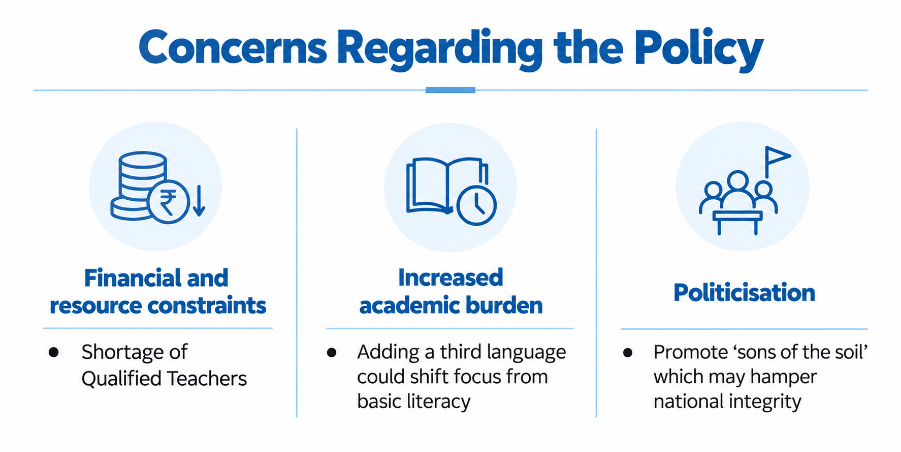
About 3-Language Policy

  • National Education Policy (NEP) 2020 requires students to learn three languages, with at least two being native to India. 
  • States and students can choose languages, promoting multilingualism while respecting cultural and regional diversity.
  • Benefits of policy: 
    • Enhances educational access, improving learning outcomes.
    • Protects languages and traditional knowledge for future generations.
    • Promotes social harmony and tolerance between linguistic and cultural groups

Evolution of the Policy

  • Kothari Commission (1964-66):  Formally proposed the three-language formula.
  • Inclusion in Education Policies 
    • It was incorporated in NEP 1968 (mandated Hindi, English, and a regional language).
    • NEP 1986 & 1992 retained the three-language formula.
    • NEP 2020 also retained the three-language formula with more flexibility in language selection.

Watch Video News Today

Explore Related Content

Discover more articles, videos, and terms related to this topic

RELATED VIDEOS

1
Lateral Entry

Lateral Entry

YouTube HD

RELATED TERMS

3

Kothari Commission (1964-66)

The Education Commission of 1964-66, chaired by Dr. D.S. Kothari, was tasked with advising the government on the future development of education in India. It advocated for a 'Common School System' aimed at providing uniformly good quality education to all children, irrespective of their background, to promote social cohesion and equality.

Three-Language Policy

A policy that recommends the learning of three languages by students, typically Hindi, English, and a regional language, with the aim of promoting national integration and linguistic diversity. It was first proposed in the National Policy on Education, 1968.

National Education Policy (NEP) 2020

A comprehensive policy framework by the Indian government that aims to reform the education system, with a focus on promoting mother tongue instruction and reviving indigenous knowledge systems, thereby addressing colonial legacies.

Title is required. Maximum 500 characters.

Search Notes

Filter Notes

Loading your notes...
Searching your notes...
Loading more notes...
You've reached the end of your notes

No notes yet

Create your first note to get started.

No notes found

Try adjusting your search criteria or clear the search.

Saving...
Saved

Please select a subject.

Referenced Articles

linked

No references added yet