
Union Health Ministry Releases Advisory on Regulation of Stem Cell Therapy in India | Current Affairs | Vision IAS

Upgrade to Premium Today

Start Now
MENU
Home
Quick Links

High-quality MCQs and Mains Answer Writing to sharpen skills and reinforce learning every day.

Watch explainer and thematic concept-building videos under initiatives like Deep Dive, Master Classes, etc., on important UPSC topics.

A short, intensive, and exam-focused programme, insights from the Economic Survey, Union Budget, and UPSC current affairs.

ESC

In Summary

  • Supreme Court's January 2026 'Yash Charitable Trust' judgment mandates advisory to regulate stem cell therapy trials.
  • Advisory restricts stem cell therapy to approved conditions and clinical trials for Autism Spectrum Disorder.
  • Unapproved use faces penalties including registration cancellation, fines, and professional misconduct charges.

In Summary

The advisory has been issued as per the January 2026 judgment of the Supreme Court in ‘Yash Charitable Trust’ Case to curb unregulated commercial Stem cell therapy trials in the country.

Key Highlights of the Advisory
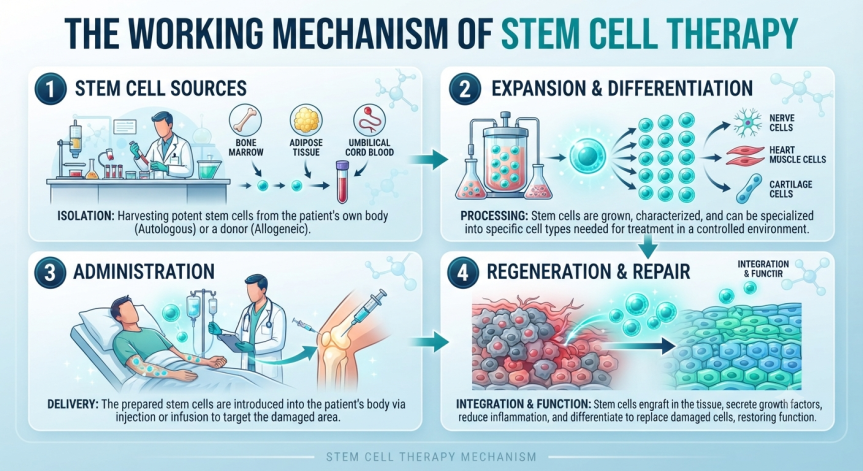
  • Approved List Only: Stem cell therapy is allowed as standard care only for conditions on the Ministry-approved list. 
  • Autism Restriction: Stem cell treatment for Autism Spectrum Disorder is limited to approved clinical trials only. 
  • Strict Enforcement: Unapproved use can result in registration cancellation, fines under the Clinical Establishments Act 2010, and professional misconduct under IMC Regulations 2002.

What is Stem Cell Therapy?

  • Definition: Stem cell therapy (or regenerative medicine) uses stem cells to replace, repair, or regenerate damaged, diseased, or dysfunctional body tissues.
    • Stem cells are the body's "master cells" or unspecialized foundation cells which can copy itself and transform into specialized cell types (such as blood, bone, muscle, or nerve cells) 
    • Types of Stem Cells:  
      • Embryonic (From 3–5 day-old embryos); 
      • Adult (Found in tissues like bone marrow and umbilical cord); 
      • Induced pluripotent (From adult cells such as skin, reprogrammed in the lab).
  • Key Benefits: Proven for blood cancers/disorders (via transplants); helps repair cartilage, heart muscle, etc. 
  • Risks: Unapproved clinics risk infection, permanent harm (e.g., blindness), etc.
  • Other issues: High cost; ethical concerns with embryonic cells, etc.


Watch Video News Today

Explore Related Content

Discover more articles, videos, and terms related to this topic

RELATED VIDEOS

1
Regulation of Big Tech Companies

Regulation of Big Tech Companies

YouTube HD

RELATED TERMS

3

Induced pluripotent stem cells (iPSCs)

A type of pluripotent stem cell that can be generated directly from adult somatic cells. This reprogramming process makes them similar to embryonic stem cells, offering a way to create patient-specific stem cells for research and therapy.

Adult stem cells

Stem cells found in specialized tissues of the body, such as bone marrow and the umbilical cord, after embryonic development. They are multipotent, meaning they can differentiate into a limited range of cell types within their tissue of origin.

Embryonic stem cells

Stem cells derived from the inner cell mass of a blastocyst (an early-stage embryo, typically 3-5 days old). They are pluripotent, meaning they can differentiate into any cell type in the body, but their use raises ethical concerns.

Title is required. Maximum 500 characters.

Search Notes

Filter Notes

Loading your notes...
Searching your notes...
Loading more notes...
You've reached the end of your notes

No notes yet

Create your first note to get started.

No notes found

Try adjusting your search criteria or clear the search.

Saving...
Saved

Please select a subject.

Referenced Articles

linked

No references added yet
