
Insurance Regulatory And Development Authority of India (IRDAI) | Current Affairs | Vision IAS
MENU
Home

Periodically curated articles and updates on national and international developments relevant for UPSC Civil Services Examination.

Quick Links

High-quality MCQs and Mains Answer Writing to sharpen skills and reinforce learning every day.

Watch explainer and thematic concept-building videos under initiatives like Deep Dive, Master Classes, etc., on important UPSC topics.

ESC

Insurance Regulatory And Development Authority of India (IRDAI)

21 May 2024
3 min

Why in the news? 

The Insurance Regulatory and Development Authority of India (IRDAI) celebrated its 25th Anniversary. 
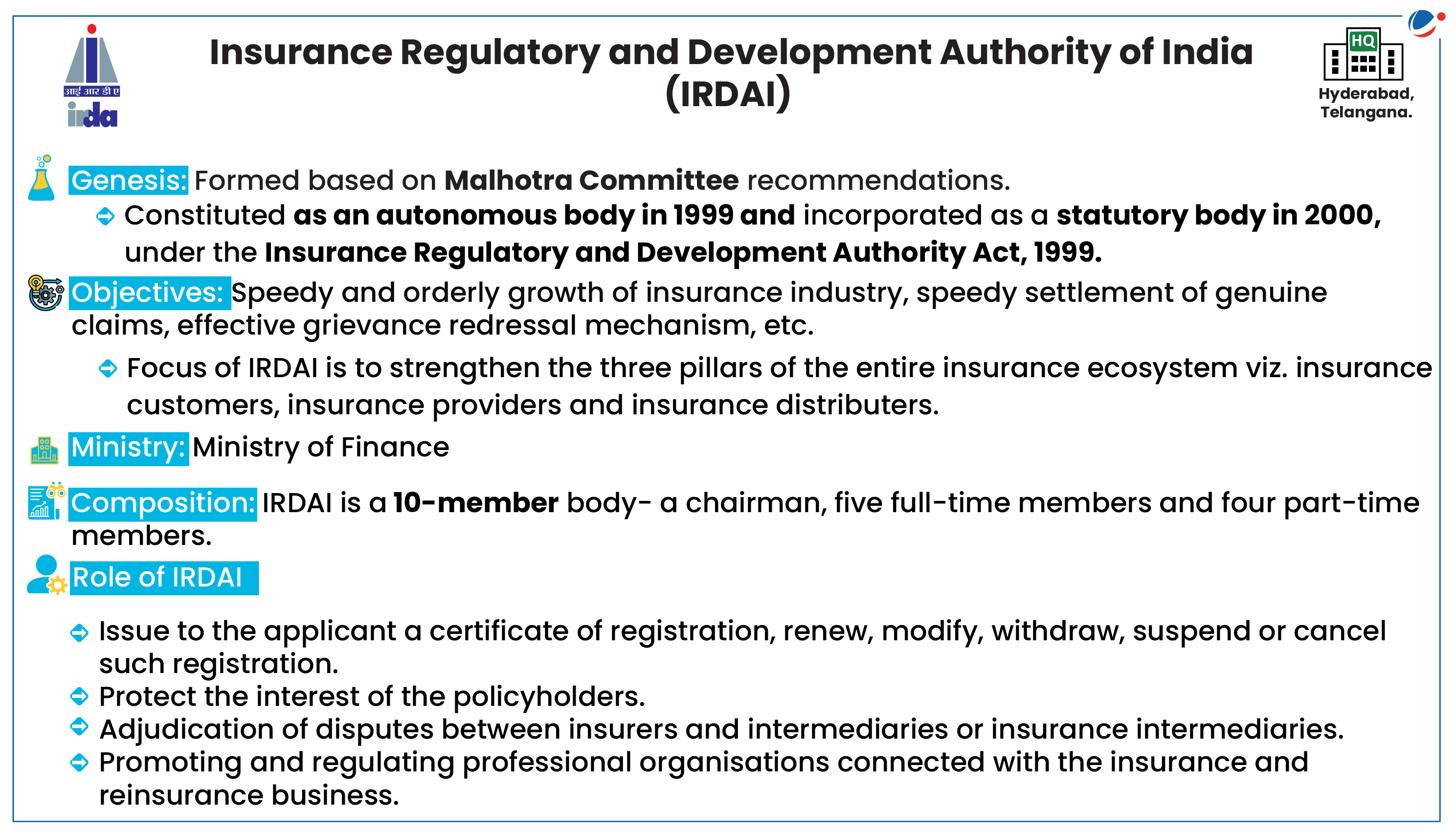
Significance of IRDAI in transforming the Insurance sector

  • Insurance Growth:
    • Insurance penetration (percentage of insurance premium to GDP) at 4.2% in 2021-22 compared to 2.71% in 2001-02.
    • Insurance Density (ratio of premium to population) at $91 in 2021-22 compared to $11.5 in 2001-02.
  • 'Insurance for All' by 2047: IRDAI has committed to enable 'Insurance for All' by 2047, where every citizen has an appropriate life, health and property insurance cover etc.
  • Expanded regulatory role: New intermediaries have started operating in the market, like corporate agents, Bancassurance (selling insurance products through banks), on-line sales, etc.
    • The digital transformation accelerated by the authority's guidance on e-KYC, paperless policies, digital payments, etc.

Recent Regulatory Governance Reforms by IRDAI

IRDAI has replaced 34 regulations with 6 regulations and introduction of 2 new regulations enhancing clarity and coherence in the regulatory landscape. 

  • IRDAI (Insurance Products) Regulations, 2024: merged 6 regulations into a unified framework aimed at enabling insurers to swiftly respond to evolving market demands, enhancing the ease of conducting business, and boosting insurance penetration.
  • IRDAI (Corporate Governance for Insurers) Regulations, 2024 aim to establish a robust governance framework for insurers, defining the roles and responsibilities of the board and management.
  • IRDAI (Registration, Capital Structure, Transfer of Shares & Amalgamation Insurers) Regulations, 2024: Streamlined 7 regulations into a single comprehensive framework. It aims to foster the growth of the insurance sector by simplifying various processes.

Major Initiatives by IRDAI

  • Bima Sugam: An online insurance marketplace for buying, selling, and servicing insurance policies as well as settling claims.
    • It is a part of IRDAI's Bima Trinity - Bima Vistaar, Bima Vahak, and Bima Sugam.
  • Saral Jeevan Bima: Provides basic protection to self-employed individuals or people in low-income groups. 
  • Integrated Grievance Management System: To create a central repository of grievances across the country and provides for various analyses of data indicative of areas of concern to the insurance policyholder.
  • Pan India survey: Through the National Council of Applied Economic Research (NCAER) in a bid to improve on its strategy of creating insurance awareness. 
  • Mandating Board Approved Policy for Insurers: Insurers are mandated to have Board approved Insurance Awareness Policy with action plan for organizing various activities promoting consumer awareness on various aspects of insurance.

Conclusion

As the insurance sector continues to evolve, IRDAI remains committed to adapting and enhancing its regulations to meet the changing needs. IRDAI's initiatives in areas such as promoting financial inclusion, encouraging innovation, etc. will be instrumental in driving the sustainable growth of the insurance sector.

Domestic Systemically Important Insurers (D-SIIs)

  • Insurance Regulatory and Development Authority of India (IRDAI) releases 2023-24 – List of D-SIIs
    • Life Insurance Corporation of India (LIC), General Insurance Corporation of India (GIC Re) and New India Assurance Company continue to be identified as D-SIIs. 
  • D-SIIs refer to insurers of such size, market importance, and domestic and global inter connectedness, whose distress or failure would cause a significant dislocation in the domestic financial system
    • D-SIIs are perceived as 'too big or too important to fail' (TBTF).
    • D-SIIs are subject to additional regulatory measures.

Explore Related Content

Discover more articles, videos, and terms related to this topic

RELATED VIDEOS

3
Circularity in Textile Structure

Circularity in Textile Structure

YouTube HD
The Contribution of Indian Cinema to the Creative Economy

The Contribution of Indian Cinema to the Creative Economy

YouTube HD
Impact Investments

Impact Investments

YouTube HD
Title is required. Maximum 500 characters.

Search Notes

Filter Notes

Loading your notes...
Searching your notes...
Loading more notes...
You've reached the end of your notes

No notes yet

Create your first note to get started.

No notes found

Try adjusting your search criteria or clear the search.

Saving...
Saved

Please select a subject.

Referenced Articles

linked

No references added yet

Subscribe for Premium Features
