


Why in the News?
2024 Financing for Sustainable Development Report was recently released by the Inter-agency Task Force on Financing for Development.
About Inter-Agency Task Force on Financing for Development
|
Key highlights of the report
- Progress towards SDGs: Countries are off track on 2030 Agenda for Sustainable Development, with around half of 140 SDG targets, deviating from the required path.
- Financing gaps in sustainable development: Report estimates SDG financing and investment gaps at between USD 2.5 trillion and USD 4 trillion annually.
- Finance divides: Developing countries are faced with significantly worse terms of access to both long-term and contingency financing, implying a finance gap, which is largest in Middle-Income Countries (MICs).
- Weak enabling environment for SDGs: Currently, public subsidies and private investment in fossil fuels and brown activities are still very high.
About Financing for Sustainable Development
- It is centered around supporting the follow-up to the agreements and commitments on Financing for Development:
- in Monterrey, Mexico in 2002;
- in Doha, Qatar in 2008; and
- in Addis Ababa, Ethiopia in 2015.
- Addis Ababa Action Agenda provides a new global framework for financing sustainable development.
- It aligns all financing flows and policies with economic, social and environmental priorities and ensures that financing is stable and sustainable.
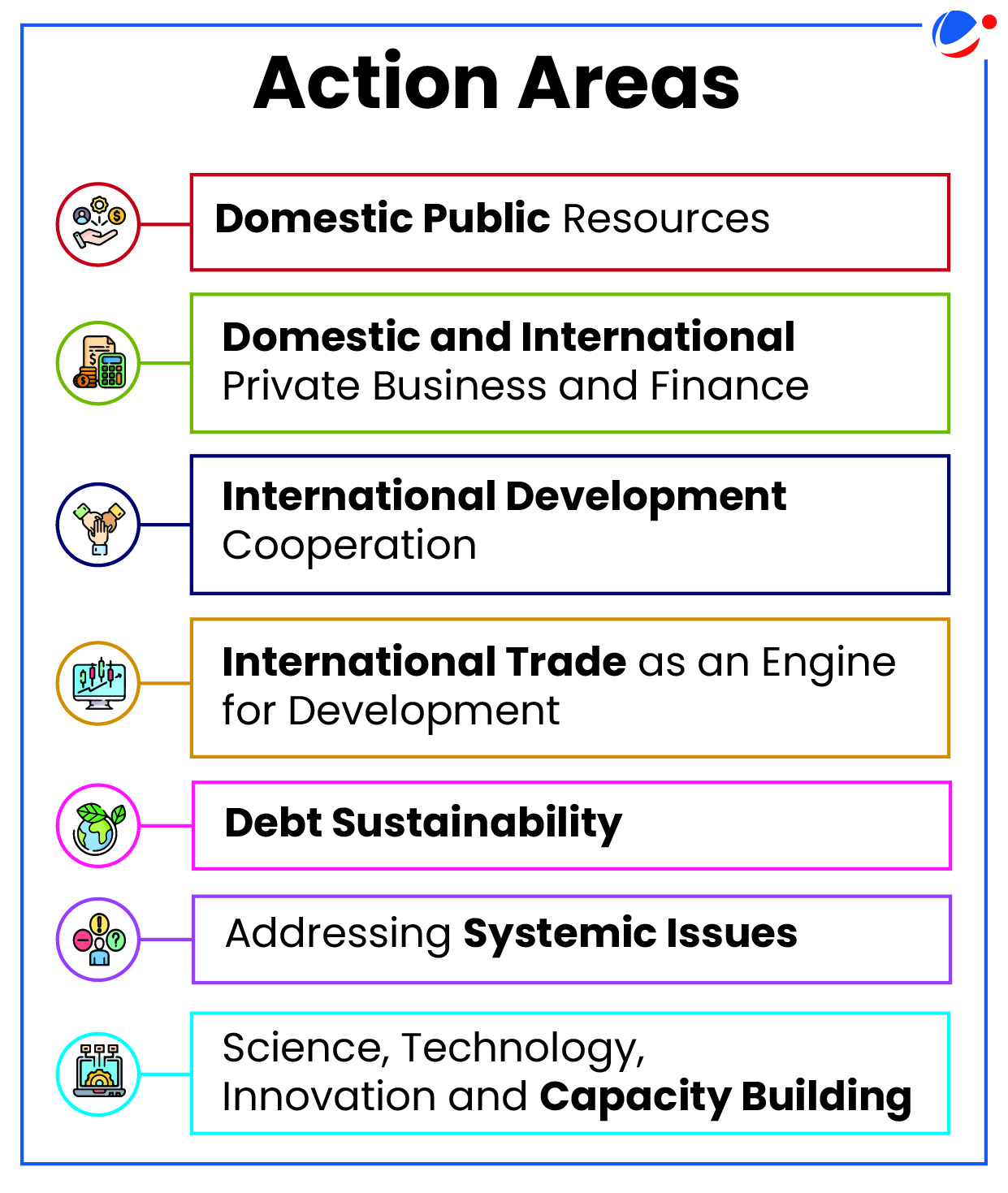
- It identified seven action areas for financing sustainable development (see infographic).
- It mandates the Task Force to
- report annually on progress in implementing the Addis Agenda and other Financing for Development outcomes and the means of implementation of the 2030 Sustainable Development Agenda.
- advise the intergovernmental follow-up process on progress, implementation gaps and recommendations for corrective action.
- Addis Ababa Action Agenda was adopted at the Third International Conference on Financing for Development held in Addis Ababa, Ethiopia, in 2015.
- Financing challenges are at the heart of the current sustainable development crisis.
Challenges in financing sustainable development
- Rise in Systemic Risks: E.g., Covid 19 pandemic, Rise in frequency of disasters etc.
- Climate crisis and more frequent and intense disasters raising stresses on public and private balance sheets.
- Annual economic disaster damage estimated at $173 billion between 2020 and 2023, up from $108 billion during the first decade of the century.
- Climate crisis and more frequent and intense disasters raising stresses on public and private balance sheets.
- Challenging Global Economic Environment: A sluggish world economy has led to subdued growth prospects with GDP growth rates in developing countries falling to just over 4% annually on average between 2021 and 2025.
- Sovereign Debt burden: Many countries are faced with high risks of debt distress, with median debt service burden for LDCs rising from 3.1% of revenue in 2010 to 12% in 2023 –highest level since 2000.
- 40% of global population live in countries where governments spend more on interest payments than on education or health.
- Rising geopolitical tensions: Geopolitical tensions, violence, conflict and war have contributed to challenging global macro-environment, risking severe fragmentation of global trading system (which could cost up to 7% of global GDP).
Actions required for bridging financing gap for sustainable development
- Enabling Environment: Countries' efforts to create enabling environments for private investment must be aligned with the SDGs, setting the right incentives through fiscal and tax policies.
- Strengthening Public Development Banks (PDBs): PDBs usually provide longer-term funding, and their development focus makes the financial durations of their lending better aligned with social and environmental sustainability.
- Integrated Financing Approaches: More than 80 countries are now using Integrated National Financing Frameworks (INFFs) to develop national financing strategies and integrate planning and financing policy functions.
- The concept of INFFs was first introduced in the Addis Agenda.
- Reforms in multilateral system: There is a need for reforms to enhance coherence between trade, investment and sustainable development.
- This includes World Trade Organization (WTO) reform, with a focus on dispute settlement, updating rules to reflect global economic changes, and continued efforts to update investment treaties.


