


Why in the News?
The Global Gender Gap Report 2025 was released recently.
About Global Gender Gap Index
- About Index: It was introduced by the World Economic Forum in 2006 to benchmark progress towards gender parity across four dimensions; Economic opportunities, Education, Health and Political leadership.
- Gender Gap: The gender gap is the difference between women and men as reflected in social, political, intellectual, cultural, or economic attainments or attitudes.
- In the index, the parity score of 1 indicates full parity and 0 denotes complete inequality.
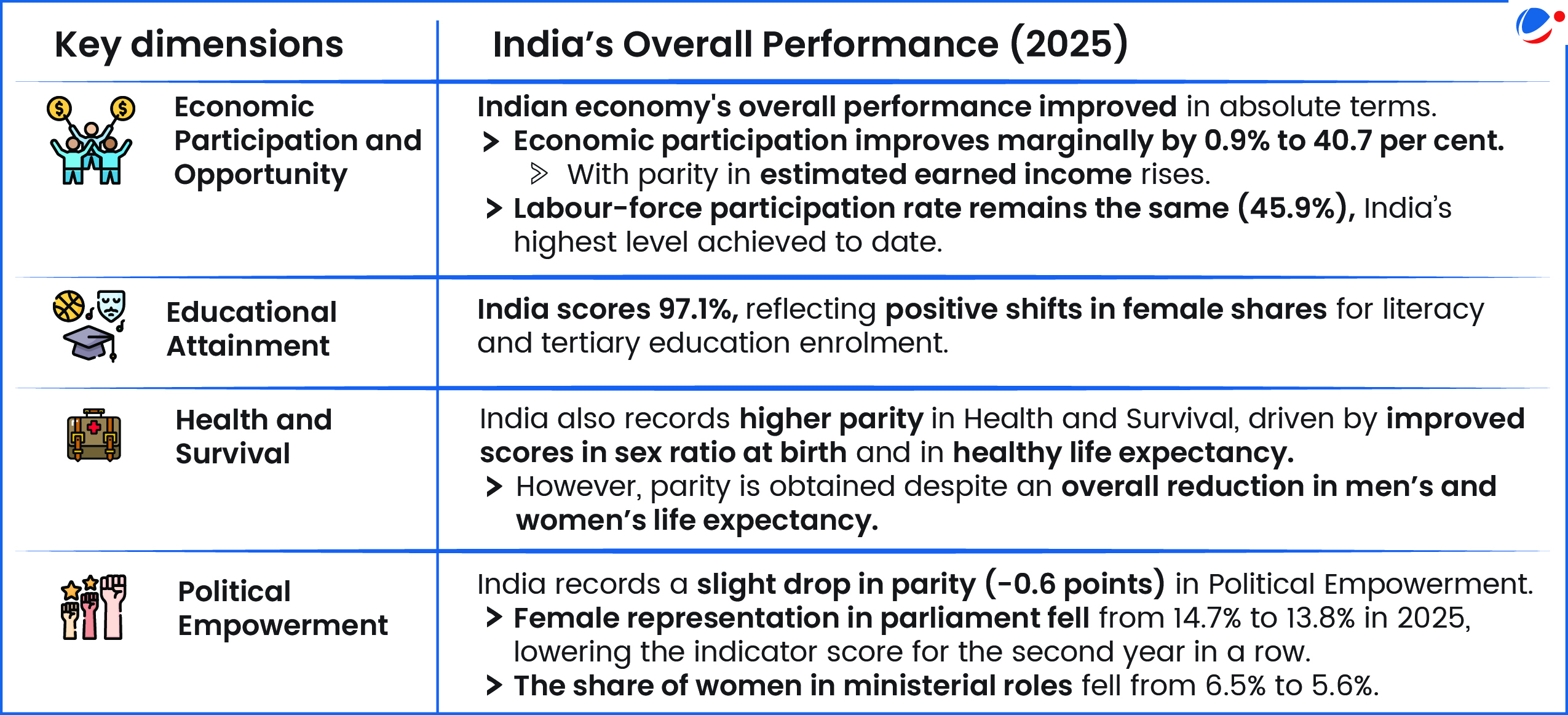
Key Findings of Report
- India: India has been ranked 131st out of 148 countries slipping from 129th position in 2024, although score improved to 0.644(2025) from 0.641(2024).
- Bangladesh emerged as the best performer in South Asia, jumping 75 ranks to rank 24 globally. Nepal ranked 125, Sri Lanka 130, Bhutan 119, ranked better than India.
- Global:
- Rankings: Iceland leads the rankings for the 16th year running, followed by Finland, Norway, the United Kingdom and New Zealand.
- Gender Gap: There is still a combined global average gender gap of over 30%.
- Overall, no economy has yet achieved full gender parity.
- It will take 123 years to reach full parity globally.
Major Challenges for India to achieving Gender Parity
- Social:
- Education: The literacy rate is 65.46 for females less than 82.14 for males and the country average of 74.04 percent.
- Child Marriage: Prevalence of child marriage was 23.3% during 2019-21. (NFHS-5)
- Women Safety: More than 13.13 lakh girls and women went missing in the country in the three years between 2019 and 2021 as per NCRB.
- Psychological: As per NCRB reports, the number of deaths by suicide for women increased by 4.6% from 42521 in 2014 to 44498 in 2020.
- Others: patriarchal norms, caste inequalities, condition of minorities, regional inequalities, tribal inequality etc.
- Digital Divide: E.g., the National Family Health Survey-5 (2019-2021) found that only 33% of women in India have used the internet compared to more than half (57%) of men.
- Economic:
- The Double Burden: The Economic Survey 2024 shows women's unpaid care work contributes 3.1% to GDP, while men's contributions are only 0.4%.
- Unorganized sector: Almost 97% of the women workforce is involved in the unorganized sectors, majorly in agriculture.
- Health:
- Prevalence of Anaemia: Nearly 57% of Indian women in the 15 to 49 age group are anaemic as reported by National Family Health Survey (NFHS)-5 which reduces their ability to learn, work, or carry pregnancies safely.
- Maternal Mortality Ratio (MMR): It is 97 in 2018-20 less than 70 as recommended by WHO by 2030.
- Reproductive Health: Around 50 million women in India suffer from reproductive health problems.
- Political Participation: It has decreased as per the report (refer infographics).
Initiatives taken by Government towards empowering women
- Nari Shakti Vandan Adhiniyam: It aims to give reservation of one-third of the total seats in the Lok Sabha, the state legislative assembles and the Legislative Assembly of the National Capital Territory of Delhi for women.
- POSHAN Abhiyaan: To improve nutritional outcomes for children, adolescent girls.
- Beti Bachao Beti Padhao (BBBP) Scheme: A social campaign aimed at addressing the declining Child Sex Ratio and empowering girls and women.
- Pradhan Mantri Matru Vandana Yojana (PMMVY): A conditional cash transfer scheme providing maternity benefits to pregnant women and lactating mothers.
- One Stop Centre (OSC): Provides integrated support and assistance under one roof to women affected by violence and those in distress.
- Universalization of Women Helpline: Provides 24x7 emergency and non-emergency response through the short-code 181 to women.
Conclusion
Despite decades of progress, efforts like expanding women's participation in the workforce, strengthening leadership pipelines, improving skills-to-work transitions, enhancing policy implementation, and ensuring inclusive outcomes in global trade is needed to ensure improvement in Gender parity.




