


Why in the News?
The United Nations Development Programme (UNDP) and the Oxford Poverty and Human Initiative (OPHI) released the 2025 Global Multidimensional Poverty Index (MPI) report.
Key Highlights of Report
- Multidimensional Poverty: 1.1 billion (18.3%) out of 6.3 billion people across 109 countries live in acute multidimensional poverty.
- Almost half of all multidimensionally poor people globally live in just six middle-income countries: Bangladesh, China, India, Nigeria, Pakistan and Tanzania.
- Around 27.8 % of all children live in multidimensional poverty, more than double the rate among adults (13.5 %).
- Poverty and Climate Hazards: Poverty and climate shocks create a double burden. Poverty drives exposure to climate hazards. These, in turn, reinforce and prolong poverty.
- Nearly 8 in 10 people living in multidimensional poverty – 887 million out of 1.1 billion globally – are directly exposed to climate hazards such as extreme heat, flooding, drought, or air pollution.
- 309 million poor people live in regions exposed to three or four overlapping climate hazards while experiencing acute multidimensional poverty.
- These individuals face a "triple or quadruple burden," often possessing limited assets and minimal access to social protection systems, amplifying the negative effects of the shocks.
- Individually, the most widespread hazards affecting poor people globally are high heat (608 million) and air pollution (577 million).
- Sub-Saharan Africa and South Asia are identified as global hotspots, accounting for the largest numbers of poor people living in regions affected by climate hazards.
- Poverty in India: In 2005–2006, 55.1 % of people in India were poor. The share plummeted to 16.4 % in 2019–2021, and roughly 414 million people left poverty.
Methodology of Global MPI
- Deprivation Indicators: Computation of the global MPI begins by constructing a deprivation profile for each household and person in it, covering 10 indicators of health, education and standard of living (see table).
- All indicators are equally weightedwithin each dimension.
- A person's deprivation score is the sum of the weighted deprivations she or he experiences.
- The global MPI identifies people as multidimensionally poor if their deprivation score is one third (33.3%) or higher.
- MPI Value: It is the product of the incidence (H, or the proportion of people who live in multidimensional poverty) and intensity of poverty (A, or the average deprivation score among multidimensionally poor people).
- Put simply, MPI = H × A.
- The MPI is known as the adjusted headcount ratio and it includes both the share of people in multidimensional poverty (Incidence or Headcount) and the extent to which they are deprived (Intensity).
- MPI values range from 0 to 1, and higher values imply higher poverty.
Dimensions of Poverty | Indicator | Deprived if living in the household where… | Weight |
Health | Nutrition | Any adult under 70 years of age or any child for whom there is nutritional information is undernourished. | 1/6 |
Child mortality | Any child under the age of 18 years has died in the family in the five-year period preceding the survey. | 1/6 | |
Education | Years of schooling | No household member aged 'school entrance age + six years or older has completed at least six years of schooling. | 1/6 |
School attendance | Any school-aged child is not attending school up to the age at which he/she would complete class eight. | 1/6 | |
Standard of living | Cooking fuel | The household cooks with dung, wood, charcoal or coal. | 1/18 |
Sanitation | The household's sanitation facility is not improved (according to SDG guidelines) or it is improved but shared with other households. | 1/18 | |
Drinking water | The household does not have access to improved drinking water (according to SDG guidelines) or improved drinking water is at least a 30-minute walk from home, round trip. | 1/18 | |
Electricity | The household has no electricity. | 1/18 | |
Housing | At least one of the three housing materials for roof, walls and floor are inadequate: the floor is of natural materials and/or the roof and/or walls are of natural or rudimentary materials. | 1/18 | |
Assets | The household does not own more than one of these assets: radio, television, telephone, computer, animal cart, bicycle, motorbike or refrigerator, and does not own a car or truck. | 1/18 |
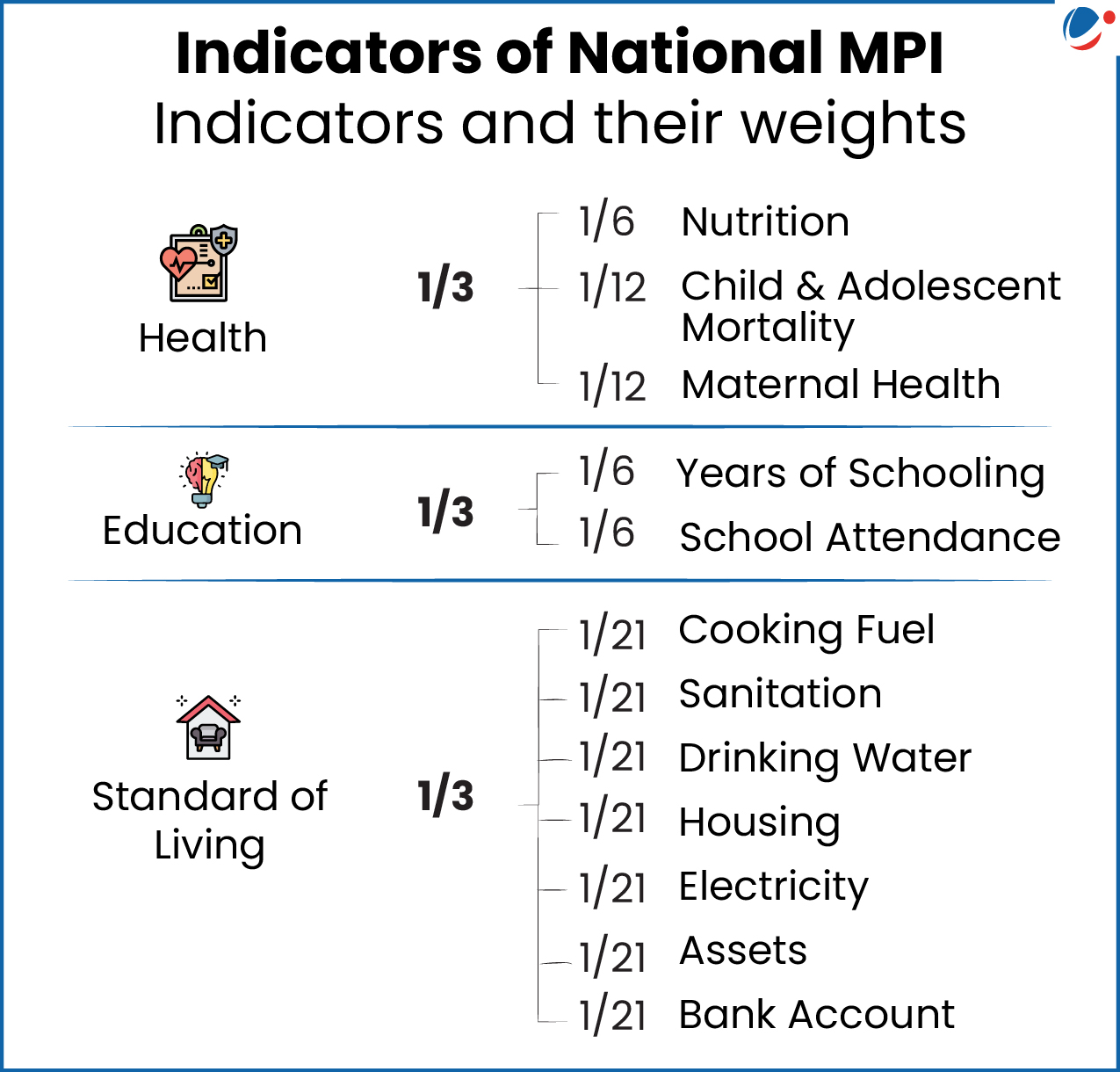
NITI Aayog National Multidimensional Poverty Index
- Methodology: It uses the internationally acclaimed Alkire Foster methodology (also used in Global MPI), retaining all 10 indicators from Global MPI and incorporating two additional indicators – Maternal Health and Bank Accounts.
- National MPI Value: Like global MPI, the MPI value is arrived at by multiplying the headcount ratio (H) and the intensity of poverty (A).
- Indicators: Like the global MPI, India's national MPI has three equally weighted dimensions Health, Education, and Standard of living – which are represented by 12 indicators (See infographic).
Conclusion
2025 Global Multidimensional Poverty Index underscores that poverty is no longer a unidimensional challenge of income deficiency but a complex web of interlinked deprivations in health, education, and living standards, now further aggravated by climate vulnerabilities. India's remarkable reduction in multidimensional poverty reflects the effectiveness of targeted welfare interventions and inclusive growth strategies. However, sustaining this progress demands a paradigm shift toward resilience-oriented development.




