


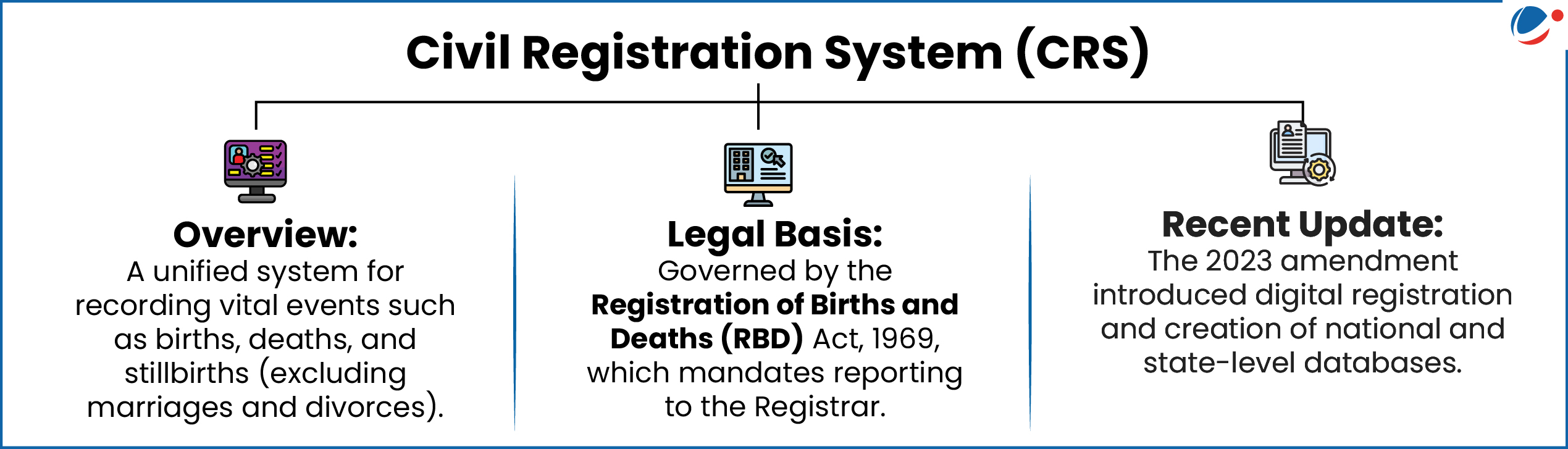
The report is compiled by the Registrar General of India (RGI), Ministry of Home Affairs.
Key highlights of the report
- Sex Ratio at Birth (SRB): (excluding Sikkim) was 928 females per 1000 males.
- Highest - Arunachal Pradesh (1,085)
- Lowest – Jharkhand (899)
- Share of institutional Deaths and Births (excluding Sikkim)- 74.7% and 24%.
- Births: Number of registered births decreased by 0.9% from 2022.
- Level of Registration of Births (LoR)- 98.4%
- Births registered in urban areas was higher than in rural areas.
- Deaths: Number of registered deaths increased by 0.1% from 2022
- Level of Registration of Deaths (LoR)- 97.2%
- Deaths registered in rural areas was higher in urban areas.
- Infant deaths increased from 2022
- 21 and 19 States/UTs have achieved 100% level of registration of births and deaths respectively.
- Birth and death registrations for males was higher than females in both rural and urban areas.
Tags:
Recently, the Ministry of Statistics and Programme Implementation (MoSPI) released the 4th issue of the Children in India 2025 Report.
- The report provides details on children’s education, health, nutrition, protection, etc. to guide evidence-based policies to improve children’s rights and well-being.
Key Highlights of the Report
- Infant Mortality Rate (IMR): Decreased from 44 (2011) to 25 (2023).
- IMR is the number of deaths of infants (children below 1 year of age) per 1,000 live births in a given year.
- Under-Five Mortality Rate (U5MR): Declined from 30 (2022) to 29 (2023).
- U5MR is the probability of a child dying before reaching the age of five, expressed as the number of deaths per 1,000 live births in a given year.
- Birth Rate: Declined to 18.4 per 1,000 population in 2023 ; Rural: 20.3, Urban: 14.9
- Dropout Rate (2022-23 to 2024-25):
- Preparatory stage: Dropped from 8.7% to 2.3%.
- Middle level: Declined from 8.1% to 3.5%.
- Secondary level: Reduced from 13.8% to 8.2%.
- Child Marriage (Women aged 20-24 married before 18): Reduced from 26.8% (2015-16) to 23.3% (2019-21).
- Adoption Statistics: Total adoptions increased from 3,927 (2017-18) to 4,515 (2024-25).
- In-country adoptions: 4,155; Inter-country adoptions: 360–653 annually.
- Gender Parity Index (GPI): Achieved parity across all education stages in 2024-25.
Tags:
Article Sources
1 sourceKey Highlights
- Decline in Global Tobacco Use: The global prevalence of current tobacco use among adults significantly dropped from 26.2% (2010) to 19.5% (2024).
- Despite this reduction, 1 in 5 adult’s worldwide remains hooked on tobacco.
- Rising Popularity of E-Cigarettes: More than 100 million people worldwide use e-cigarettes.
India’s Progress and Status
- Tobacco Use in India (2024): In 2024, India accounted for approximately 243.48 million tobacco users aged 15 and older.
- India on Track to Meet WHO NCD Target: India's expected relative reduction in tobacco use prevalence between 2010 and 2025 is substantially high, projected at 43%.
- WHO NCD Target to achieve a 30% reduction in tobacco use by 2025.
India’s Steps to Curb Tobacco Use
- Cigarettes & Other Tobacco Products Act (COTPA), 2003: Prohibits smoking in public places; ban on sale of tobacco products to minors, etc.
- Cigarettes and other Tobacco Products (Packaging and Labelling) Amendment Rules, 2022: Provided images for display on package with health warnings.
- National Tobacco Control Programme: To create awareness & reduce the production and supply of tobacco products.
- Prohibition of Electronic Cigarettes Act, 2019.
Tags:
Article Sources
1 sourceThe Ministry of Housing and Urban Affairs (MoHUA) has launched the Swachh Shehar Jodi (SSJ) initiative.
- It will be implemented under the Swachh Bharat Mission- Urban (SBM-U).
About SSJ initiative:
- It is a structured mentorship and collaborative action program involving 72 mentor cities and around 200 mentee cities.
- The mentee cities will get direct exposure to well performing cities to replicate their best practices.
- Aim: Foster knowledge and experience sharing, peer learning and transforming best practices in sanitation and waste management across urban India.
Tags:


