


Why in the News?
The Prime Minister launched The Pradhan Mantri Dhan-Dhaanya Krishi Yojana (PMDDKY) initiative to revolutionize Indian agriculture by making it more productive, sustainable, and financially rewarding for farmers.
About PM Dhan Dhaanya Krishi Yojana (PMDDKY)
- It was announced during the Union Budget 2025-26 and draws inspiration from NITI Aayog's Aspirational District Programme.
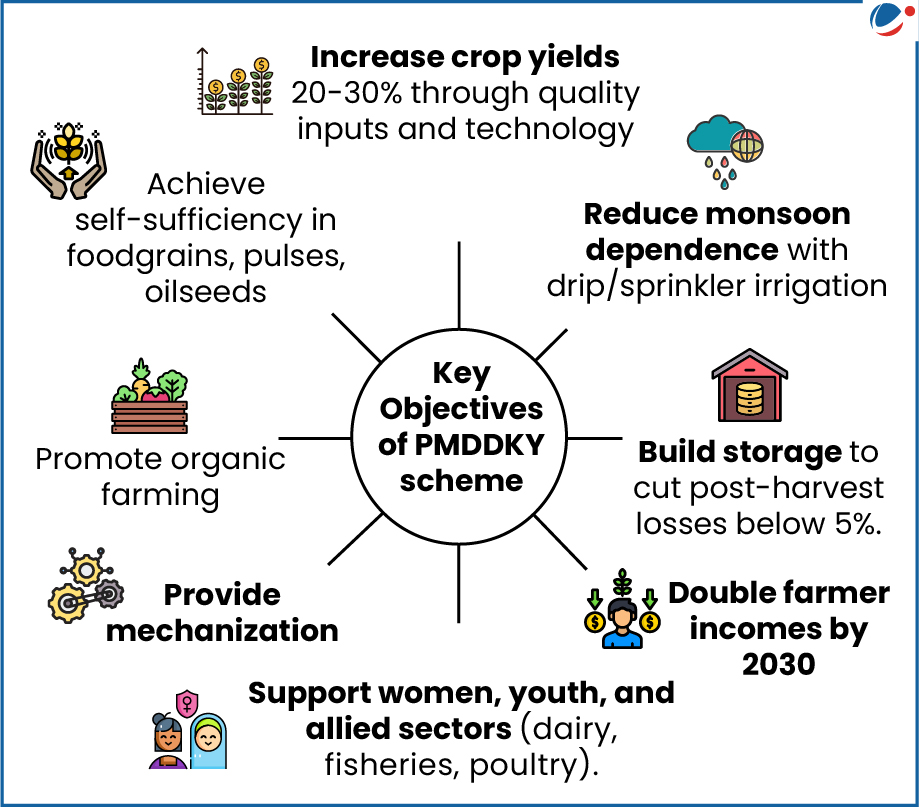
- It consolidates 36 existing agricultural schemes across 11 ministries, including PM-KISAN (cash transfers), PMFBY (crop insurance), PMKSY (irrigation), with multiple benefits (refer table).
- The convergence will also include state schemes and local partnerships with the private sector.
- Aim: To support 1.7 crore farmers, particularly small and marginal farmers owning less than 2 hectares of land, who constitute 86% of India's farming population (Economic Survey 2024-25).
- Ministry: Ministry of Agriculture and Farmers' Welfare.
- Duration: 6 Years (2025-26 to 2030-31).
- Financial Outlay: Annual budget of ₹24,000 crore for 6 years, totaling ₹1.44 lakh crore.
- 40% for subsidies, 30% for infrastructure (storage, irrigation), 20% for loans, and 10% for training and market support.
- Coverage: 100 underperforming districts with low crop yields, water scarcity, and limited access to resources. (minimum of 1 district from each state).
- Uttar Pradesh to have maximum 12 districts in scheme.
- Focus: On regions with low crop yields (e.g., wheat yields below 3.5 tonnes/hectare national average), moderate cropping intensity (fewer than 1.55 crop cycles per year), and limited access to credit.
- Beneficiaries: Small and Marginal Farmers, Women Farmers, Young Farmers adopting modern farming techniques/starting agribusinesses/value-added product ventures, Farmers in Low-Productivity Areas, Farmer Producer Organizations (FPOs), Allied Sector Workers.
- Significance of Consolidation of agricultural schemes under PMDDKY: It will resolve Duplication & inefficiency.
- 45% of capital expenditure in agriculture is actually utilized for asset formation, indicating low expenditure efficiency.
- Sectors like water supply, transport, etc., allocate more than 75% of capital towards asset formation.
Key Benefits and their impacts | ||
Aspect | Benefit | Impact |
Crop Yields |
|
|
Financial aid |
|
|
| ||
Storage |
|
|
Irrigation |
|
|
Market Access |
|
|
Modern skills, global exposure |
|
|
Structural Design and Institutional Mechanism of the scheme
- National level: Oversight from a National Steering Committee
- Two teams to be formed at the central level: One under Union Ministers and another under Secretaries and department officers.
- State level: Nodal committees
- District level: District Dhan Dhaanya Samitis led by District Collectors.
- District-level plans will be prepared by district collectors with support from agricultural universities and NITI Aayog.
- Use of digital dashboard, farmer app, and district ranking system (117 Key Performance Indicators (KPIs)) to ensure transparency.
- Central Nodal Officers appointed for each district to conduct regular field visits, monitor progress, and coordinate with local teams.
Conclusion
The PM Dhan Dhaanya Krishi Yojana ensures scheme convergence, data-driven planning, and resource optimisation, fostering integrated agricultural growth, productivity enhancement, and farmer welfare through holistic, sustainable, and technology-enabled rural transformation.


