
⁠National Statistics Office (NSO) to conduct Survey on Migration across India | Current Affairs | Vision IAS
MENU
Home
Quick Links

High-quality MCQs and Mains Answer Writing to sharpen skills and reinforce learning every day.

Watch explainer and thematic concept-building videos under initiatives like Deep Dive, Master Classes, etc., on important UPSC topics.

ESC

In Summary

  • A survey from July 2026 to June 2027 will detail migration patterns, rural-urban and inter-state movement, and reasons.
  • PLFS 2020-21 shows a 28.9% migration rate, with marriage driving female migration (86.8%) and employment driving male migration (22.8%).
  • Key measures include rural development (DAY-NRLM), urban resilience (AMRUT), and worker welfare schemes (PMSYM, PMGKAY, ONORC).

In Summary

Survey to be conducted during July 2026 to June 2027 would capture detailed information on extent/nature of migration, rural–urban and inter-state movement, key reasons, etc. 

Recent Trends on Migration in India

  • Overall migration rate stood at 28.% with sharp gender differences in patterns (Periodic Labour Force Survey (PLFS) 2020-21).
  • Migration rate was estimated at 10.7% among males and 47.9% among females.

Key Reasons for Migration

  • Gender Specific: Marriage accounted for the predominant cause among females (86.8%) while employment (labour market opportunities) accounted for the major reason among males (22.8%). 
  • Pull Factor: Driven primarily by thepresence of job opportunities and the prospect of a better life. E.g., Case of Rural-to-Urban Migration.
    • Nearly one in four rural Indians (26.8%) was a migrant in 2020-21. (Economic Survey 2025-26). 
  • Push Factors: Person tend to leave their native place due to lack of job opportunities, low wages or salaries, unfavourable environmental conditions and natural calamities, etc.
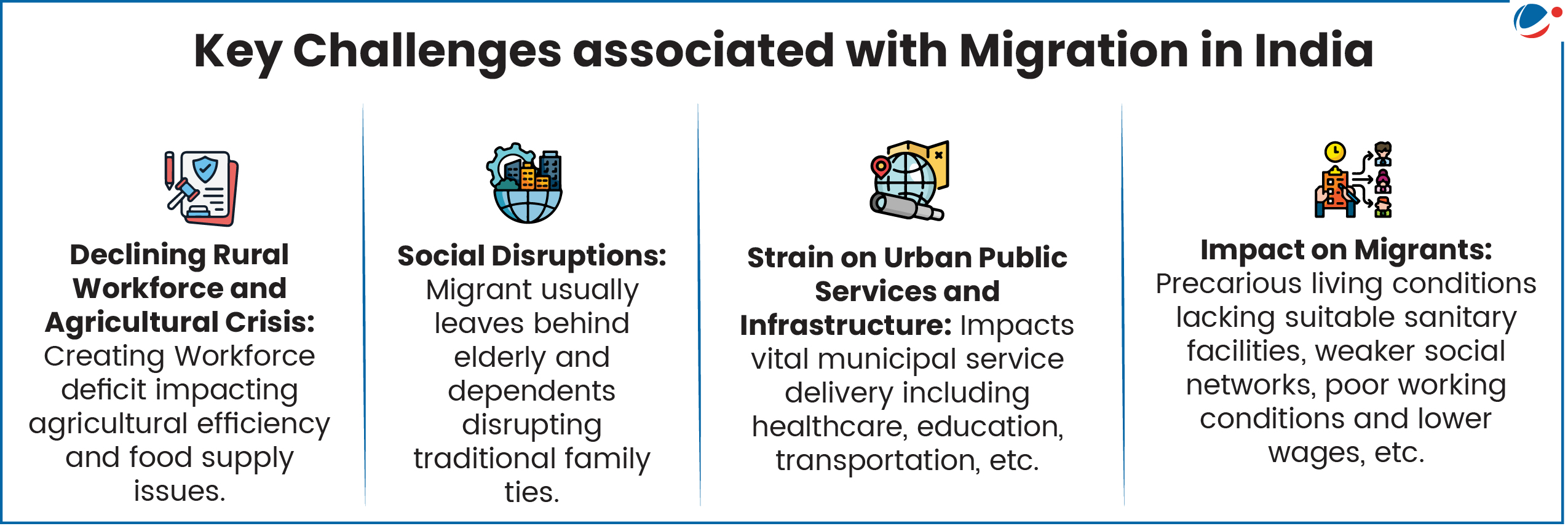
Key Measures to taken to address challenges

  • Rural Development Initiatives: Deendayal Antyodaya Yojana – National Rural Livelihoods Mission (DAY-NRLM); Viksit Bharat- Guarantee for Rozgar and Ajeevika Mission (Gramin) Act, 2025 strengthening rural employment, etc.
  • Urban Resilience Initiatives: Atal Mission for Rejuvenation and Urban Transformation (AMRUT); Smart Cities; Implementation of Transit-oriented Development (ToD), etc. 
  • Workers’ Welfare: Key Schemes like Pradhan Mantri Shram Yogi Maan-Dhan Yojana (PMSYM); Pradhan Mantri Garib Kalyan Anna Yojana (PMGKAY); One Nation One Ration Card (ONORC) scheme for robust safety net for migrants, etc. 

Watch Video News Today

Explore Related Content

Discover more articles, videos, and terms related to this topic

RELATED VIDEOS

1
Economic Growth and Structural Transformation

Economic Growth and Structural Transformation

YouTube HD

RELATED TERMS

3

Push Factor

Factors that compel people to leave their place of origin. These can include lack of employment, low wages, poverty, natural disasters, political instability, or unfavorable environmental conditions.

Rural–urban migration

The movement of people from rural areas to urban areas, often in search of better economic opportunities, education, or lifestyle. This phenomenon is a significant demographic trend with substantial implications for both rural and urban development.

One Nation One Ration Card (ONORC)

A reform allowing all cardholders, especially migrant beneficiaries, to get their share of food grains from any Fair Price Shop (FPS) across the country, thereby enhancing food security and portability of ration cards.

Title is required. Maximum 500 characters.

Search Notes

Filter Notes

Loading your notes...
Searching your notes...
Loading more notes...
You've reached the end of your notes

No notes yet

Create your first note to get started.

No notes found

Try adjusting your search criteria or clear the search.

Saving...
Saved

Please select a subject.

Referenced Articles

linked

No references added yet