
The Ministry of Road Transport and Highways proposes rules to allow higher ethanol-blended fuels in vehicles | Current Affairs | Vision IAS

Upgrade to Premium Today

Start Now
MENU
Home
Quick Links

High-quality MCQs and Mains Answer Writing to sharpen skills and reinforce learning every day.

Watch explainer and thematic concept-building videos under initiatives like Deep Dive, Master Classes, etc., on important UPSC topics.

A short, intensive, and exam-focused programme, insights from the Economic Survey, Union Budget, and UPSC current affairs.

ESC

In Summary

  • Draft amendment to Central Motor Vehicles Rules, 1989 includes E85, E100 ethanol, and B100 biodiesel for vehicle certification.
  • Significance includes reduced GHG emissions (65% for sugarcane ethanol), saved foreign exchange (~₹1.08 trillion since 2014), and enhanced energy security.

In Summary

It has issued a draft to amend Central Motor Vehicles Rules, 1989 to include E85, E100 ethanol fuels and B100 biodiesel for vehicle certification and use. 
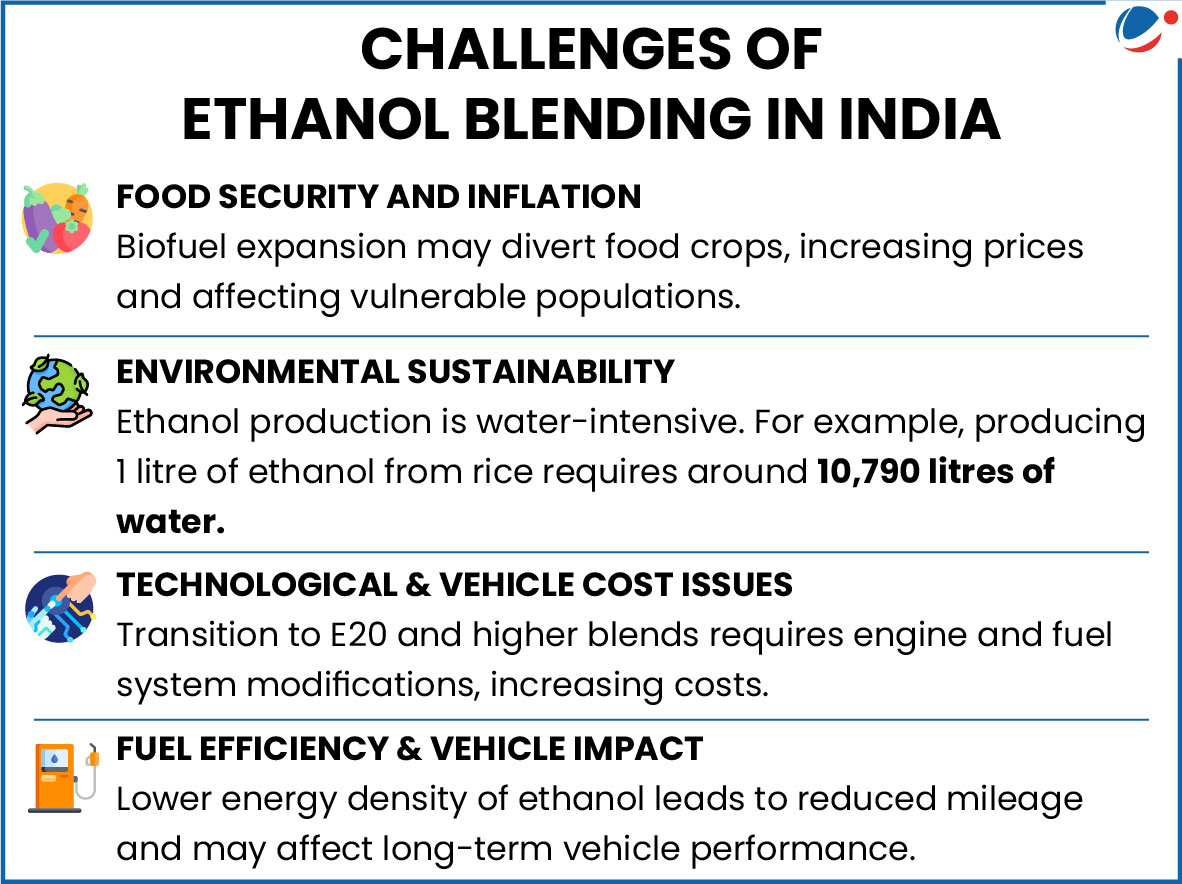
About Ethanol Blending

  • This involves blending different percentages of ethanol with petrol to produce a fuel that burns cleaner and is more sustainable.
  • Types: E10 (10% Ethanol by Volume), E20 (20% Ethanol), E85 fuel (85% Ethanol) etc. 
    • The use of E-20 gives better acceleration, better ride quality and lowered carbon emissions by approximately 30% as compared to E10 fuel.  

Significance of Ethanol Blending

  • Reduced Carbon Emissions: Sugarcane and maize-based ethanol reduce GHG emissions by 65% and 50%, respectively, compared to petrol (NITI Aayog Study).
  • Reduce Imports: Ethanol blending programme has saved about ₹1.08 trillion in foreign exchange since 2014 (till 2024), reducing dependence on fuel imports.
  • Energy Security: India’s heavy dependence on imported crude makes it vulnerable, and ethanol blending reduces this risk.
  • Others: Economic growth, Crop diversification, Fuel Efficiency, Rural Development etc. 

Initiatives 

  • Ethanol Blended Petrol (EBP) Programme: Launched in 2003 to promote blending of ethanol in petrol.
  • The National Policy on Biofuels (2022 Amendment): It advanced the deadline to reach the blending target of 20% bioethanol in petrol, from 2030 to 2025-26.
  • Pradhan Mantri JI-VAN (Jaiv Indhan- Vatavaran Anukool fasal awashesh Nivaran) Yojana: Provides financial support to integrated bio-ethanol projects for setting up Second Generation (2G) ethanol projects. 
Watch Video News Today

Explore Related Content

Discover more articles, videos, and terms related to this topic

RELATED VIDEOS

3
News Today (May 13, 2025)

News Today (May 13, 2025)

YouTube HD
News Today (Aug 17-18, 2025)

News Today (Aug 17-18, 2025)

YouTube HD
News Today (Sep 03, 2025)

News Today (Sep 03, 2025)

YouTube HD

RELATED TERMS

3

Second Generation (2G) Ethanol

2G ethanol is produced from non-food biomass such as agricultural waste, forest residues, and dedicated energy crops. It is considered more environmentally sustainable than first-generation ethanol (produced from food crops) as it avoids competition with food production.

Pradhan Mantri JI-VAN (Jaiv Indhan- Vatavaran Anukool fasal awashesh Nivaran) Yojana

A scheme that provides financial assistance for integrated bio-ethanol projects, with a focus on establishing Second Generation (2G) ethanol production facilities. This aims to utilize agricultural waste for fuel production.

National Policy on Biofuels (2022 Amendment)

An updated policy that revised the target for ethanol blending in petrol from 2030 to 2025-26. It signifies a stronger government commitment to advancing biofuel usage.

Title is required. Maximum 500 characters.

Search Notes

Filter Notes

Loading your notes...
Searching your notes...
Loading more notes...
You've reached the end of your notes

No notes yet

Create your first note to get started.

No notes found

Try adjusting your search criteria or clear the search.

Saving...
Saved

Please select a subject.

Referenced Articles

linked

No references added yet
