


Unlike typical monsoon rains that are steady and widespread, cloudbursts are localized, affecting small areas.
What is a Cloud Burst?
- According to the IMD, if rainfall of about 100 mm or above per hour is recorded over a place that is roughly less than 100 sq.km area, it is classified as a cloudburst event.
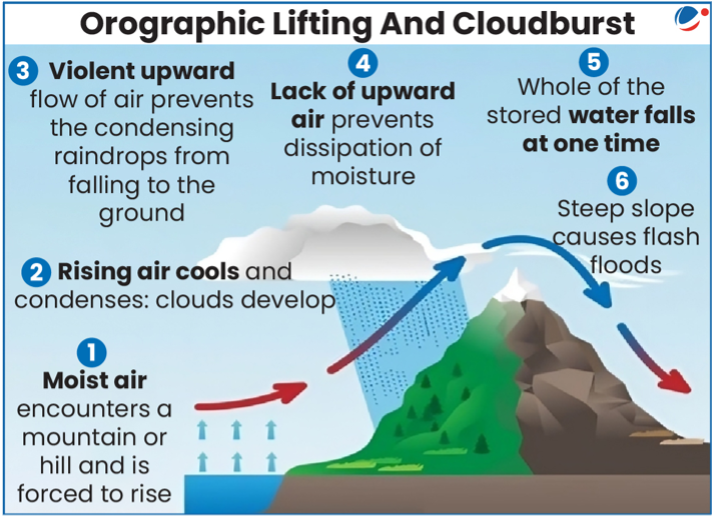
- They are infrequent as they occur only via :
- Orographic lift (See infographics)
- Occasionally when a warm air parcel mixes with cooler air, resulting in sudden condensation.
- Forecasting: Using Doppler radars it is possible to forecast the possibility of cloudbursts about six hours and sometimes 12-14 hours in advance.
- Impact: Leads to flash floods, dam breaches, mudslides, and landslides, resulting in casualties, damage to homes, roads, public infrastructure, and ecosystems.
Way forward:
- National Disaster Management Plan (NDMP) 2019
- State responsibility: Enhancing capabilities of Urban Local Bodies and Panchayati Raj Institutions to prepare and cope with events like cloudbursts and hailstorms.
- Centre responsibility: Develop Database management system relating to Hailstorm, Cloudburst & Climate Change
- Under the ‘Mission Mausam’, India also plans to more than double its radar network, from the current 40 or so, and use artificial intelligence to better predict hyperlocal events
