


Why in the News?
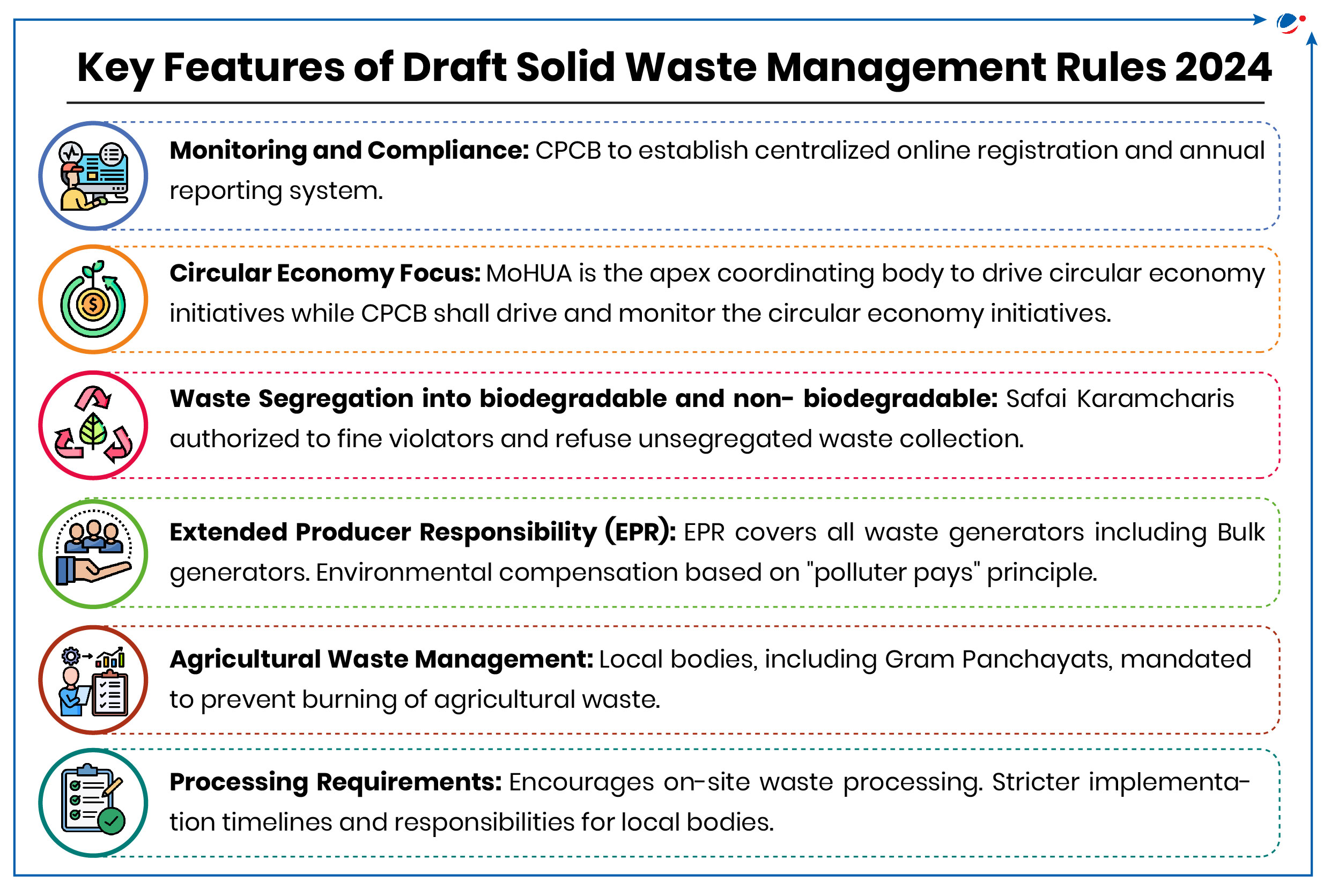
The Ministry of Environment, Forest and Climate Change (MoEFCC) has released the Draft Solid Waste Management (SWM) Rules, 2024 for wider public consultations.
More on the News
- Statutory Provisions: The SWM Rules, 2024 amend and expand upon the Solid Waste Management (SWM) Rules of 2016.
- SWM Rules are issued under the Environment Protection Act (EPA), 1986.
- The Central Pollution Control Board (CPCB) and State Pollution Control Boards (SPCBs) are responsible for enforcing the pollution control guidelines including the rules under the EPA, 1986.
- Implementation Date: The rules are set to come into force on October 1, 2025, providing a transition period for stakeholders.
About SWM in India
- Definition: Any discarded material including garbage, trash, and refuse.
- Categorisation: India legally classifies waste into 6 types: Municipal, Hazardous, Electronic, Biomedical, Plastic, and Construction waste.
- Current Status (according to the TERI):
- Annual waste generation: 62+ million tons
- Collection: 43 million tons
- Treatment: Only 12 million tons
- Remaining 31 million tons dumped in wasteyards
Solid Waste Management Challenges in India
- Basic Service Issues
- Poor collection systems, especially in rural areas.
- Limited waste separation at source.
- Shortage of trained workers.
- Low public awareness about proper disposal.
- Limited land for disposal leads to illegal dumping.
- Financial constrains
- Local bodies struggle with limited budgets.
- Outdated practices continue, including unsafe waste handling.
- Overlapping Jurisdiction
- Multiple agencies share oversight responsibilities.
- For example, MoEFCC develop rules and guidelines while the Ministry of Housing and Urban Affairs (MoHUA) oversees ground-level enforcement, which can lead to challenges in coordination, funding, and enforcement.
- Multiple agencies share oversight responsibilities.
- Technology Gap
- Modern solutions (blockchain, IoT, AI) exist but they are not widely used.
- High costs and low awareness prevent adoption.
Key Initiatives for Promoting Effective SWM
|
Way forward for Effective SWM in India
- Policy Implementation: Ensure strict enforcement of new rules with clear guidelines and support for local bodies with adequate funding.
- Technological Innovation: For instance, Bhopal Municipal Corporation (Madhya Pradesh) has developed a strong GPS-enabled vehicle tracking system for door-to-door collection of waste.
- Enhanced Public-Private Partnerships: Leverage private sector capabilities for better waste management infrastructure and technology adoption.
- E.g. City of Mumbai, Bhopal, Bangalore, etc. have entered into a contractual arrangement with private sector for setting up compost plants.
- Strengthening Monitoring: E.g. strengthening of regulatory bodies like CPCB and SPCBs with adequate infrastructure, trained staff and law enforcers can pave the way in this direction.
- Public Awareness: Effective implementation of initiatives like SBM which have played a major role in generating awareness and community-level engagement for waste segregation, proper disposal, etc.



