


It is believed to be the first glacier to be officially declared dead due to climate change.
- In 2014, the Okjökull glacier in Iceland was declared dead after it became so thin that it stopped moving.
- Okjökull was a dome-shaped glacier situated around the summit crater on Ok shield volcano, northwest of Reykjavík (Capital of Iceland).
- Other glaciers that disappeared include Anderson Glacier, Clark Glacier and Glisan Glacier (USA), Baumann Glacier (New Zealand), Calderone Glacier (Italy), Martial Sur Glacier (Argentina), Pico Humboldt Glacier (Venezuela), Pizol Glacier (Switzerland), Sarenne Glacier (France), and Schneeferner Glacier (Germany).
About Glaciers
- Glacier is a large, perennial accumulation of snow and ice that slowly flows over land under the influence of its own weight and gravity.
- Typically, glaciers exist in areas where mean annual temperatures are close to freezing point and winter precipitation produces significant accumulations of snow.
- Importance of Glaciers:
- Water Reservoirs: Glaciers store about three-quarters of Earth's freshwater, making them the largest freshwater reservoirs.
- Food Systems: Glaciers are source of irrigation in many regions while glacial fed rivers make grounds fertile for agriculture.
- Biodiversity: Glacier melt delivers nutrients into lakes, rivers, and oceans, driving blooms of phytoplankton—the base of aquatic food chains.
Impact of Melting of Glaciers due to Climate Change
Initiatives to Protect Glaciers
|
Recently Narwhal’s have been studied for the first time for their tusking behaviour.
About Narwhals
- Narwhals are known for their long tusk, which is actually a tooth.
- Males have a tusk while females do not, but there are variations. Some females may have a small tusk, some males may lack one, and some narwhals can even have two tusks.
- Uses of Tusks: sensing salinity and water temperatures, hunting, adaptation to environmental changes.
- Scientific Name: Monodon monoceros (Meaning: Whale with one tooth and one horn).
- Location: Arctic waters of Canada, Greenland, Norway and Russia.
- IUCN Status: Least Concern.
- Lifespan: Females (~100 years), Males (~84 years)
- Reproduction: Gestation Period (~13 to 16 months).
Rushikonda Beach wins back the Blue Flag tag which was earlier withdrawn due to poor maintenance.
- Rushikonda Beach in Visakhapatnam is the only Blue Flag beach in Andhra Pradesh and is among the 13 Blue Flag beaches in India.
About Blue Flag Certification
- Conferred upon: For beaches, marinas, and sustainable tourism boats. (has different criteria for each)
- Conferred by: Denmark-based Foundation for Environment Education (FEE).
- Criteria: Applicants have to comply with a number of stringent environmental, educational, safety and accessibility criteria at the time of the award.
Four new sites have been added to the IUCN Green List.
- These include Sharaan Nature Reserve and King Abdulaziz Royal Nature Reserve of Saudi Arabia, Aqaba Marine Reserve of Jordan and Sir Bu Nair Protected Area from UAE.
About IUCN Green List
- It is a global programme of certification aiming to achieve and promote effective, equitable, and successful protected and conserved areas.
- Focus: Highlights best practices, and sets benchmarks for progress in conservation management.
- Objective:
- increase number of protected and conserved areas that are effectively and equitably managed.
- deliver conservation outcomes, contributing to SDG 15 “Life on land” and towards meeting Aichi Target 11 of the Convention on Biological Diversity (CBD).
Article Sources
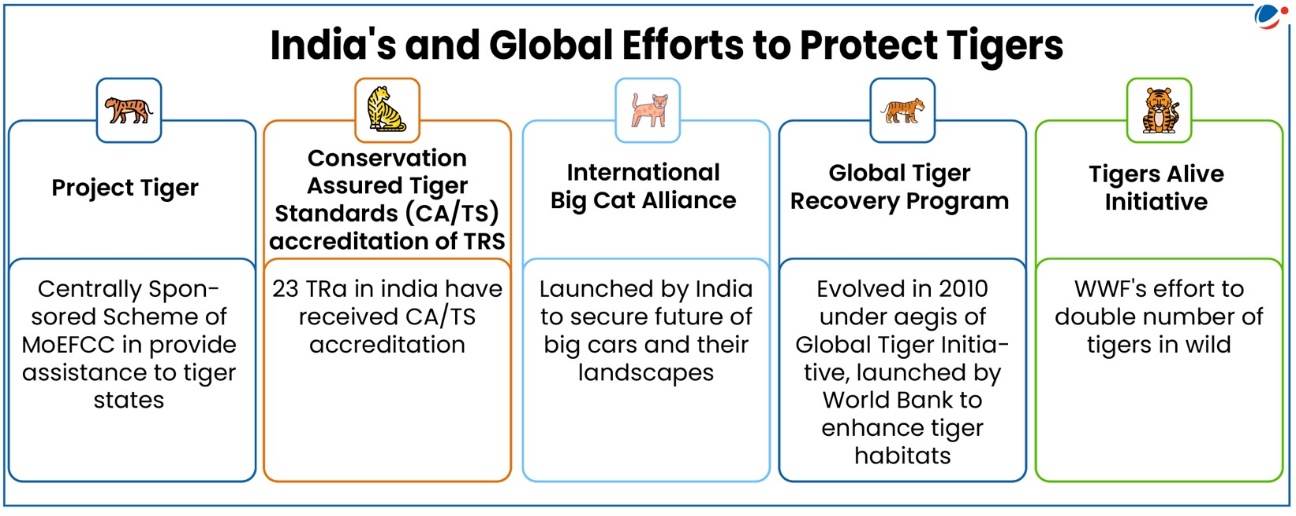
1 sourceMadhav National Park in Madhya Pradesh (M.P) became India’s 58th Tiger Reserve.
- It becomes ninth tiger reserve from M.P to get the recognition. Other TRs from M.P includes Ratapani, Veerangana Durgavati, Sanjay Dhubri, Satpura, Panna, Bandhavgarh, Pench etc.
About Madhav National Park
- Location: Shivpuri district in Chambal region and on northern fringe of Central Highlands of India forming a part of Upper Vindhyan Hills.
- It was notified as a National Park in 1958.
- Lakes: Sakhya Sagar and Madhav Sagar in southern part of park.
- Fauna: Nilgai, Chinkara, Chowsinga, Chital, Barking Deer, Marsh Crocodile, Leopard, Jackal, Python etc.
- Flora: Northern Tropical dry deciduous mixed forest and dry thorn forest. Kardhai is dominant tree species.
Process of declaring tiger reserve in India
- Tiger Reserves are notified by State Governments as per provisions of Section 38V of Wildlife Protection Act (WPA), 1972 on advice of National Tiger Conservation Authority (NTCA).
- Following steps are involved in notification:
- Proposal is obtained from State.
- In-principle approval is communicated from NTCA, soliciting detailed proposals under section 38V of WPA, 1972.
- NTCA recommends proposal to State after due diligence.
- State Government notifies area as a TR.
Tiger (Panthera tigris)
|
Kasampatty Sacred Grove is declared as Tamil Nadu (TN)’s second BHS (Arittapatti in Madurai being the first in TN).
- It is located near the Alagarmalai Reserve Forest in Dindigul district.
About Biodiversity Heritage Site
- BHS are unique, ecologically fragile ecosystems having rich biodiversity comprising - species richness, high endemism, presence of rare, endemic and threatened species, keystone species, etc.
- Notified as per Section 37 (1) of the Biological Diversity Act,2002.
- It states that State Government, in consultation with the local bodies, notify in the Official Gazette, areas of biodiversity importance as BHS.
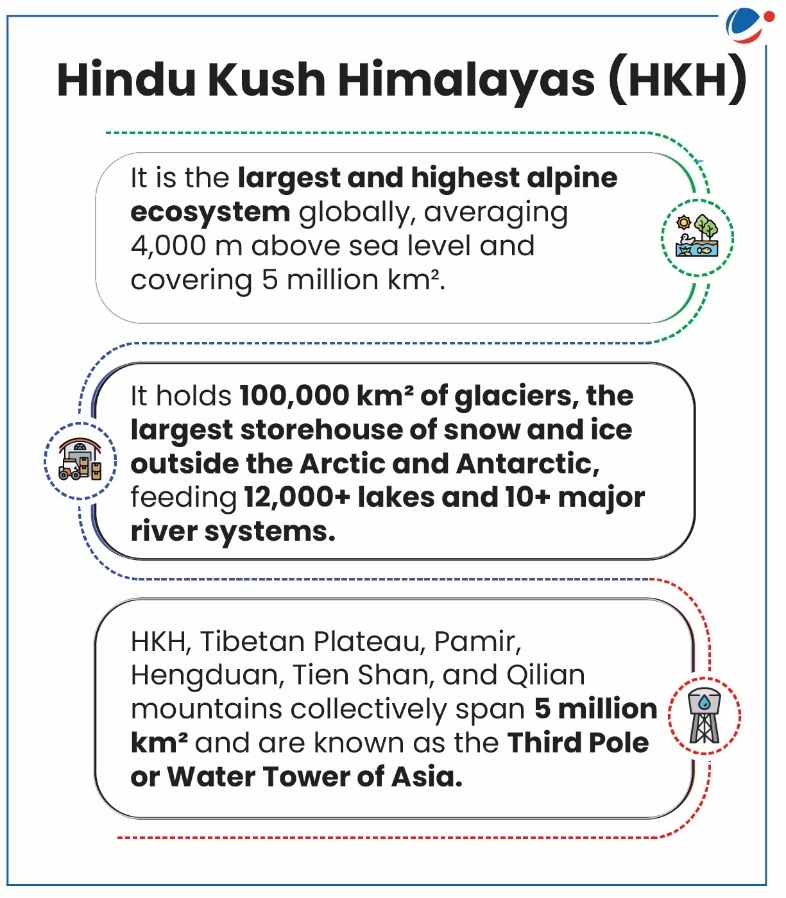
The report published by UNESCO highlights the vital role of mountains and alpine glaciers (water towers) in sustaining ecosystems, economies and societies.
Mountain Ecosystem
- Ecosystem: Forests cover approximately 40% of the global mountain area and at higher elevation consists of grasslands and alpine tundra.
- Water Regulation: An estimated two-thirds of irrigated agriculture globally depends on runoff contributions from mountains.
- Carbon Storage: Mountain soils with permafrost contain approximately 66 Pg of soil organic carbon, which is 4.5% of the global pool.
- Biodiversity: Mountain systems host 25 of the world’s 34 biodiversity hotspots containing high endemic biodiversity, preserving vital agricultural and medicinal plant gene pools etc.
Vulnerabilities of Mountain Ecosystem:
- Glacier Loss: Rapid melting in Andes (30–50% since 1980s), Hindu Kush Himalayas (50% glacier loss by 2100) etc. threatens water security.
- Watermelon snow (glacier blood) effect: Red algae blooms lower surface albedo and accelerate snow melt.
- Urbanization: It significantly alters the hydrological cycle, results in overexploitation of resources and disturbs ecological balance amplifying disasters.
- Atmospheric Pollution: Due to long-range transport, ice cores and lake sediments have shown an increase in black carbon.
International Energy Agency published its Global Energy Review 2025 report.
Key Highlights of the Report
- Global energy demand grew by 2.2% in 2024 with Emerging and Developing Economies accounting for over 80% of this demand.
- 80% of the increase in global electricity generation in 2024 was provided by renewable sources and nuclear, which together contributed 40% of total generation for the first time.
- Deployment of solar PV, wind, nuclear, electric cars and heat pumps since 2019 now prevents 2.6 billion tonnes of CO2 annually, the equivalent of 7% of global emissions.
Article Sources
1 source7th annual World Air Quality Report 2024 released by IQAir.
- The Report evaluates the global state of air quality for the year 2024.
Key findings of the report
- Seven countries met the WHO annual average PM2.5 guideline of 5 µg/m3: Australia, Bahamas, Barbados, Estonia, Grenada, Iceland, and New Zealand.
- The five most polluted countries in 2024 were: Chad>Bangladesh>Pakistan>Democratic Republic of Congo>India.
- Delhi remains the most polluted capital city.
- Byrnihat (Assam), India was the most polluted metropolitan area of 2024.
- Oceania is the world’s cleanest region.
Ahmedabad Municipal Corporation (AMC) becomes 1st Urban Local Body to include separate Climate chapter in its Budget.
- AMC has earmarked one-third of its budget for Climate Action for 2025-26 focusing on implementing Net-zero Climate Resilient City Action Plan aligned with India’s 2070 target.
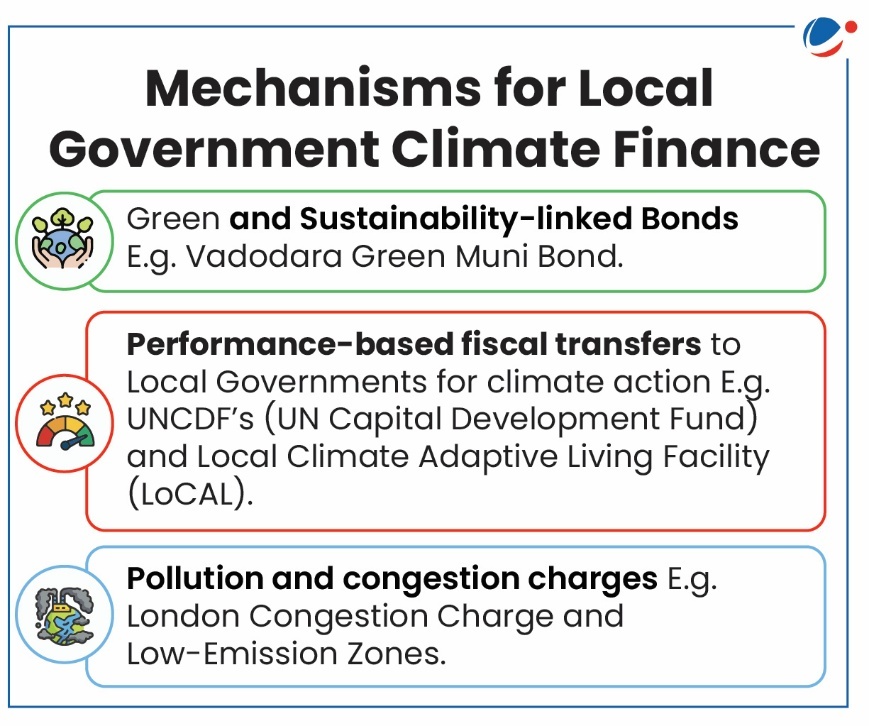
- Earlier, unlike AMC, Brihanmumbai Municipal Corporation (BMC) unveiled Climate Budget consisting 33% capital expenditure for climate-related projects.
About Climate Budgeting
- It is a governance system mainstreaming climate commitments into decision-making on policies, actions and budget.
- This means integrating climate targets from city’s Climate Action Plan into city’s budgeting process and assigning responsibility for implementation and monitoring across city government.
- Importance of Climate Budgeting for Cities
- Foster climate-resilient development; curb emissions and aid in achieving global and national climate targets.
- Aids in estimating climate finance gap by analysing expenditures and promote innovative financial models mobilising climate finance.
Role of Local Administration in Climate Action
- Varied localized climate action: Impact of climate change is geographically and socio-economically varied, making local actions more effective.
- E.g. In 2024-25, Mumbai (BMC) allocated ~30% of its capital budget to tackle urban flooding.
- First Responder to climate change induced extreme weather events. E.g. Landslides
- Access to local and traditional knowledge for climate adaptation and mitigation. E.g. Kundi rainwater harvesting in Rajasthan.
2030 Global Forest Vision (GFV): Priority Actions for Governments in 2025 released by Forest Declaration Assessment.
- Forest Declaration Assessment (FDA), established as New York Declaration on Forests (NYDF) Progress Assessment in 2015, is a civil society-led effort to assess progress towards NYDF goals.
- NYDF was adopted in 2014 by an alliance of governments, companies, indigenous peoples and NGOs, and was endorsed at the 2014 Climate Summit.
- NYDF is voluntary in nature, has ten goals and has not been endorsed by India yet.
Eight Priority Actions in 2030 GFV
- Ambition: Integrate forest goals in national climate and biodiversity plans and in UNFCCC COP30 outcomes.
- Trade: Partner to promote legal and deforestation-, conversion- and degradation-free trade.
- Finance: Significantly scale up finance for forests in line with the Forest & Climate Leaders’ Statement on Forest Carbon Results-Based Payments and Credits, adopted in 2024.
- Rights: Secure the land rights of Indigenous Peoples (IPs) and Local Communities (LCs).
- Supervision: Governments and financial supervisors’ mandates should ensure that forest-related risks are sufficiently assessed, managed and mitigated by financial institutions.
- Subsidies: Repurpose subsidies that harm forests towards sustainable food systems transformation, bioeconomy transition and sustainable forest management.
- Governance: Strengthen governance in land-use sector, aligning them with global commitments.
- Debt: Increase fiscal flexibility in multilateral development finance by incorporating value of forest’s natural capital as assets in countries’ debt management.
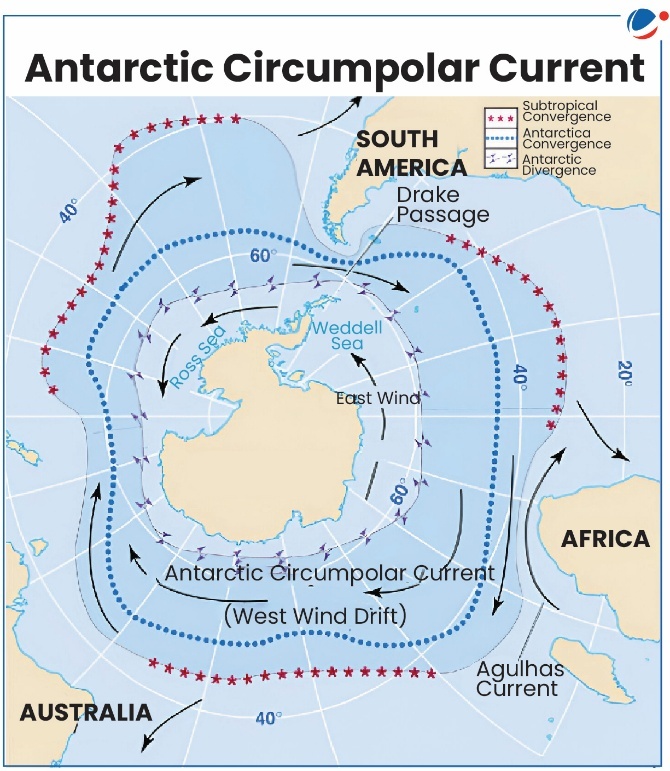
Scientists have warned that ACC might slow down by around 20 per cent by 2050 in the high carbon emissions scenario.
What is ACC?
- ACC is the strongest and the largest wind-driven current on Earth and moves clockwise around Antarctica, driven by strong westerly winds.
- It is the only current that goes all the way around the planet and connects the Atlantic, Pacific, and Indian Oceans.
- Significance:
- It’s a type of cold current that acts as a barrier and prevents warmer waters from reaching Antarctica.
- Significantly influences uptake of heat and carbon dioxide in the ocean.
- Blocks invasive species (e.g., bull kelp, shrimp, mollusks) from other continents reaching Antarctica.
Reasons for weakening of ACC
- Changes in Ocean Salinity: Due to accelerated melting of ice shelves (from global warming) around Antarctica has resulted in weakening of Antarctic Bottom Water (AABW).
- AABW is a sinking process and a critical component of global ocean circulation tied to circulation of ACC.
- Changes in Wind Patterns: Climate change can alter pattern of westerly winds in Southern Hemisphere.
- Positive Feedback Loop: Reduced sea ice can exacerbate warming & freshwater input, creating a feedback loop that further weakens ACC.
Potential Impact of weakening of ACC
|
Thriving deep-sea ecosystems discovered in antarctica after iceberg detaches from George Vi Ice Shelf.
- The discovery came from Challenger 150 initiative which is endorsed by UNESCO/ Intergovernmental Oceanographic Commission (IOC) as part of the Ocean Decade Action (2021-2030).
Key Findings
- Flourishing Ecosystems: At depths of up to 1,300 meters (Mesopelagic Zone), ecosystems were thriving, with large corals and sponges as well as supporting diverse animal. E.g., icefish & giant sea spiders.
- These ecosystems had been isolated under 150-meter-thick ice for centuries, completely cut off from surface nutrients, essential for deep-sea life.
- New Species Discovered: Giant-sea spiders, Octopi, giant phantom jellyfish (can grow up to 1 meter wide), Vase-shaped sponge (possibly hundreds of years old).
About Deep-Sea Ecosystem
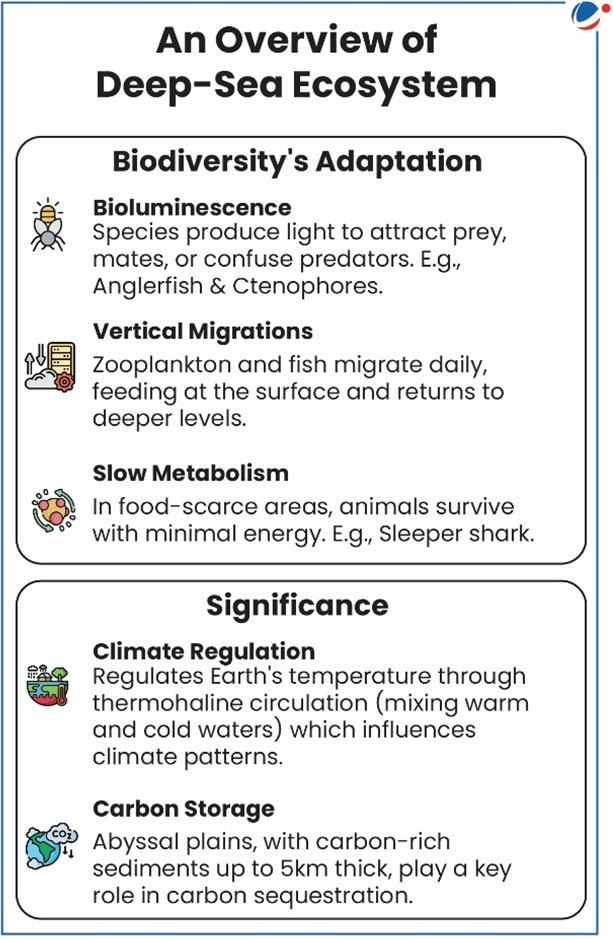
- Definition: Defined as the sea and seabed below 200m, the aphotic zone (where light fades) makes up 90% of Earth's marine environment, representing the planet's largest biome.
- Unique Deep-Sea Habitat and Biodiversity:
- Abyssal Plains: Dark and muddy seafloor; Species rely on marine snow for sustenance. E.g., Sea cucumbers.
- Marine Snow: Consists of organic matter drifting down from ocean surface; serve as food & aid carbon sequestration.
- Hydrothermal Vents: Hot, mineral-rich towers; Species rely on chemosynthetic bacteria for sustenance. E.g., Tubeworms and Yeti crabs
- Whale Falls: As whale carcass sinks, it creates a temporary ecosystem, supporting scavengers. E.g. Hagfish.
- Abyssal Plains: Dark and muddy seafloor; Species rely on marine snow for sustenance. E.g., Sea cucumbers.




