


Why in the News?
This year marks the centenary of the official withdrawal of Vaikom satyagraha on November 30, 1925.
More on the News
- The Vaikom satyagraha was a significant event in India's history, as it marked the milestone in the fight against untouchability.
- The satyagraha was withdrawn after consultations between Gandhi and W.H. Pitt, the then police commissioner of Travancore.
About Vaikom Satyagrah
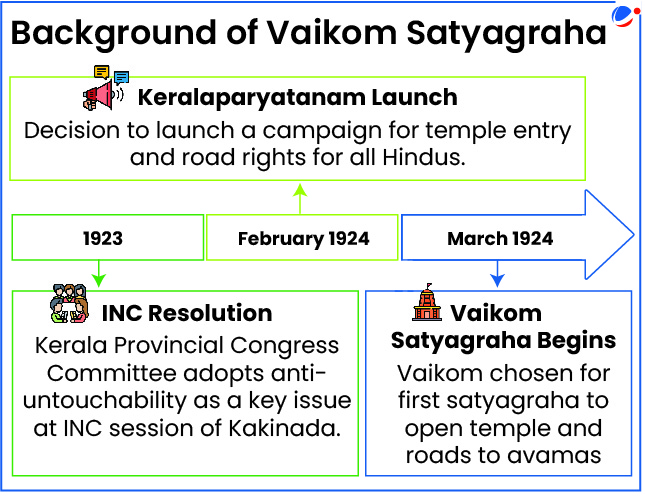
- The Vaikom Satyagraha was a non-violent civil rights movement in Travancore, Kerala against Hindu caste discrimination.
- It specifically protested the prohibition that prevented lower castes (avarnas) from using public roads surrounding the Shiva temple at Vaikom.
- The Satyagraha began by sending three volunteers daily on the road instead of a procession due to prohibitory orders.
- Dressed in khadi, three young men namely Govinda Panikkar, a Nair, Bahuleyan, an Ezhava and Kunjappu, a Pulaya, marched ahead to the temple.
- They were promptly stopped and arrested. So, the next morning, another three men entered the forbidden roads and courted arrest.
- This went on every day until the police stopped making arrests and barricaded the whole area instead.
- From then, the Satyagrahis used peaceful protest methods like blocking roads, organizing quiet demonstrations, and holding gatherings.
- Satyagraha Ashram were stablished near the temple to house volunteers from various castes, fostering unity. The satyagraha gained popular support from the Akalis of Punjab as well as Christian and Muslim leaders of different parts of the country.
Key Leadership
|
Challenges faced by Satyagrahis
- Orthodox Resistance: Upper-caste Hindus and temple authorities resisted, with violent attacks on satyagrahis, including beatings and irritants poured into their eyes.
- Funding and Morale: Frequent arrests and fund shortages tested the movement's resilience,
- Internal Tensions: A minor misunderstanding between Gandhi and Sree Narayana Guru arose over Satyagraha's methods, which caused temporary rift.
- Flood: Satyagrahis had to face the challenge of severe flood, where they had to stand in waist-deep water while the police stood guard in boats.
Significance of Vaikom satyagraha
- Partial Success (November 1925): Three of the four temple roads were opened to all, including Ezhavas and untouchables; the fourth was restricted to Brahmins only.
- Long-term Impact: Paved the way for the 1936 Temple Entry Act in Travancore, allowing all Hindus access to temples and their roads.
- National Significance: Drew all-India attention, with Dr. B.R. Ambedkar calling it the "most important event" for untouchables, raising awareness about untouchability across India.
- Communal Harmony: Fostered unity among Savarnas, Avarnas, Christians, Muslims, and Sikhs, demonstrating people's solidarity.
- Gandhian Principles: Proved Satyagraha's effectiveness as a non-violent tool for social reform.
Conclusion
Vaikom Satyagraha was a landmark in India's fight against untouchability, linking social justice with the freedom movement and integrating princely states into the national struggle.
