


Why in the News?
The Communist Party of India (CPI) celebrated its 100th foundation day on 26 December 2025.
About CPI
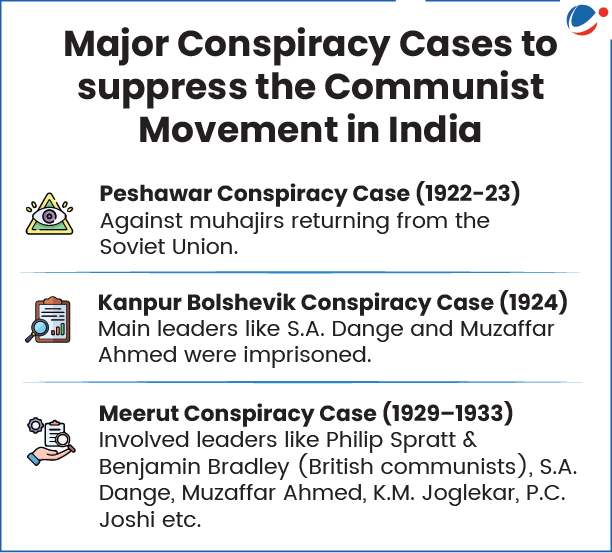
- Background:
- Foundation outside India (1920) in Tashkent (then part of Soviet Turkistan) by a group of 7 revolutionaries, united by opposition to British rule and inspired by the October Revolution (1917).
- Founding Members: M.N. Roy, Evelyn Trent-Roy, Abani Mukherjee, Rosa Fitingov, Mohd. Ali, Mohd. Shafiq (elected Secretary), M.P.T. Acharya.
- Formation of CPI inside India: Formally established through a resolution adopted during Kanpur Communist Conference (1925) bringing together various communist groups active across British India.
- First President: Singaravelu Chettiar
- First general secretaries: S.V. Ghate and J P Bagerhatta
- Founding members of the party: Satyabhakta, M.N. Roy, E.T. Roy, Abani Mukherjee, Mohammad Ali, Hasrat Mohani etc.
- Other Prominent Leaders: A. K. Gopalan, S.A. Dange, E.M.S. Namboodiripad, P.C. Joshi, Ajay Ghosh and P. Sundarraya etc.
- Ideological Foundations: They followed Marxist and Leninist ideas, aimed not only at political freedom but also social and economic liberation.
- Marxism-Leninism is a political ideology and a system of government based on the ideas of Karl Marx and Vladimir Lenin.
- It combines Marxist socialism with Leninist vanguardism, emphasizing the role of a communist party in leading a revolution to establish a socialist state and eventually a communist society.
- Publications supported by CPI: Ganavani (Bengali weekly); Kranti, Jeevanmarg, kamgar (Marathi weekly); Mazdoor, Kisan Sabha journals (Hindi); Prabhatham (Malayalam); Labour Kisan Gazette (First officially recognised CPI publication inside India).
- Major goals of CPI: Nationalization of banks, workers and peasants' rights, land reforms, abolition of zamindari, formation of socialist state etc.
- Key events in the history of CPI:
- Ban: Declared illegal by British government in 1934, ban lifted in 1942.
- Split: In 1964 following the ideological rift between Soviet Union and China, CPI split
- into the CPI (pro-Soviet faction) and CPI (Marxist) (pro-China faction).
Role of CPI in Indian Freedom Struggle
- Mobilizing the masses: Through CPI led organizations like All India Trade Union Congress (AITUC) in 1920, All India Kisan Sabha (AIKS) and All India Student's Federation in 1936 and Mahila sanghmas.
- Indian National Movements like non-cooperation, civil disobedience saw huge participation from women, peasants, workers and middle class.
- Demand for Complete Independence: CPI was the first to demand for full independence through an open letter to the Ahmedabad session (1921) and Gaya session (1922) of Indian National Congress (INC).
- Such a resolution was later passed in INC session of Lahore in 1929.
- Social reforms: CPI advocated for Dalit equality, unity of Hindu and Muslims etc. Examples include-
- E.g., CPI leaders like AK Gopalan and P Krishna Pillai led the satyagraha in Kerala for entry of untouchables inside the temple (Guruvayur).
- Communist leaders also participated in Mahad Satyagraha (1927), Kalaram Mandir Entry (1930), etc.
- Role of CPI in Constitution making
- Idea of constitution was formally proposed by M.N. Roy in 1934.
- CPI put forth the idea of a constituent assembly.
- In 1925, the CPI became the first party to bar members of communal organizations from its ranks.
- CPI significantly influenced the ideals of secularism, justice, equality, universal suffrage, minority rights, abolition of landlordism (Zamindari system) etc. which are incorporated in the Constitution
- Party pioneered the demand for the and conferring land ownership to the tillers.
- Ideological Influence: Through organizations like the All India Students Federation and the All India Progressive Writers Association, communists propagated the idea of overthrowing the British rule through the revolutionary activities.
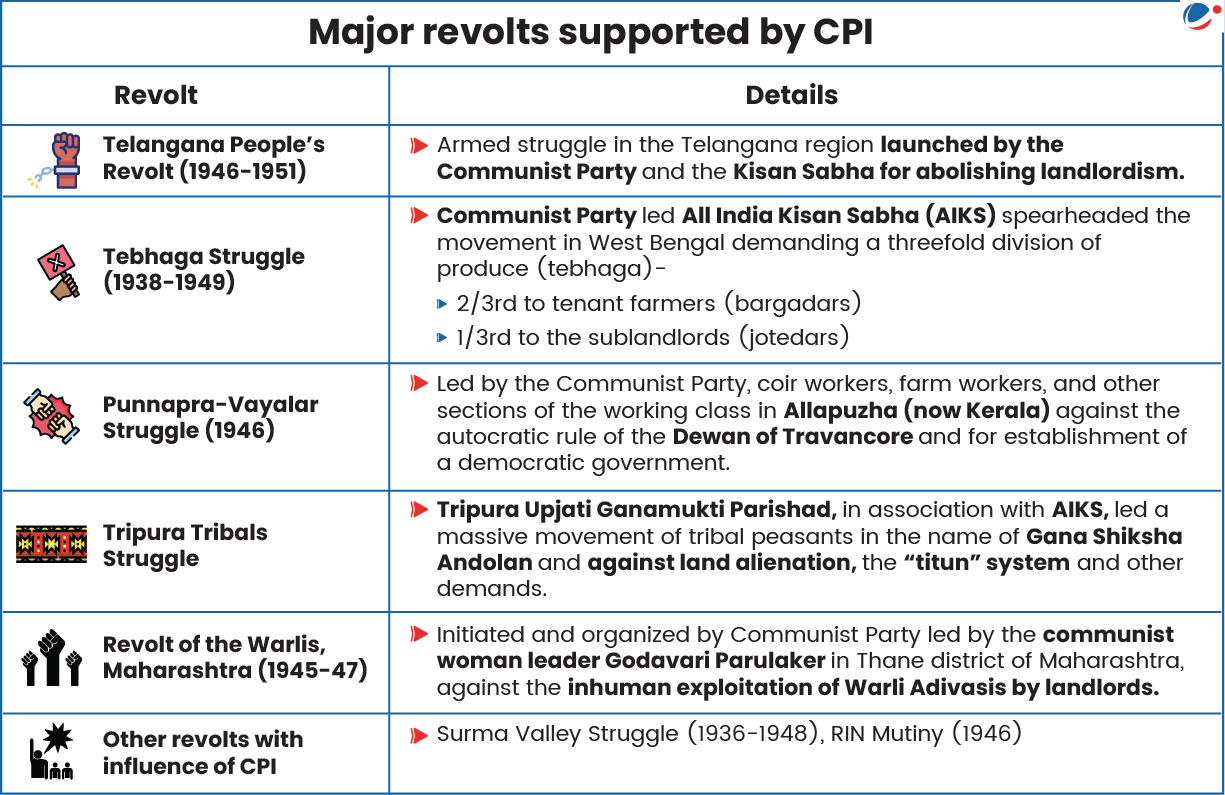
- Support to struggles: CPI and its leaders supported several major peasant and worker struggles in India. (see infographic)
Conclusion
Communist Party of India played significant role in India's freedom struggle through mass mobilisation, social reform movements, and early advocacy of complete independence and constitutionalism.
