Why in the News?
This year marks the centenary of the Self-Respect Movement which changed the course of the political discourse in South India.
About Self Respect Movement
- Launched by: E.V. Ramaswamy (commonly known as Periyar) in 1925.
- The concept of self-respect: It is a theoretical idea that aims to establish an egalitarian society where any type of discrimination, hatred on the basis of caste, religion and gender cease to exist.
- Described as: Arivu Vidutalai Iyakkam, that is, a movement to liberate the intellect by Periyar.
- The objectives were outlined in two pamphlets: Namathu Kurikkol and Tiravitak Kalaka Lateiyam.
- Features of the Movement:
- Social Upliftment: The movement opposed the Devadasi system, caste discrimination, and restrictions on widow remarriage, promoting social equality.
- Self-Respect Marriages: Legitimized marriages without priests, undermining the monopoly of Brahmin priests and reducing ritual costs.
- Inter caste Marriages: It opposed child marriage, encouraged love marriage and intercaste marriage.
- Self-Respect Conference: In 1929, Periyar held the first provincial conference at Chengalpattu, led by W.P.A. Soundara Pandian.
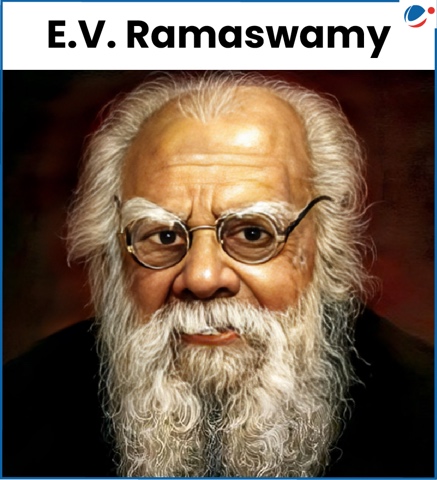 About E. V. Ramaswamy (Periyar) (1879-1973)
|
Significance of the Self-Respect Movement
- Challenged Brahminical Dominance: Questioned the social and religious hierarchy that privileged upper castes and laid the foundation for anti-caste politics in Tamil Nadu.
- Women's Rights: Pioneered reforms in widow remarriage, right to property, right to divorce, and reproductive choices, setting early examples for gender justice.
- Promotion of Rationalism: Encouraged critical thinking, scientific temper, and rejection of superstition, helping to modernize social attitudes.
- Language & Cultural Renaissance: Strengthened the Tamil language, Dravidian culture, and local identity.
- Educational Access: Demanded mass literacy and education for marginalized sections, challenging the traditional denial of knowledge to non-Brahmins.
- Economic Justice: Linked caste inequality to economic exploitation and demanded proportionate representation in government jobs and resources.
- Political Impact: Provided the ideological foundation for the rise of Dravidian parties (Justice Party, DMK, AIADMK) and shaped Tamil Nadu's distinctive welfare-oriented politics.
- Global Influence: Inspired Tamil diaspora movements in Malaysia, Singapore and elsewhere, reinforcing identity and rights consciousness abroad.
Other Social Reform & Anti-Caste Movements
- Satyashodhak Samaj (1873): Founded by Jyotirao Phule in Maharashtra to fight Brahminical domination, promote education for lower castes and women, and question religious orthodoxy.
- (Shree Narayana Dharma Paripalana Movement (1903): By Narayan Guru, and promoted the slogan "One Caste, One Religion, One God" for humanity; fought caste discrimination among Ezhavas in Kerala.
- Bahishkrit Hitkarini Sabha (1924): By Dr. B.R. Ambedkar to promote the education, social, cultural, and economic advancement of the Dalit community.
- Vaikom Satyagraha (1924–25): Social agitation in Travancore (Kerala) demanding temple-road entry for oppressed castes.
- All India Depressed Classes Association (1930): By Dr B.R. Ambedkar to fight for the social, economic, and political rights of the Scheduled Castes (Dalits).
- All India Anti-Untouchability League (1932): Set up by Gandhi Ji for the eradication of untouchability in society.
Conclusion
The Self-Respect Movement marked a turning point in South India's socio-political history by challenging caste hierarchy and religious orthodoxy. It laid the foundation for rationalism, gender justice, and social equality, transforming Tamil society and politics. Its legacy continues to inspire movements for social reform, inclusivity, and empowerment even today.