


Maharashtra, Andhra Pradesh, Assam, Tripura are top performers in their respective groups in State Energy Efficiency Index 2024(sixth edition).
About State Energy Efficiency Index (SEEI)
- Developed by: Bureau of Energy Efficiency (BEE) in association with the Alliance for an Energy Efficient Economy (AEEE).
- Purpose: The index assesses the energy efficiency performance of 36 States and Union Territories (UTs) supporting data-driven monitoring, best practice sharing, and healthy competition.
- States are classified into four performance categories: Front Runners (>60%), Achievers (50-60%), Contenders (30-50%), and Aspirants (<30%).
- The State Energy Efficiency Action Plans initiated by BEE, are crucial in integrating energy efficiency into the most energy-intensive sectors.
Recent events like the Punjab floods, landslides and flash floods in Uttarakhand, Himachal Pradesh and Jammu and Kashmir highlight the growing frequency and intensity of monsoon-related extreme weather events.
Changing nature of Monsoon
- Erratic patterns of rainfall: Research suggests that monsoon winds are weakening. However, rising temperatures are increasing atmospheric moisture, creating more intense bursts of rainfall separated by frequent dry spells.
- Changing El Niño-monsoon relationship: Weakening of the correlation between El Niño and reduced monsoon rainfall over India due to changes in global atmospheric circulation patterns.
- Spatial distribution of monsoon: Humid regions are becoming drier and dry regions are becoming wetter.
- E.g., decreasing rainfall along the Ganga basin states while increasing rainfall in Gujarat’s Saurashtra, Rajasthan.
- Climate change: Rising sea levels and temperatures result in changes in monsoon patterns, increasing water vapour holding capacity of clouds, impacting intensity of rainfall.
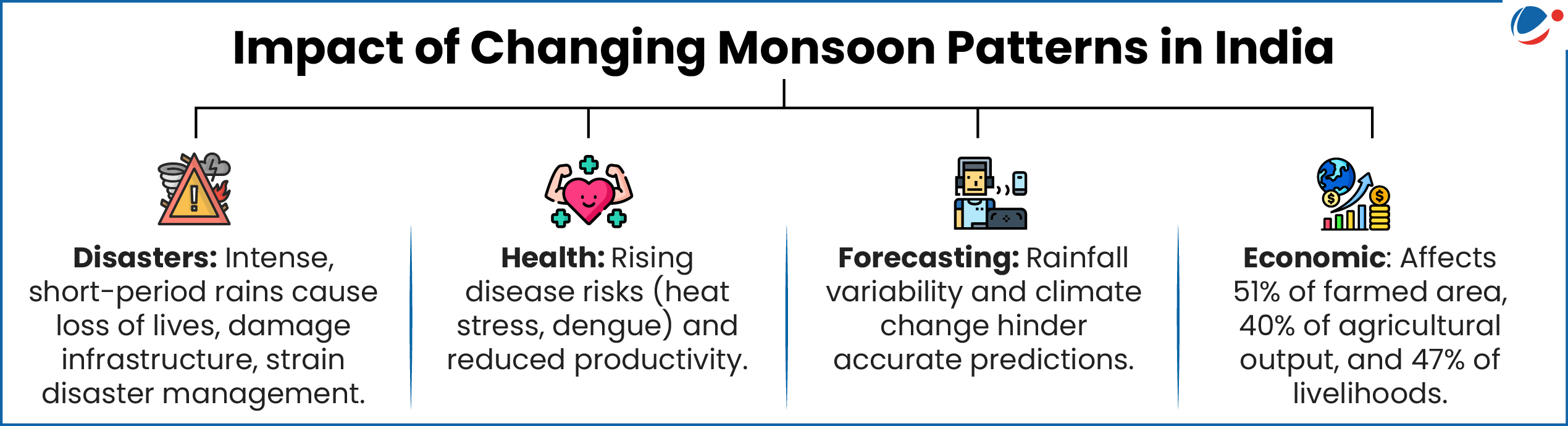
Conclusion
This shift in monsoon patterns highlights the need to move from a post-disaster response to a pre-disaster focus on reducing vulnerabilities through sustainable infrastructure and effective early-warning systems.
The report released by World Meteorological Organization (WMO) highlights that water cycle has become increasingly erratic and extreme, swinging between deluge and drought.
Key Highlights of Report
- Glacier Melt: All glacier regions worldwide report losses due to melt for third straight year.
- Many small-glacier regions have already reached or are about to pass the so-called Peak Water Point - when a glacier's melting reaches its maximum annual runoff, after which this decreases due to glacier shrinkage.
- Erratic Water Cycle: Two thirds of global river catchment area have too much or too little water.
- This is leading to increasing extreme events – unusual heavy rainfall in Africa’s tropical zone, extensive flooding in Europe and Asia, drought in Amazon Basin etc.
Water Cycle
- Water cycle describes the continuous movement of water within the Earth and atmosphere and involve pools and fluxes.
- Pool refers to many forms and places where water is stored like lake, glacier, atmosphere etc.
- Fluxes are ways that water moves between the pools, including state changes like evaporation or condensation.
- Impact of Climate Change: Warming global climate intensifies water cycle as it increases the role of evaporation.
- It leads to more water being stored in atmosphere, increasing extreme weather events such as droughts, heavy precipitation, and hurricanes.
- It is causing sea level rise through melting glaciers and expansion of ocean water, flooding coastal areas.
Article Sources
1 sourceProduction Gap Report 2025 has been released by Stockholm Environment Institute, Climate Analytics, and International Institute for Sustainable Development.
Key Highlights
- Massive Overproduction:
- Planned fossil fuel production in 2030 will exceed levels consistent with limiting warming to 1.5°C by more than 120% and to 2°C by 77%.
- Coal remains the most misaligned, with projected 2030 global output 500 % higher than the 1.5°C pathway.
- Fossil fuel subsidies by governments remain near record highs despite pledges to cut them.
A study has revealed that Wayanad landslides were grey rhino event.
What is a Great Rhino Event?
- Grey Rhinos are defined as highly probable, high impact but yet neglected systemic disruptions.
- These are not random surprises (like Black Swan events) but occur after clear warnings and accumulating evidence.
Why Waynad landslides were Great Rhino Event?
- As per the study, Wayanad landslide happenedin an area that has been categorised as a landslide-prone area, repeatedly hit by landslides in the recent past, yet ignored by government.
Philippines was affected by Super Typhoon Ragasa.
About Super Typhoon
- It is a tropical cyclone with maximum wind speed exceeding 185 kph or more than 100 knots.
- Tropical cyclones are warm-core low pressure systems associated with a spiral inflow at the bottom level and spiral outflow at the top level.
- They always form over oceans where sea surface temperature is greater than 26°C.
- They develop at latitudes usually greater than 5° from the equator.
Terms for Tropical Cyclones:
- Hurricane – North Atlantic, Eastern North Pacific and South Pacific Ocean.
- Cyclone – Indian Ocean.
- Typhoon – Western North Pacific Ocean.
- Willy-willy: Eastern part of the Southern Indian Ocean.
- Sawalkote Project: A run-of-the-river project proposed on the river Chenab.
- Location: District Ramban & Udhampur of UT Jammu & Kashmir.
- Heo and Tato-I: Projects on Siyom River, in Arunachal Pradesh, close to the border with China.
- Siyom River originates from the eastern Himalayas and flows for much of its range from West to East, before joining the Siang (name used for Brahmaputra River in Arunachal Pradesh).
- Oju Hydroelectric Project: Project on Subansiri River near the India-China Border.
- Subansiri River originates in Tibet and is Largest tributary of the Brahmaputra. It is a trans-Himalayan antecedent river.
- Enters Arunachal Pradesh, India, flows into Assam, and joins Brahmaputra.
- The River is also called the “Gold River” because of the gold dust found in its waters
- Subansiri River originates in Tibet and is Largest tributary of the Brahmaputra. It is a trans-Himalayan antecedent river.
Article Sources
1 sourceFresh Eruption Reported at Barren Island Volcano, Andaman Islands.
About Barren Island
- Location: Situated in the Andaman Sea, Andaman and Nicobar Islands, India. Northeast of Port Blair
- Status: India’s only active volcano.
- Type: Stratovolcano, part of the Andaman volcanic arc.



