
AERB approves Excavation for Nuclear Project in Rajasthan | Current Affairs | Vision IAS

Upgrade to Premium Today

Start Now
MENU
Home
Quick Links

High-quality MCQs and Mains Answer Writing to sharpen skills and reinforce learning every day.

Watch explainer and thematic concept-building videos under initiatives like Deep Dive, Master Classes, etc., on important UPSC topics.

A short, intensive, and exam-focused programme, insights from the Economic Survey, Union Budget, and UPSC current affairs.

ESC

Approval of excavation for the construction of the Mahi Banswara Rajasthan Atomic Nuclear Power Project (MBRAPP) units one and two was given by The Atomic Energy Regulatory Board (AERB).
About Mahi Banswara Rajasthan Atomic Nuclear Power Project (MBRAPP)

  • Location: Banswara, Rajasthan near the Mahi Dam on River Mahi. 
  • Capacity: 4 x 700 MWe PHWR (4 nuclear power units of Indigenous PHWRs (Pressurized Heavy Water Reactors)).
    • PHWRs use natural uranium as fuel and heavy water (deuterium oxide) as coolant and moderator.
  • Development: By Anushakti Vidhyut Nigam (ASHVINI), a joint venture between Nuclear Power Corporation India Limited (NPCIL) and National Thermal Power Corporation Limited (NTPC). 
  • The project is part of India’s “fleet mode” initiative.
    • Under this Initiative, ten identical 700 MW reactors are being built across India under uniform design and procurement plans.

Steps taken to boost nuclear energy production in India

  • Nuclear Energy Mission: Announced in Union Budget 2025–26 focused on research and development (R&D) of Small Modular Reactors (SMRs) aiming to develop at least five indigenously designed and operational SMRs by 2033.
  • Nuclear Energy Target: 100 GW nuclear power capacity by 2047. 
  • SHANTI Act, 2025: Consolidating and modernising India’s nuclear legal framework.

Nuclear Power Capacity in India

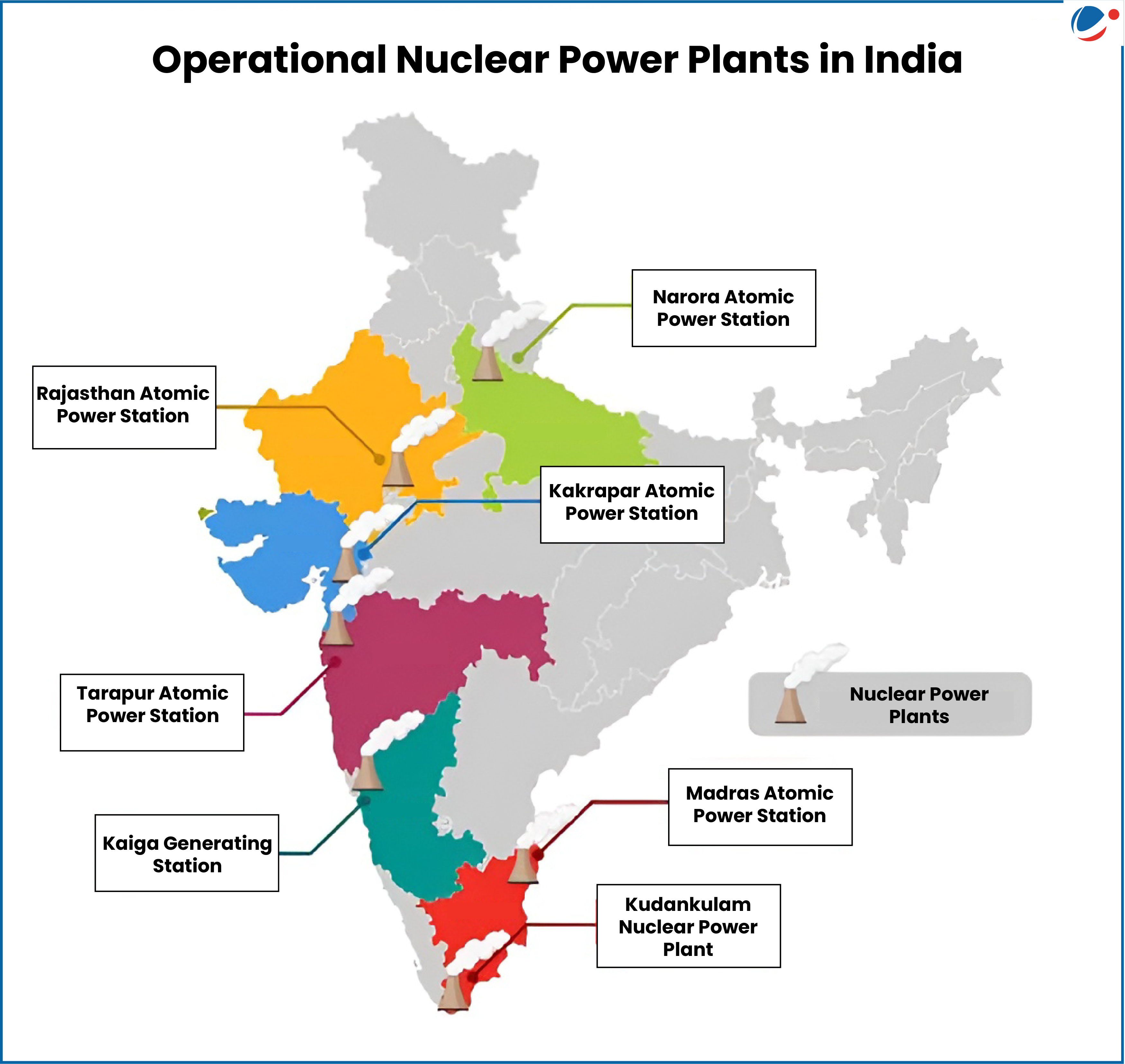
  • India currently has 24 reactors across 7 power plants with installed nuclear energy capacity of 8,780 MW comprising 24 nuclear power plants (excluding RAPS-1 – 100 MW). (March 2026)
  • The government plans to increase this to 22,480 MW by 2031-32.
  • Nuclear power accounts for around 3.1 % of India’s total electricity generation in, making it the fifth-largest Non-fossil fuel source of electricity. (2024–25)
Watch Video News Today

Explore Related Content

Discover more articles, videos, and terms related to this topic

RELATED TERMS

3

Non-fossil fuel source of electricity

Refers to electricity generated from sources other than coal, oil, and natural gas, such as nuclear power, hydropower, solar, wind, and biomass. In India, nuclear power is a significant contributor to this category.

Small Modular Reactors (SMRs)

Advanced nuclear reactor designs that are smaller in size, factory-built, and can be deployed more rapidly and flexibly than traditional large-scale nuclear power plants. They are crucial for diversifying the energy mix and meeting clean energy targets.

Fleet Mode

An initiative by India to expedite nuclear power development by building multiple identical reactors (e.g., ten 700 MW reactors) under standardized design and procurement plans, aiming for faster commissioning and cost efficiencies.

Title is required. Maximum 500 characters.

Search Notes

Filter Notes

Loading your notes...
Searching your notes...
Loading more notes...
You've reached the end of your notes

No notes yet

Create your first note to get started.

No notes found

Try adjusting your search criteria or clear the search.

Saving...
Saved

Please select a subject.

Referenced Articles

linked

No references added yet
