


DPI approach offers one way to democratise access to AI infrastructure by building shared, standards-based layers that enhance access, interoperability, accountability, and trust.
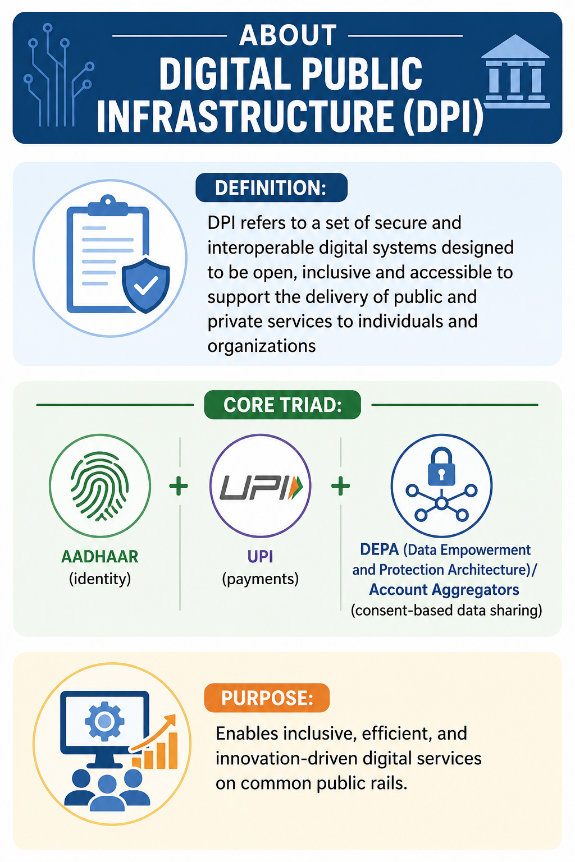
Need for DPI Approach for AI Development
- Reduce AI Dependence and enhance Digital Sovereignty: Build domestic AI capabilities to reduce reliance on costly foreign AI services.
- Democratise AI: Open compute, datasets, and models enable startups, MSMEs, and researchers.
- Smarter Governance: Enables predictive public services, fraud detection, and better policy delivery.
- E.g. multilingual, voice-based AI for last-mile governance.
Challenges
- Capacity Gaps: India generates ~20% of global data but has only ~3% of data centre capacity and <5% of AI compute; infrastructure concentrated in Tier-1 cities.
- Energy Constraints: AI infrastructure requires expansion of electricity and cooling systems.
- High Entry Barriers: Expensive GPUs, TPUs, and HPC limit access for startups and research institutions.
- Uneven AI Adoption: Slow in agriculture, public services etc.
- Data Governance: Ensuring privacy, interoperability, and security under the DPDP Act, 2023.
Recommendations
AI-DPI Enablers: People (AI skilling), Infrastructure (cloud, GPUs), and Governance (Responsible AI & DEPA).
- Adopt DPI & DPG Approach: Treat AI datasets, compute, and model hubs as Digital Public Goods (DPGs).
- Expand Compute Access: Under IndiaAI Mission, National Supercomputing Mission and India Semiconductor Mission.
- Build Shared Data Repositories: Expand platforms like AIKosh, Bhashini, TGDeX with federated data sharing.
- Regional and Green Infrastructure: Develop Tier-2/3 edge data centres through PPPs and state incentives; Promote renewable-powered, energy-efficient data centres.
- Support Indigenous AI: Provide compute credits and funding for sovereign AI models and local-language applications.



