


Why in News?
NITI Aayog launched the "DPI@2047 for Viksit Bharat" strategic roadmap to advance inclusive, livelihood-centric, and productivity-led growth.
Key Highlights of the report
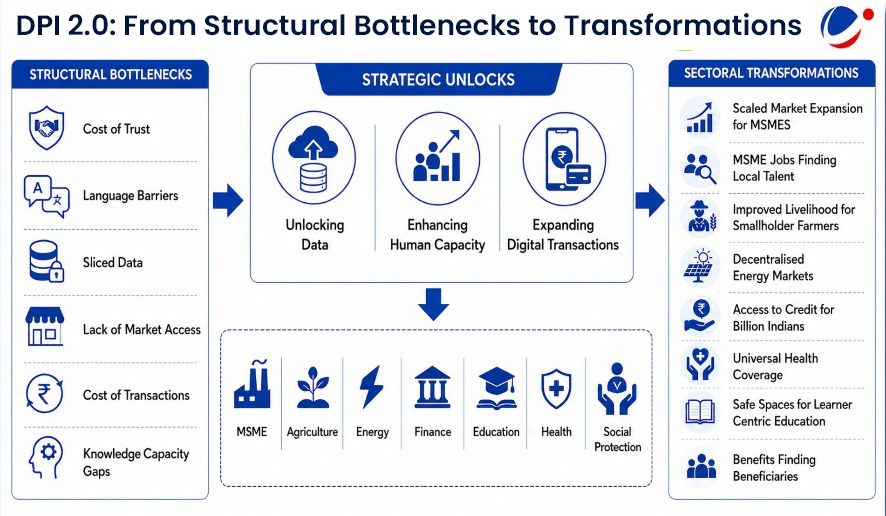
- The report recommends a two-phase approach, namely DPI 2.0 (2025–2035) for immediate focus to drive livelihood-led growth at scale, followed by DPI 3.0 (2035–2047) to enable broad-based prosperity.
- Core Elements of DPI 2.0
- Eight Sectoral Transformations: Designed to systematically dismantle structural bottlenecks across critical core sectors: MSMEs, agriculture, education, and health.
- Systemic Enablers: Aims to strengthen foundational networks across credit, decentralized energy, and benefit delivery.
- Four Execution Imperatives:
- District-led demand aggregation
- Scaling technology entrepreneurship
- Leveraging Artificial Intelligence (AI)
- Deploying cross-sector unlocks (through better data usage, digital transactions, stronger human capacity, and the democratisation of AI).
About Digital Public Infrastructure
- It refers to foundational, interoperable digital systems primarily built around digital identity, instant payments, and consent-based data sharing. It enables governments, businesses, and citizens to interact securely.
- Characteristics of DPI:
- Interoperability: Integrates seamlessly with other systems and platforms, enabling secure and efficient data exchange.
- Scalability: Designed for large-scale adoption, capable of handling millions or like in India's case, billions of users.
- Inclusivity: Upholds the non-excludable and non-rivalrous principles of a public good, ensuring unrestricted access for governments, businesses, and individuals, including marginalized communities.
- Governance: Requires robust governance through transparent institutional foundations of DPI frameworks, accountable oversight, and participatory policymaking that safeguard public interest.
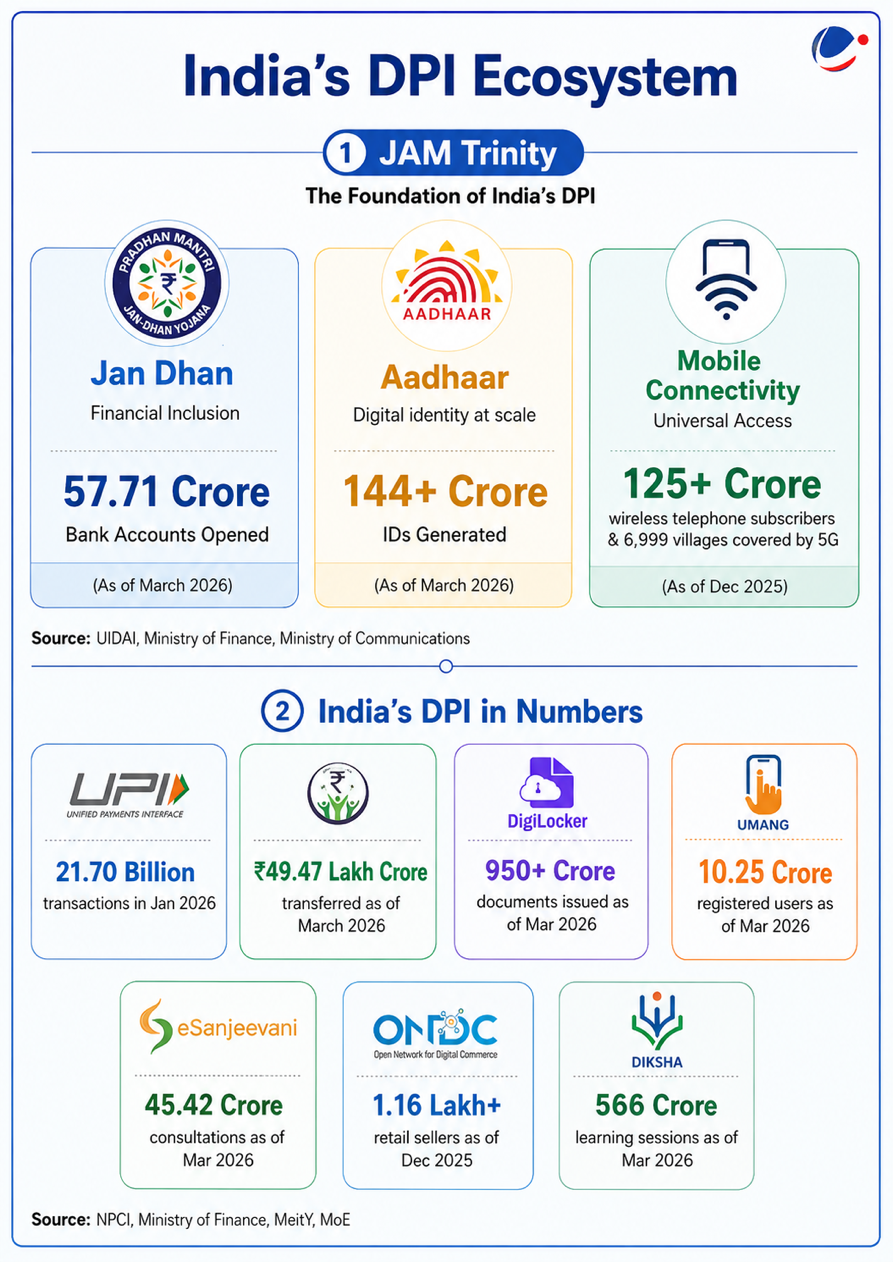 DPI Ecosystem of India
|
Transformative role played by DPI in India
- Economic growth: DPI contributed 0.9% to India's GDP in 2022 (with projections of 4.2% by 2030).
- Inclusive growth: MSMEs registered under GST grew to 1.5 crore in December 2024 (from 5 lakh in 2017-18), etc.
- Financial Inclusion: India achieved 80% bank account penetration in eight years, a feat Bank for International Settlements (BIS) estimated would have taken 47 years.
- Plug leakages in the social benefits: Leveraging JAM Trinity (Jan Dhan, Aadhaar, Mobile), Direct Benefit Transfer (DBT) mission created the world's largest government-to-person (G2P) payment infrastructure, significantly plugging social benefit leakages.
- ₹3.48 lakh crore was saved through leakage prevention with DBT.
- Increase mobile penetration: Aadhaar-based e-KYC increased households' ownership of mobiles in India to 85% by May 2025 from 15% in 2026.
- Hockey Stick Effect: Explosion of new services previously unimaginable providing rapidly accelerating growth following 'hockey-stick' curve.
- For instance, DPI enabled startups created over $100 billion in market value.
- DPI diplomacy: As of February 2026, Government of India has signed Memoranda of Understanding (MoU) and agreements with 24 countries for cooperation on India Stack and Digital Public Infrastructure.
- Further, during India's G20 presidency, New Delhi Leaders' Declaration explicitly recognised DPI as a development accelerator and Global Digital Public Infrastructure Repository was launched as a knowledge platform to share lessons and practices.
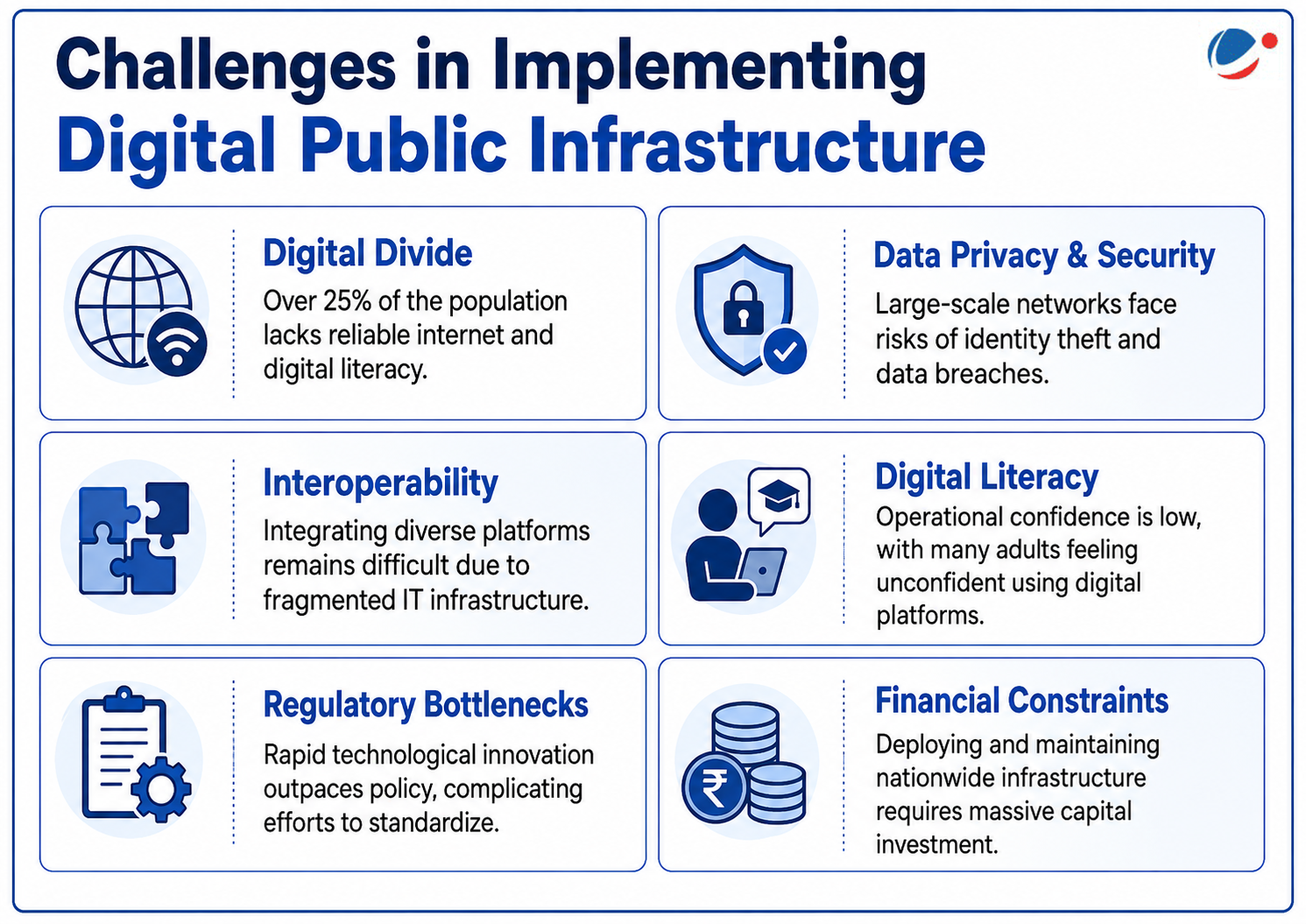
Way Forward: Recommendations for DPI 2.0
- Decentralized Execution: Empower states to lead DPI 2.0 initiatives with guidance from the Government of India and NITI Aayog.
- Collaborative 2-year Iterative cycles of Transformations: Utilize two-year cycles to refine and validate scalable models before ecosystem-wide expansion.
- First cycle (2026-2027) focus on MSME and Agriculture: Focus 2026–2027 efforts on three MSME and Agriculture transformations, deploying lighthouse pilots in six states followed by broader rollout.
- Neutral ecosystem body for global engagement: Establish a neutral, expert-backed body by 2027 to spearhead international collaboration on DPI and AI for public good.
Conclusion
The global technological advantage is shifting from pure capital and chip power to a nation's ability to connect digital infrastructure with economy-wide diffusion and impact. By merging DPI, AI, and domestic entrepreneurship, India aims to build a vernacular, population-scale model of AI adoption.


