Third Launch Pad | Current Affairs | Vision IAS
MENU
Home

Periodically curated articles and updates on national and international developments relevant for UPSC Civil Services Examination.

Quick Links

High-quality MCQs and Mains Answer Writing to sharpen skills and reinforce learning every day.

Watch explainer and thematic concept-building videos under initiatives like Deep Dive, Master Classes, etc., on important UPSC topics.

ESC

Third Launch Pad

22 Feb 2025
3 min

Why in the News?

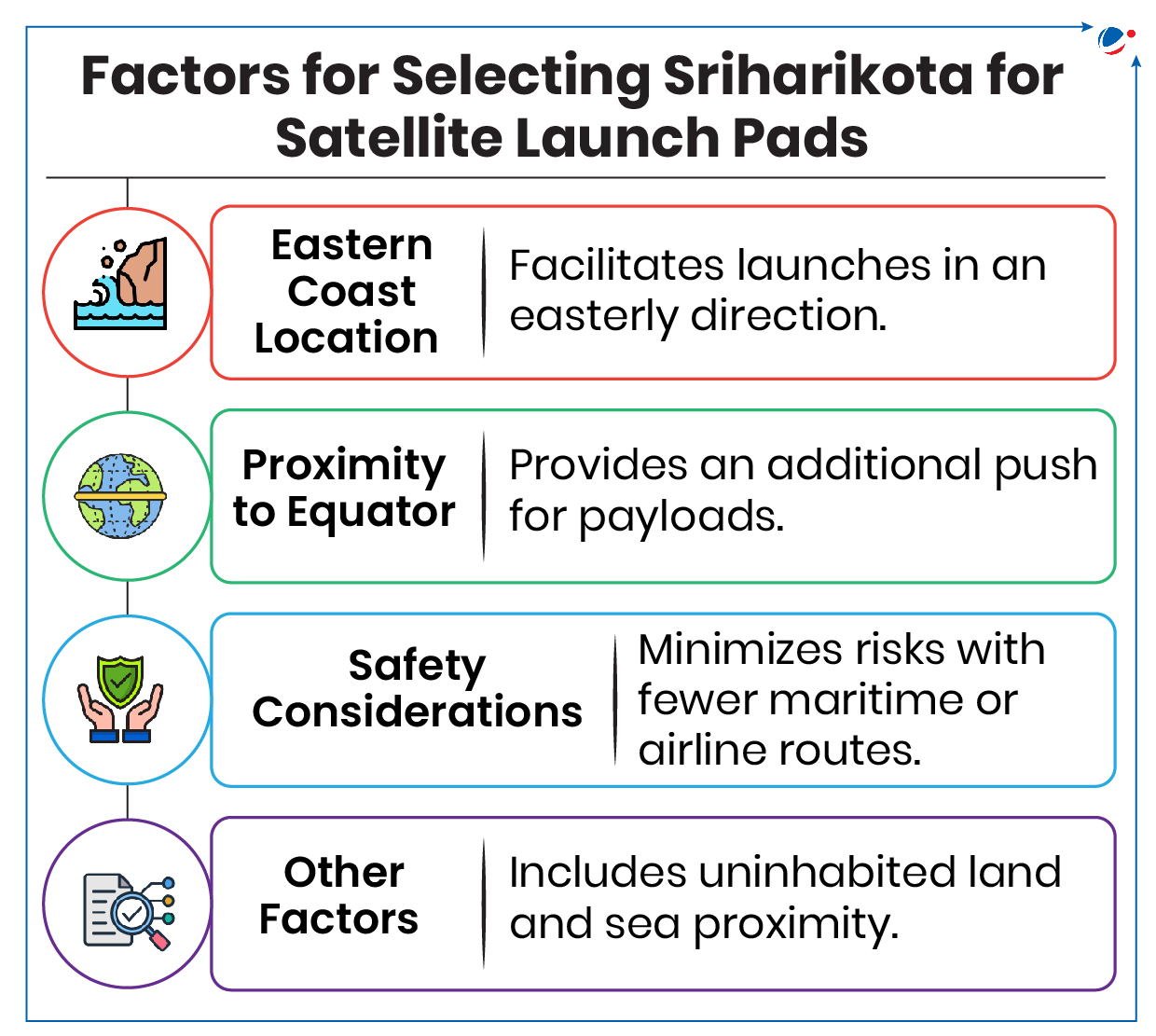
Union Cabinet approved the establishment of 'Third Launch Pad' (TLP) project at Satish Dhawan Space Centre of ISRO at Sriharikota, Andhra Pradesh.
About TLP

  • Key Features: Configured to support Launch of Next Generation Launch Vehicles (NGLV) and Launch Vehicle Mark-3 (LVM3) with Semi cryogenic stage as well as scaled up configurations of NGLV.
  • Timeline: To be established within 4 years.
  • Significance of TLP 
    • Capacity augmentation: Enables higher launch frequencies and enhances the launch capacity for future human spaceflight & space exploration missions, etc.
    • Expanded vision of Indian Space Programme: Bharatiya Antariksh Station (BAS) by 2035 and an Indian Crewed Lunar Landing by 2040 require a next generation of heavier launch vehicles with new propulsion systems.
    • Future Transportation: It is highly essential so as to meet the evolving space transportation requirements for another 25-30 years.

Existing Launch pads in India

  • Currently, ISRO relies on 2 launch pads located at Shriharikota:
    • First Launch Pad provides launch support for Polar Satellite Launch Vehicle (PSLV) and Small Satellite Launch Vehicle (SSLV).
    • Second Launch Pad was established primarily for Geosynchronous Satellite Launch Vehicle (GSLV) & LVM3 and also functions as standby for PSLV.

Conclusion

The expeditious establishment of a Third Launch Pad to cater to a heavier class of Next Generation Launch Vehicles and as a stand by for SLP is highly essential so as to meet the evolving space transportation requirements.

Next Generation Launch Vehicles (NGLV) Programme

  • About: It aims to develop a new rocket (also known as Soorya Rocket) to launch satellites, spacecraft, and other payloads.
  • Features
    • 3 stage vehicle with reusable first stage. Reusability results in low-cost access to space and modular green propulsion systems.
    • The booster stages will use semi-cryogenic propulsion, using refined kerosene as fuel and liquid oxygen (LOX) as oxidizer.
    • It will have 3 times the present payload capability with 1.5 times the cost compared to LVM3.

Other Launch Vehicles of the ISRO

  • Polar Satellite Launch Vehicle (PSLV): It is the third generation launch vehicle of India. 
    • It is a 4 stage launch vehicle with 1st & 3rd stages being solid rocket motors and 2nd & 4th being liquid engines.
  • Geosynchronous Satellite Launch Vehicle (GSLV): It is operational fourth generation launch vehicle with 3-stage and four liquid strap-on motor.
    • It is used to launch communication satellites in geo-transfer orbit using cryogenic third stage.
  • Small Satellite Launch Vehicle (SSLV): It is a 3 stage Launch Vehicle configured with three Solid Propulsion Stages and liquid propulsion based Velocity Trimming Module (VTM) as a terminal stage.
  • Geosynchronous Satellite Launch Vehicle Mk-III (LVM3): LVM3 is configured as a three stage vehicle with two solid strap-on motors (S200), one liquid core stage (L110), and a high thrust cryogenic upper stage (C25).

Explore Related Content

Discover more articles, videos, and terms related to this topic

RELATED VIDEOS

2
News Today (Jan 17, 2025)

News Today (Jan 17, 2025)

YouTube HD
News Today (May 18-19, 2025)

News Today (May 18-19, 2025)

YouTube HD
Title is required. Maximum 500 characters.

Search Notes

Filter Notes

Loading your notes...
Searching your notes...
Loading more notes...
You've reached the end of your notes

No notes yet

Create your first note to get started.

No notes found

Try adjusting your search criteria or clear the search.

Saving...
Saved

Please select a subject.

Referenced Articles

linked

No references added yet

Subscribe for Premium Features