


Why in the News?
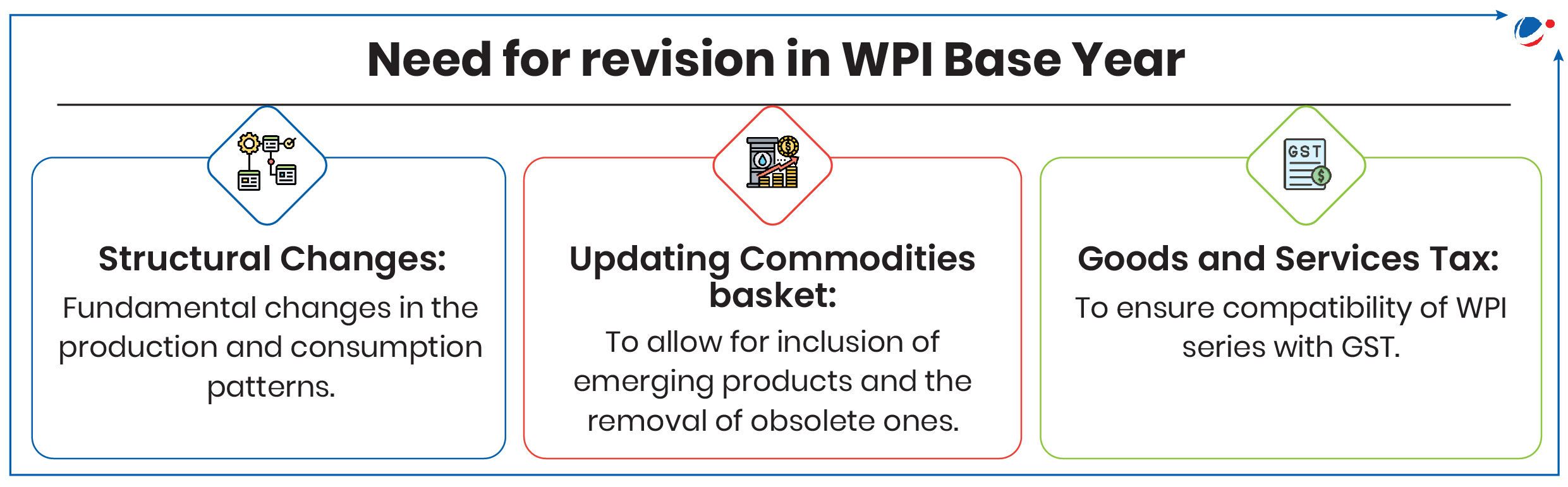
The Government of India has constituted a Working Group for base revision of the current series of Wholesale Price Index (WPI) from base 2011-12 to 2022-23.
More on the News
- Working Group will be chaired by Prof. Ramesh Chand, Member, NITI Aayog.
- Additionally, the Group will also suggest improvement in compilation and presentation and recommend roadmap for switch over from WPI to Producer Price Index (PPI).
- Terms of Reference of the Group also include review the existing system of price collection, decide on the computational methodology to be adopted for WPI / PPI, among others.
About WPI
- It is a measure of the average change of prices of a fixed set of goods at the first point of bulk sale in a commercial transaction in the domestic market over a given period of time.
- Released by: Office of the Economic Adviser, Department for Promotion of Industry and Internal Trade, Union Ministry of Commerce & Industry.
- Measurement: Measured as weighted average of a basket of commodities.
- Composition of Basket: Comprises 697 items categorized into three major groups:
- Primary Articles (Weight: 22.618 out of 100): Consists of 4 sub-groups: Food Articles; Non-Food Articles; Minerals; and Crude petroleum and natural gas.
- Fuel and Power (Lowest weight: 13.152 out of 100): Consists of 3 sub-groups: Coal; Mineral Oils; Electricity.
- Manufactured Products (Highest weight: 64.230 out of 100): Consists of 22 sub-groups.
About Producer Price Index (PPI)
- It measures the average change in the price a producer receives for his goods/services sold in the domestic market/ exports.
- Two types:
- Output PPI: Measures the average price change of all covered goods and services resulting from an activity and sold on the domestic/ export markets.
- Input PPI: Measure the change in the prices of all intermediate inputs used in production by a specified sector of the economy.
Need to replace WPI by PPI
- Multiple Counting Bias: WPI has inbuilt bias due to double/ multiple counting of same product.
- Exclusion of Services: WPI also excludes the service sector (about 55% of GDP).
- Exclusion of taxes: News WPI (2011-12) series considers only basic prices and does not include taxes, rebate/trade discounts, transport and other charges.
- Advantages of PPI: Cover services, exclude indirect taxes among some, International Prominence of PPI being used by advanced economies like U.S.A. etc.
Comparison
Parameters | WPI | PPI | CPI |
Definition
| Measures price changes at the wholesale level (before retail). | Measures price changes at the producer level (prices received by producers for goods and services). | Measures price changes at the consumer level (retail prices paid by consumers). |
Scope | Covers goods at the wholesale stage before reaching consumers. | Covers goods and services at the producer level, including inputs and outputs. | Covers goods and services consumed by households. |
Base Year | 2011-12 | Not yet officially implemented in India. | 2012 |
Composition | Primarily includes manufactured products, fuel, and primary articles. | Includes both goods and services across different production stages. | Includes goods and services like food, healthcare, education, and housing. |
Are services included? | No | Yes | Yes |
Measurement | The weights of the WPI are based on production values. | Weights of items are derived from Supply Use Table. | The weights of the CPI basket are based on the average household expenditure taken from the Consumer expenditure survey. |
Inclusion of taxes | Excludes indirect taxes | Some variants of PPI may include taxes if they are passed on to producers. | Includes indirect taxes |
Multiple Counting bias | Present | Absent | Present |
Published by | Office of Economic Advisor, DPIIT, Ministry of Commerce and Industry. | Not yet officially implemented in India. | National Statistics Office (NSO), Ministry of Statistics and Programme Implementation. |
Conclusion
The WPI base year revision and the planned transition to PPI may pave the way for a more precise and globally aligned inflation metric. Moving forward, adoption of PPI can also enhance economic policymaking, improve price tracking across sectors, and provide a robust framework for data-driven decisions in a dynamic economy.


