


The declarations aims at modernization of the Armed Forces into a technologically-advanced combat-ready force capable of multi-domain integrated operations and give impetus to the ongoing and future reforms.
Identified areas for focussed interventions
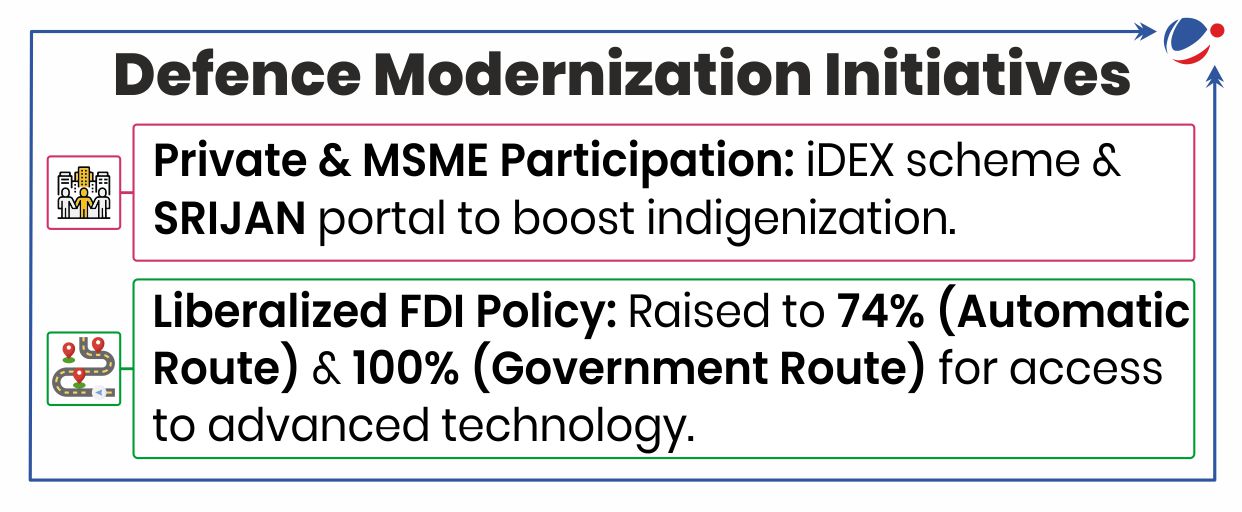
- Integrated Theatre Commands (ITCs): To bolster Jointness & Integration initiatives to facilitate establishment of ITCs.
- ITCs are tri-service commands incorporating units from the Army, Navy, and Air Force, collectively for addressing security challenges within designated geographic areas.
- Emerging technologies and new domains: Focus on Cyber and Space domains, AI/ML, Hypersonics, etc., to be future war-ready.
- Technology transfer and knowledge sharing: To be facilitated through enhanced ease of doing business and PPP.
- Collaboration: Breaking silos, promoting civil-military coordination and developing joint operational capabilities through inter-service cooperation & training.
- Defence exports and R&D: Position India as a credible exporter of defence products, fostering R&D and partnerships.
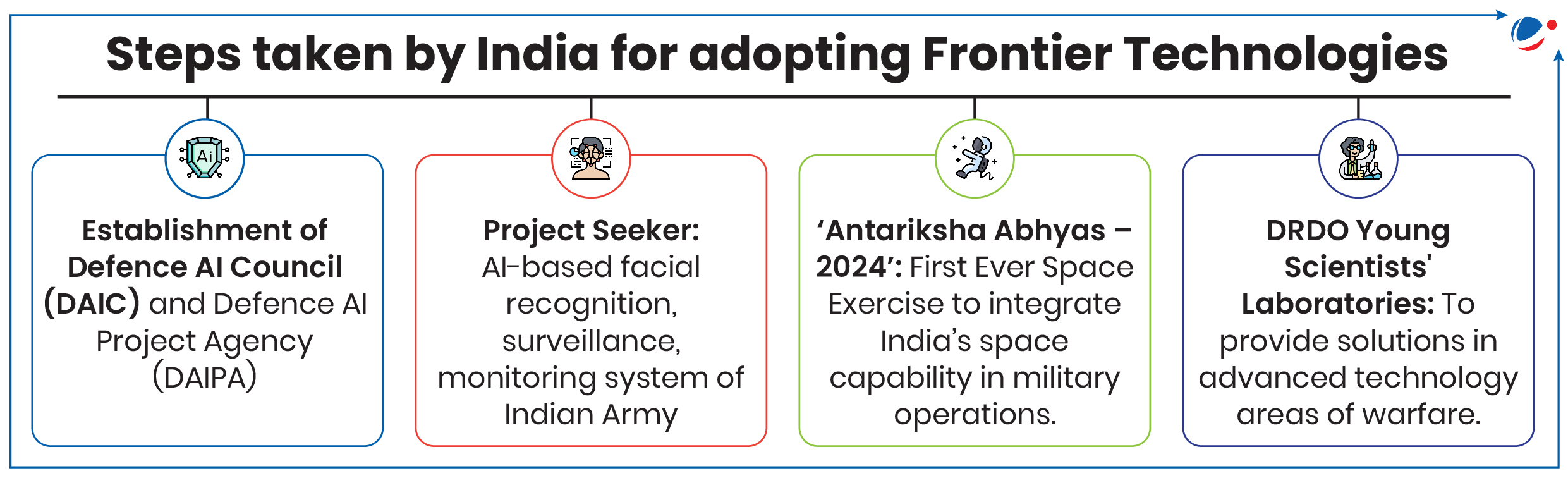
Raksha Mantri said that “Mastering frontier technologies is need of the hour”.
- Frontier technologies such as AI, proxy warfare, space warfare and cyber-attacks are posing a big challenge and reshaping nature of warfare.
Frontier Technologies in Warfare
- AI based warfare: AI based tools are designed to assist complex decisions like target selection, collateral damage assessments, providing recommendation etc. e.g. AI-powered drones
- Electromagnetic warfare: It is a military capability that exploits electromagnetic energy across the battlespace to create offensive and defensive effects.
- Space warfare: Military operations in outer space, utilizing both kinetic (physical) and non-kinetic (electronic, cyber) means to achieve strategic objectives. E.g. Anti-satellite (ASAT) weapons
- Cyber attacks: it is deliberate exploitation of computer systems to steal critical data of a country. E.g. cybersecurity breach at Kudankulam Nuclear Power Plant
Issues with Frontier Technologies
- Challenges to International Security: Increased risk of destabilization due to asymmetry in technological capabilities and Proliferation of advanced technologies to non-state actors.
- Legal gaps: lack of international laws on use of these technologies in warfare further increases vulnerability of human rights violation.
- Dual use dilemma: Technologies designed for peaceful purposes can be repurposed for military applications, blurring lines between civilian and military tech use.
- Other Issues: Risks of algorithmic bias, accountability issues, potential for AI arms races etc.
Recently, the Union Finance Minister asked banks to complete Indian Cybercrime Coordination Centre (I4C) integration to check financial frauds.
- After the integration, any complaint on financial fraud will be routed to the concerned bank for speedy remedial action.
About Indian Cybercrime Coordination Centre
- Ministry: Ministry of Home Affairs
- Objectives:
- Serve as a central hub to combat cybercrime, particularly against women and children, by simplifying complaint filing and trend analysis.
- Provide early warnings and proactive measures for law enforcement while enhancing public awareness
- Support capacity building for police, prosecutors, and judicial officers in cyber-related fields.
Union Ministry of Home Affairs in its annual report of 2023-24 highlighted the new cyber fraud known as the "pig butchering scam" or "investment scam".
About Pig-Butchering scam
- It is a global phenomenon and involves large-scale money laundering and even cyber slavery.
- It is a type of confidence and investment fraud in which the victim is gradually lured into making increasing monetary contributions to a seemingly sound investment before the scammer disappears with the contributed monies.
- Scammers target mostly unemployed youths, housewives, students, etc.
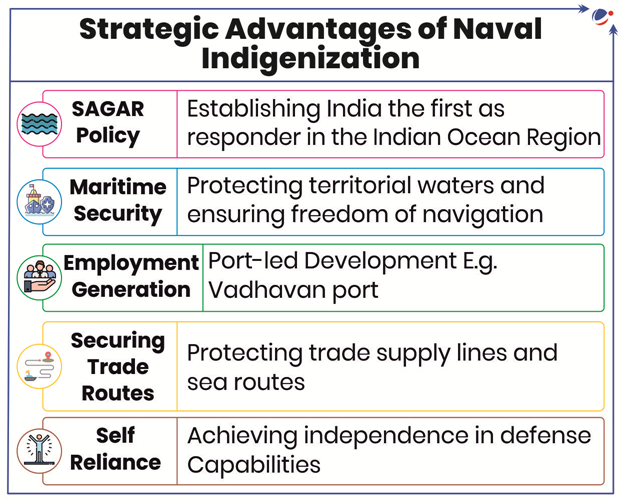
This first tri-commissioning of indigenously developed destroyer, frigate and submarine marks a significant step towards realizing India’s vision of becoming global leader in naval indigenisation and maritime security.
About three frontline naval combatants
- INS Surat: 4th and final ship of the P15B Guided Missile Destroyer Project.
- INS Nilgiri: 1st ship of the P17A Stealth Frigate Project designed by the Indian Navy’s Warship Design Bureau.
- INS Vaghsheer: 6th and final submarine of the P75 Scorpene Project built by Mumbai-based Mazagon Dock Limited.
- It is an indigenously constructed submarine of the Kalvari-class based on French Scorpene-class design.
India's Naval Indigenization efforts
- Policies:
- Indian Navy’s Maritime Capability Perspective Plan (MCPP): Targets a force of 200 ships by 2027 with a vision of transforming it from a buyer’s navy to a builder’s navy.
- Indian Naval Indigenisation Plan (INIP) 2015-2030: Encourages domestic industries including MSMEs to participate in ship construction.
- Navy's expansion of Make in India initiative: Of the 40 naval vessels included in the Navy in the past decade, 39 have been built in Indian shipyards.
- E.g. INS Vikrant (aircraft carrier), INS Arihant and INS Arighat (nuclear submarines).
- R&D initiatives: Underwater Domain Awareness (Samudrayaan project), Scientific partnerships with Indian Ocean Rim countries and development of autonomous systems for high-risk environments like mine detection.
Article Sources
1 sourceDRDO has announced that field evaluation trials of ATGM- Nag-Mk 2 were successfully conducted recently at Pokhran Field Range in Rajasthan.
About ATGM- Nag Mk 2
- Indigenously-developed third-generation ATGM.
- It uses advanced fire-and-forget technology, allowing operators to lock onto targets before launch and strike with pinpoint accuracy, even in complex battlefield environments.
- It is capable of neutralising modern armoured vehicles equipped with explosive reactive armour.
- Guidance: Passive Homing through IIR Seeker.
- An Imaging Infra-Red (IIR) seeker is a system that uses infrared to detect and track targets.
- Operation: Day & Night
Article Sources
1 sourceIndia has successfully tested its first indigenous micro-missile system, Bhargavastra, designed to counter the threat of swarm drones.
- Swarm drones are multiple unmanned aerial vehicles (UAVs) working together as a coordinated system.
Key Features of Bhargavastra
- Detection Capability: Capable of detecting small incoming drones at distances exceeding 6 kilometers.
- Rapid Response: Designed for rapid deployment on mobile platforms.
- Multi-Target Engagement: can simultaneously detect and track & engage up to 64 targets.
- Guided Micro Munitions: Utilizes micro munitions that can be guided towards identified threats.
Tactical ballistic missile Pralay & long-range Pinaka rocket system will be part of Republic Day parade.
About Pralay missile
- Surface-to-surface short-range ballistic missile (SRBM)
- Developed by Defence Research and Development Organisation.
- Missile has a range of 150-500 km and can be launched from a mobile launcher.
- Missile guidance system includes a state-of-the-art navigation system and integrated avionics.
About Pinaka Pinaka multi-barrel rocket launcher (MBRL) system
- It is a long-range artillery system capable of striking targets up to 75 kilometers away.
- Developed by DRDO, it has multiple variants, which offer flexibility in terms of payload, firepower, and range.
India has joined Eurodrone programme as an observer member.
- Eurodrone or European Medium Altitude Long Endurance Remotely Piloted Aircraft System (MALE RPAS) is a twin-turboprop MALE unmanned aerial vehicle (UAV).
- It can be used for long-endurance missions such as intelligence, surveillance, target acquisition, and reconnaissance (ISTAR), maritime surveillance, etc.
About Eurodrone programme
- Members: Four-nation initiative involving Germany, France, Italy, and Spain.
- Led by: the Organisation for Joint Armament Cooperation (OCCAR).
The Defence Minister recently launched SANJAY, an advanced Battlefield Surveillance System (BSS), to enhance the Indian Army’s surveillance and reconnaissance capabilities.
About SANJAY System
- It is jointly developed by the Indian Army & Bharat Electronics Limited (BEL), in line with the ‘Aatmanirbhar Bharat’ initiative.
- It creates a unified surveillance picture of the battlefield via the Army Data Network and Satellite Communication Network by processing the gathered information.
- The system is designed to seamlessly integrate data from both ground and aerial battlefield sensors.
Surya Kiran | Indian Army contingent left for Nepal to take part in the 18th Battalion Level Joint Military Exercise, SURYA KIRAN.
|
La Perouse | Navies of nine Indo-Pacific countries, including India, took part in a multilateral exercise, La Perouse. About La Perouse
|

