


Why in the news?
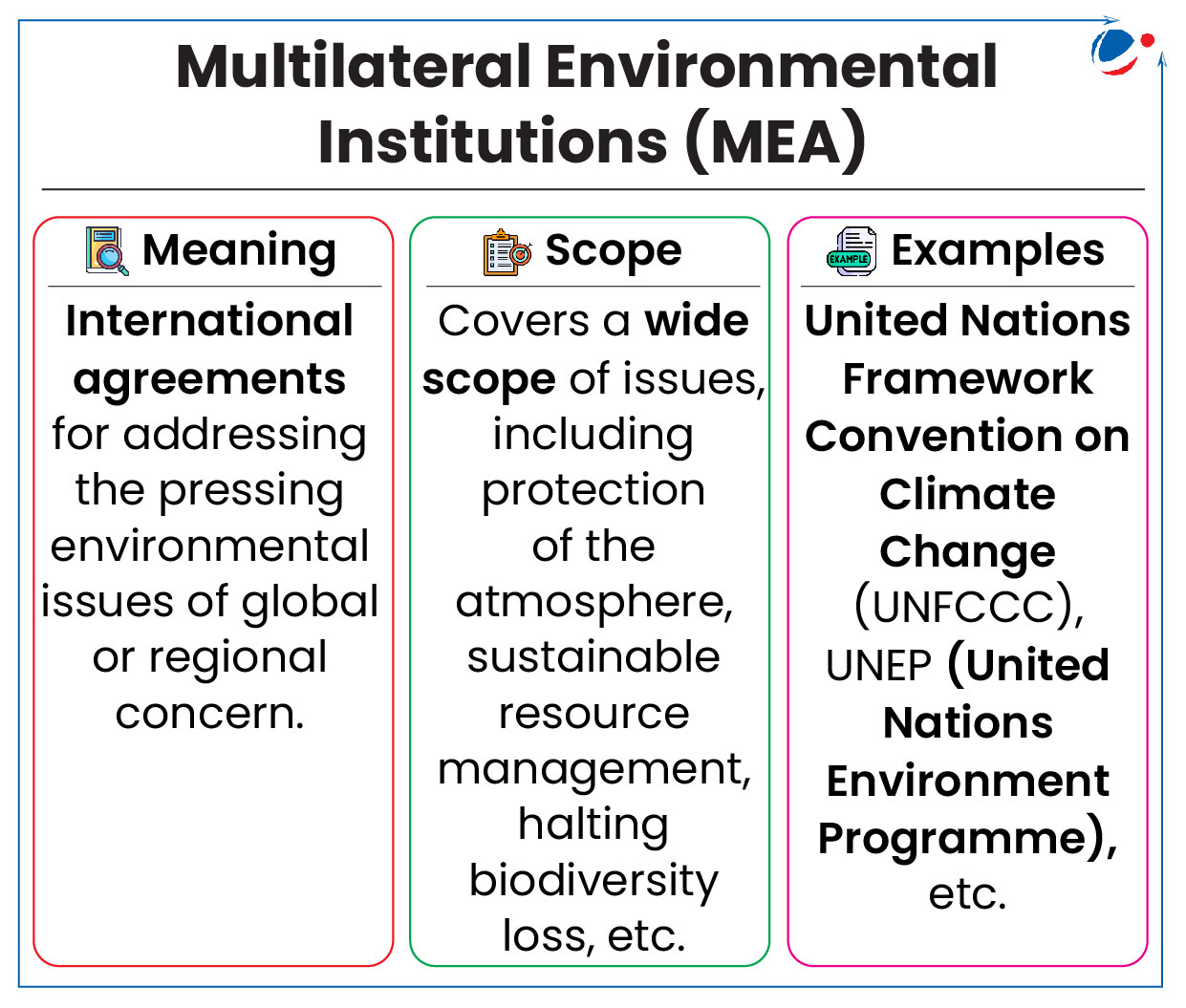
Recent CoP29 of the UNFCCC in Baku, Azerbaijan witnessed a rift on the issue of climate finance between the developed and the developing countries questioning the efficacy of multilateral institution in provisioning of global common good.
Role of Institutions in advancing climate negotiations
- Legitimacy and Credibility: Institutions provide legitimacy to climate negotiations through structured frameworks, membership inclusivity, confidence-building measures, and binding obligations.
- Building Trust: Well-designed institutional frameworks foster trust among nations through transparency, structured interactions, and ideological balance.
- Addressing Climate Corruption: Institutions can help curb environmental crimes such as illegal logging, unregulated coal burning, and deforestation, which contribute significantly to greenhouse gas emissions.
- Supporting implementation in Global South: Institutions through its sets of rules, formal or informal procedures play a crucial role in implementing, sustaining, and enhancing climate change mitigation in the Global South.
- Flexibility to ensure compliance: It is done by avoiding overly stringent standards, offering discretion in implementation; promoting domestic interests, etc.
- Promoting Climate Justice: Institutions provide a platform to the vulnerable and small island developing states to forward their grievances.
Challenges in Multilateral Climate Negotiations
- Limitations of UNFCCC: Under the Paris Agreement and its rulebook, all countries are now on their own to mitigate, adapt and pay for the costs of climate impacts reducing UNFCCC to merely a platform to collect, synthesize and disseminate information.
- Unresolved Issue of Climate Justice: The UNFCCC has lacked in its ability to provide dependable assurances to developing countries on climate finance from developed countries.
- Non-Recognition to the Problem of Climate Change: Major countries like USA responsible for large emissions do not recognise the problems of climate change as evident from the recent withdrawal of USA from Paris Agreement.
- Rising Emissions: Despite Kyoto Protocol, major agreements like Cancun and Paris, UNFCCC has little results with the increased levels of emissions.
Way forward on promoting effective institutional frameworks for Climate Negotiations
- Role of Minilateralism: A polycentric and multi-level governance system, involving smaller, interest-based coalitions, can be more effective than large multilateral negotiations.
- Examples: Climate Vulnerable Forum (CVF) and the G20 Climate and Energy Framework.
- Inclusive Multilateralism: Climate institutions should involve diverse stakeholders, including youth, women, Indigenous communities, and civil society, ensuring a bottom-up approach to climate action.
- Promoting Epistemic Institution: Organizations like the Intergovernmental Panel on Climate Change (IPCC) play a crucial role in integrating scientific research into policy frameworks for better decision-making.
- Promoting Value-Based Cooperation: Institutions must uphold core values like equity, transparency, inclusivity, and non-discrimination to ensure fair and effective climate policies.
- Strengthening Climate Finance Mechanisms: A clear and enforceable framework for climate finance, including loss and damage compensation, is necessary to build trust and ensure accountability.

