Why in the news?
The cancellation of NEET (UG) 2026 by the National Testing Agency (NTA) amid alleged paper leaks reflects larger concern of failure of Exam Ecosystem in India.
About Examination System in India
- School Examinations: Conducted by boards such as Central Board of Secondary Education (CBSE), Council for the Indian School Certificate Examinations (CISCE), and State Boards.
- Higher Education Entrance Examinations: Managed by NTA. Major exams include NEET-UG; JEE Main; Common University Entrance Test (CUET).
- Recruitment Examinations: Conducted by agencies such as UPSC, SSC, Railway Recruitment Boards (RRB), State Public Service Commissions.
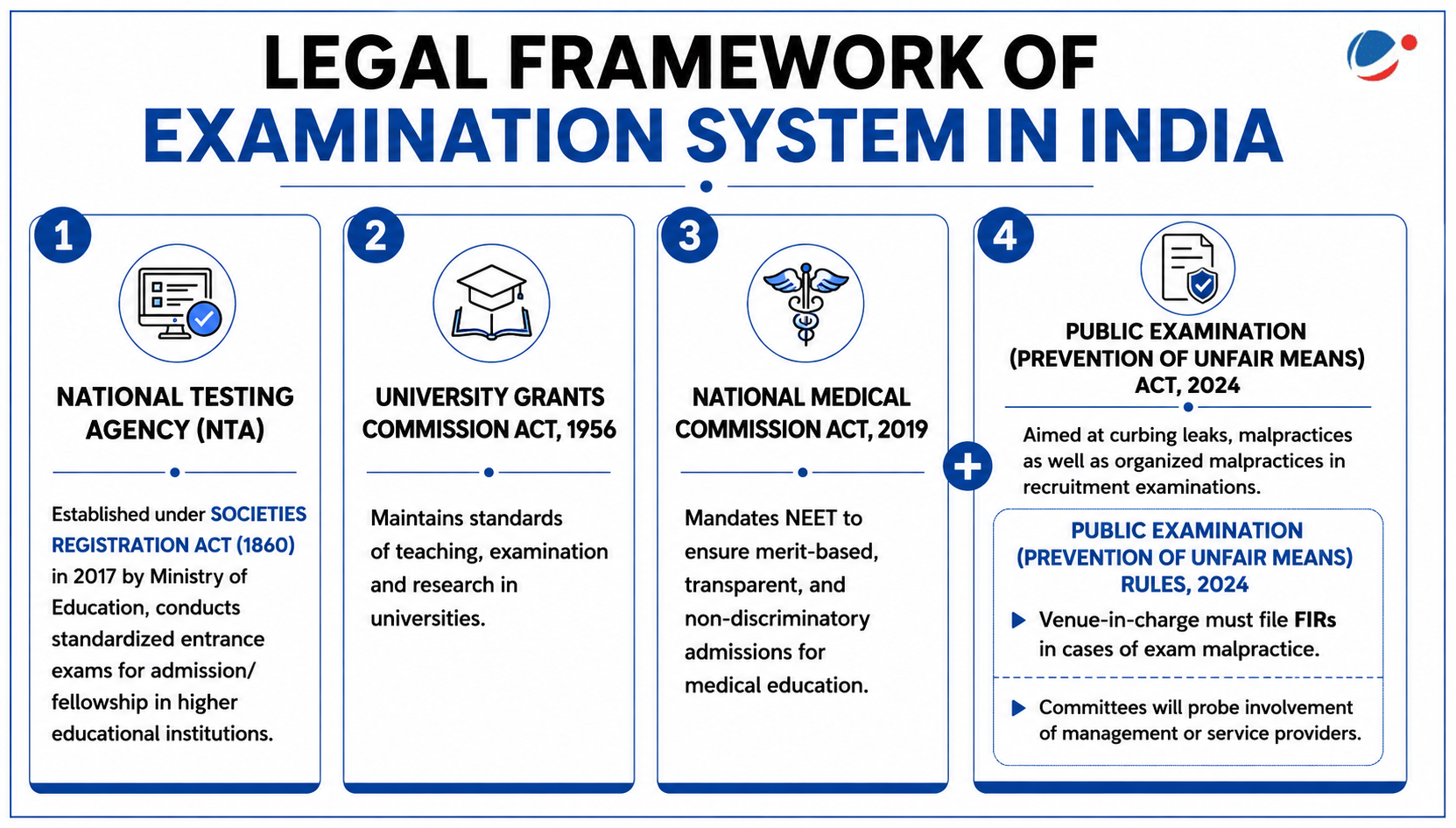
Reasons for failure of India's Examination Ecosystem
- Societal Pressure: Expectations to secure prestigious jobs and admissions, coupled with fear of failure and the huge supply-demand gap in educational institutions/government jobs.
- Limited oversight: Weak oversight, administrative loopholes, existence of paper leak syndicates, instances of collusion among officials or service providers creates an ecosystem facilitating paper leakages. E.g. SSC CGL 2017 Exam leak.
- Further, One Nation, One Exam" approach ignores regional and educational diversity creating excessive pressure on a single test.
- Policy instability: Frequent changes in exam patterns or eligibility criteria which creates confusion and stress for students. E.g., Introduction and subsequent removal of upper age limits for NEET.
- Inadequate Deterrence: Delayed investigations, low conviction rates, and inconsistent penalties reduce the perceived risks associated with examination malpractice.
- Technological Misuse: Advances in digital technology facilitate rapid transmission/ sale of leaked question papers through encrypted messaging platforms.
- Decline in Ethical Values: Insufficient emphasis on ethical education and integrity, combined with peer influence can normalize cheating, and use of unfair means like leaked papers to succeed.
Impact of failure of Examination System of India
- Erosion of Meritocracy: Cheating and paper leaks undermine fundamental principle of merit-based selection by providing an unfair advantage to certain candidates, compromising the credibility of examinations.
- Loss of Public Trust: Repeated instances of examination malpractice weaken public confidence in recruitment agencies, educational institutions, and government bodies, eroding faith in institutions to ensure fairness and transparency.
- E.g. Vyapam scam (Madhya Pradesh) undermines trust in examinations.
- Impact on Governance: Cancellation of exams often lead to prolonged litigation, investigations, and re-examinations, delaying filling of vacancies, adversely impacting administrative efficiency.
- Psychological Impact on Aspirants: Cancellation/re-conduction of examinations due to leaks can cause financial stress, create career uncertainty for genuine aspirants.
- Administrative and Fiscal Burden: Conducting fresh examinations, strengthening security arrangements, and undertaking investigations require substantial public resources, imposing additional financial and administrative costs on the state.
- Threat to Constitutional and Ethical Values: Examination malpractice violates the principles of equality, fairness, and equal opportunity enshrined under Articles 14 and 16 of the Constitution.
Way ahead
- Recommendations of K. Radhakrishnan Committee, 2024
- NTA Restructuring: To conduct higher education entrance exams only.
- Establish 10 specialized verticals covering technology, operations, products, test security, and surveillance.
- Create an empowered governing body with sub-committees for test audit, ethics and transparency, and stakeholder relations.
- Director-General (head of agency) should be dedicated leadership position, free from external influence, to ensure smooth and continuous operation.
- Adopt Hybrid process: For computer-assisted secure testing, combining both computer-based testing (CBT) and paper-and-pencil testing (PPT) methods to reduce potential security risks during PPT printing, storage, and transportation phases.
- Testing Centres: Establish at least 1,000 secure testing centres, prioritising reputable government institutions.
- Collaborate with Kendriya Vidyalyas, Navodaya Vidyalayas to create nationwide network of 400–500 centres which accommodate 2–2.5 lakh candidates in a single CBT session.
- Multi-session (when participant numbers exceed 2 lakh) and multi-stage testing:Clearly define, document, and communicate normalization and scoring mechanisms to ensure fairness despite variations in question paper difficulty.
- Mobile testing Centres: To help overcome barriers to accessing remote and hard-to-reach locations, including Northeast, North Himalayan states, and Andaman and Nicobar Islands.
- Establish ties with state/district authorities: Use District Magistrates- led committees and state government coordination to conduct high-stakes examinations, and prevent malpractice.
- Introduce DigiExam on lines of DigiYatra using Aadhaar based biometrics authentication and AI-based data analytics to prevent impersonation.
- NTA Restructuring: To conduct higher education entrance exams only.