


Why in the news?
The Office of the Registrar General of India (ORGI) has released the Sample Registration System (SRS) Statistical Report 2024.
Key Findings of the Report
- Fertility Trends:
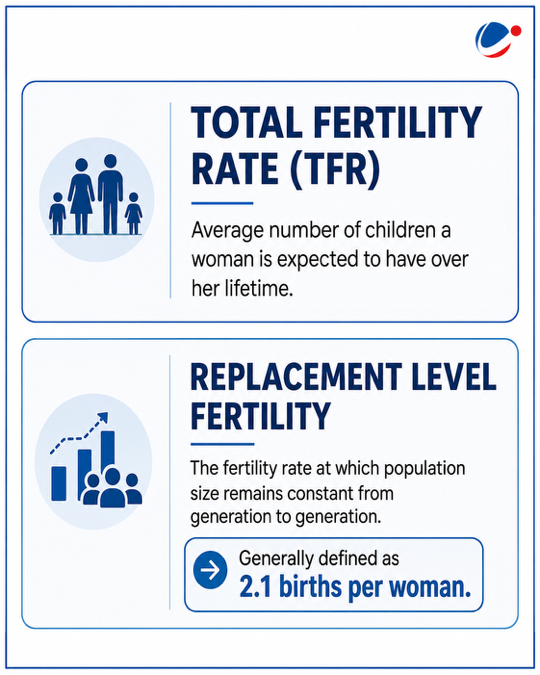
- Sub-Replacement Fertility: Total Fertility Rate (TFR) remained at 1.9, staying below the replacement level (2.1) for the fifth consecutive year.
- Declining Birth Rate: Crude Birth Rate (CBR) declined to 18.3(2024).
- CBR: (Number of live births during the year/ Mid-year population) X 1000.
- Education-Fertility Link: Fertility levels decline significantly with higher educational attainment among women.
- Mortality Trends:
- Crude Death Rate (CDR): CDR 6.4 in 2024; overall death rate remains higher than pre-pandemic levels.
- Infant Mortality: Infant Mortality Rate (IMR) declined to 24. Kerala recorded the lowest IMR (8).
- IMR: Number of infant deaths from birth to 1 year old per 1,000 live births.
- Under-Five Mortality: Under-Five Mortality Rate (U5MR) stood at 28, reflecting enhanced child survival.
- Neonatal Mortality Burden: Neonatal deaths accounted for nearly 73% of all infant deaths.
- Neonatal Mortality Rate (NMR): Number of neonatal deaths that from birth to 29 days per 1,000 live births.
- Demographic Transition:
- Demographic Dividend: Working-age population (15–59 years) increased to 66.4% of the total population.
- Population Ageing: The population aged 60 years and above reached 9.7%, signalling an emerging ageing challenge.
- Marriage Trends: Mean age at effective marriage for females increased to 23.1 years, while only 2.1% of females married before the legal age of 18 years.
- Gender Indicators:
- Sex Ratio at Birth (SRB): Improved marginally to 918 females per 1,000 males, though gender imbalance persists.
- Sex Ratio at Birth: Number of females per 1000 males at birth.
- Sex Ratio at Birth (SRB): Improved marginally to 918 females per 1,000 males, though gender imbalance persists.
- Health Indicators:
- Institutional Deliveries: 95.4% of deliveries received medical attention.
- External Causes of Death:
- Deaths due to road accidents rose to 3.2%, while suicides accounted for 2.8% of total deaths.
About the Sample Registration System (SRS)
|
Implications
- Advanced Demographic Transition: Sustained below-replacement fertility indicates India is moving towards a mature demographic stage with slower population growth.
- Demographic Dividend Opportunity: Rising share of working-age population (66.4%) provides potential for higher economic growth, productivity, and savings.
- Improved Child Health Outcomes: Declining IMR and U5MR reflect progress in maternal and child healthcare services.
- Better Healthcare Access: High institutional delivery rates indicate improved access to healthcare and safer childbirth practices.
- Social Development Gains: Rising age at marriage and lower incidence of child marriage reflect improvements in female education and empowerment.
Concerns
- Persistent Below-Replacement Fertility: TFR remaining below replacement level may lead to long-term demographic imbalances and a shrinking workforce, e.g., demographic winter witnessed in Japan and Italy.
- Persistent Regional Disparities: Significant rural-urban and inter-state variations in health and demographic indicators highlight uneven progress in India's demographic transition.
- Population Ageing: Rising elderly population (60+) signals increasing demand for geriatric healthcare, pensions, and social security.
- Gender Imbalance at Birth: Persistent skew in sex ratio at birth reflects continuing socio-cultural preference for male children and gender discrimination.
- High Neonatal Mortality Burden: A significant share of infant deaths occurring during the neonatal period highlights gaps in maternal and newborn healthcare services.
- Rising Road Accident and Suicide Deaths: A growing share of deaths due to accidents and suicides highlights road safety and mental health challenges.
Conclusion
India's demographic landscape is witnessing a structural shift, making investments in health, skills, productivity, and social protection critical for sustaining long-term growth. As fertility declines and longevity rises, the focus must shift towards enhancing human capital and ensuring inclusive, resilient development across all age groups.


