


Why in the News?
India is sharing its Digital Public Infrastructure model globally, enabling countries to adopt scalable, inclusive, and interoperable digital governance systems.
More in the News
- As of February 2026, Government of India has signed Memoranda of Understanding (MoU) and agreements with 24 countries for cooperation on India Stack and Digital Public Infrastructure.
- Areas of cooperation include digital identity, digital payments, data exchange frameworks and service delivery systems.
Digital Public Goods (DPGs)
|
- UPI is now live in 8 countries including the United Arab Emirates, Singapore, Bhutan, Nepal, Sri Lanka, France, Mauritius and Qatar.
- During its G20 Presidency in 2023, India placed DPI at the centre of the development agenda.
- More than 25 nations are adopting or exploring the Modular Open-Source Identity Platform (MOSIP) for their national identity programmes.
What is Digital Public Infrastructure?
- Definition: Digital Public Infrastructure (DPI) refers to a set of secure and interoperable digital systems designed to be open, inclusive and accessible to support the delivery of public and private services to individuals and organizations.
- Features: It functions as an intermediate layer in the digital ecosystem between the physical infrastructure (internet connectivity, devices, servers, data centres, cloud systems and routers) and the sectoral applications (information systems, e-commerce, social protection, remote education and telehealth).
- India's DPI emerged through a phased and deliberate process through concept of JAM (Jan Dhan, Aadhar, Mobile) Trinity, linking identity, finance and connectivity at unprecedented scale.
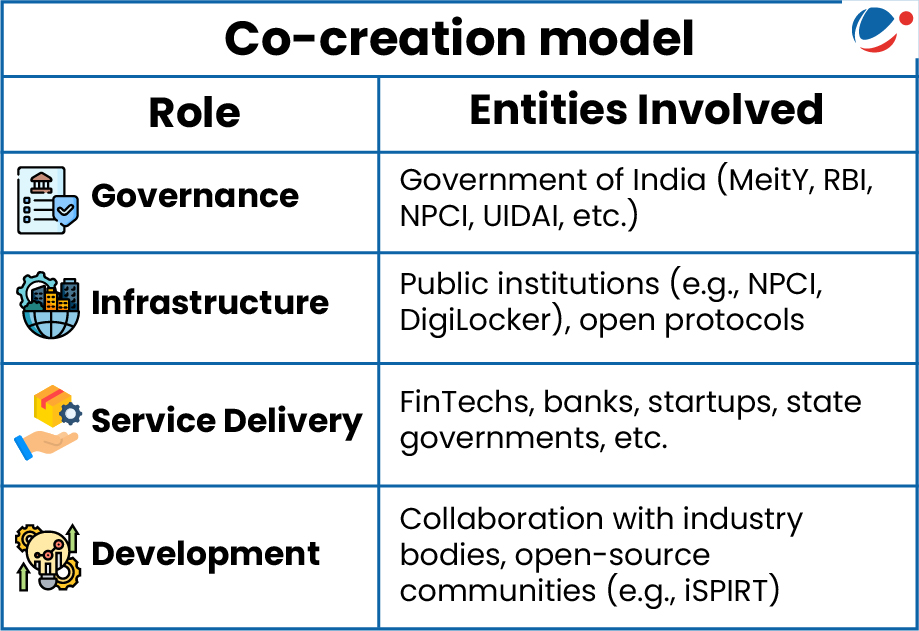
- India's DPI follows a co-creation model. The co-creation model has provided a fertile ground for private sector participation.
Significance of Digital Public Infrastructure
- Shift to Digital Infrastructure: Infrastructure has evolved beyond physical assets like roads and ports to include digital systems forming the backbone of modern societies.
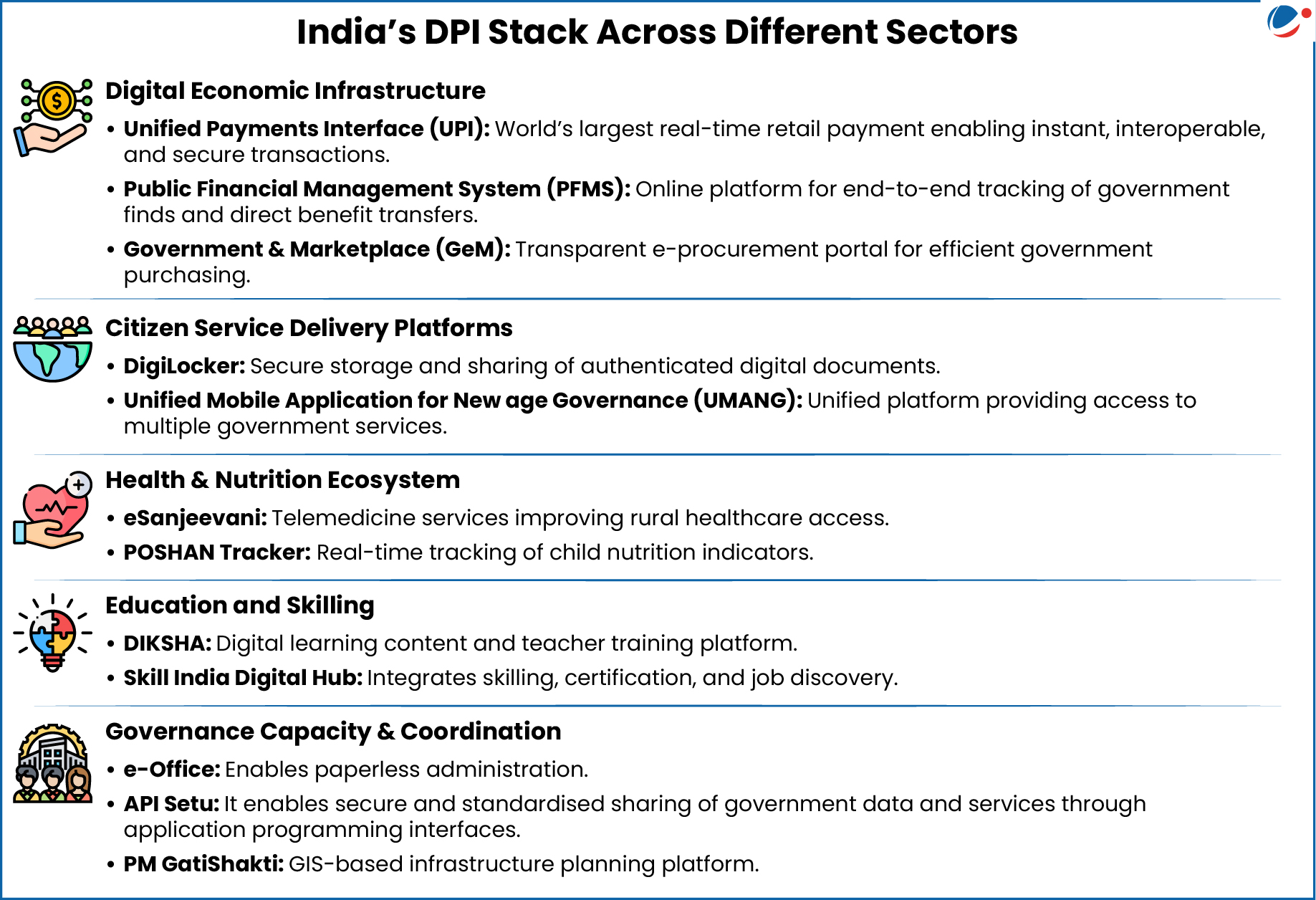
- Seamless Interactions: DPI enables secure and seamless interaction among individuals, businesses and governments.
- MyGov App, streamline access to government services, thus cutting down administrative overheads.
- Transparency and Accountability: DPI enhances transparency by providing real-time access to information, eliminating bureaucratic red tape, and reducing human discretion in decision-making.
- E.g. Public Financial Management System (PFMS) allows real-time tracking of government funds.
- Financial Inclusion and Access: DPI enhances financial inclusion by providing access to banking and financial services in remote areas
- Expanding Access and Rights: DPI now determines access to markets and rights in the digital economy. Eg. Open Network for Digital Commerce (ONDC)
- Strengthening State Capacity: It improves governance through efficient subsidy delivery, secure banking systems etc. Eg. Aadhar Enabled Payment System (AePS)
- Enhancing Economic Opportunities: Eg. Government e-Marketplace (GeM)
Challenges associated with DPI
- Data breaches and ransomware: The massive scale of India's DPI makes it a prime target for cyberattacks, and the integration of Aadhaar across multiple government services has created cascading privacy risks through dangerous "linkage attacks".
- Data Governance Trade-offs: There is an inherent tension between protecting individual privacy and fostering continuous innovation.
- The 2023 Digital Personal Data Protection (DPDP) Act mandates strict standards for privacy, explicit consent, and data localisation, creating a key challenge in balancing regulatory compliance with the seamless accessibility of DPIs.
- AI-powered threats: Malicious actors and state-sponsored groups can use artificial intelligence to launch adaptive, targeted attacks on critical infrastructure, creating the potential for cascading failures across systems.
- The digital divide: Despite widespread adoption, DPI success is hindered by an ongoing digital divide especially in rural areas.
- Technical reliability: Platforms like UPI still face persistent infrastructural gaps, including poor rural penetration, bank server outages and network failures.
- Algorithmic bias: DPIs excessive reliance on AI could result in algorithmic bias which can perpetuate inequalities across India's highly diverse population, varying economic strata and differing digital literacy levels.
Way Forward
- Preserving Digital Sovereignty: As India's DPI models are adopted by other countries through initiatives like MOSIP, it should be emphasized that the DPI ensures data sovereignty within those countries' boundaries and are not locked-in to Indian systems and data registries.
- Integrating Samaj, Sarkar, and Bazaar: DPI must be designed to serve all three, balancing their interests and fostering collaboration.
- Focus on outcomes over technology: The design of DPI should be driven by real-world use cases and thorough needs assessments to ensure the technology actually solves specific problems for people and firms.
- Bridge the digital divide: Sustainable DPI growth requires urgent expansion of underlying telecommunications connectivity and affordable device access
- Global Cooperation: Strengthen international cooperation to establish inclusive global standards, curb regulatory arbitrage by Big Tech, and facilitate secure cross-border data and payment flows.




