


Why in the News?
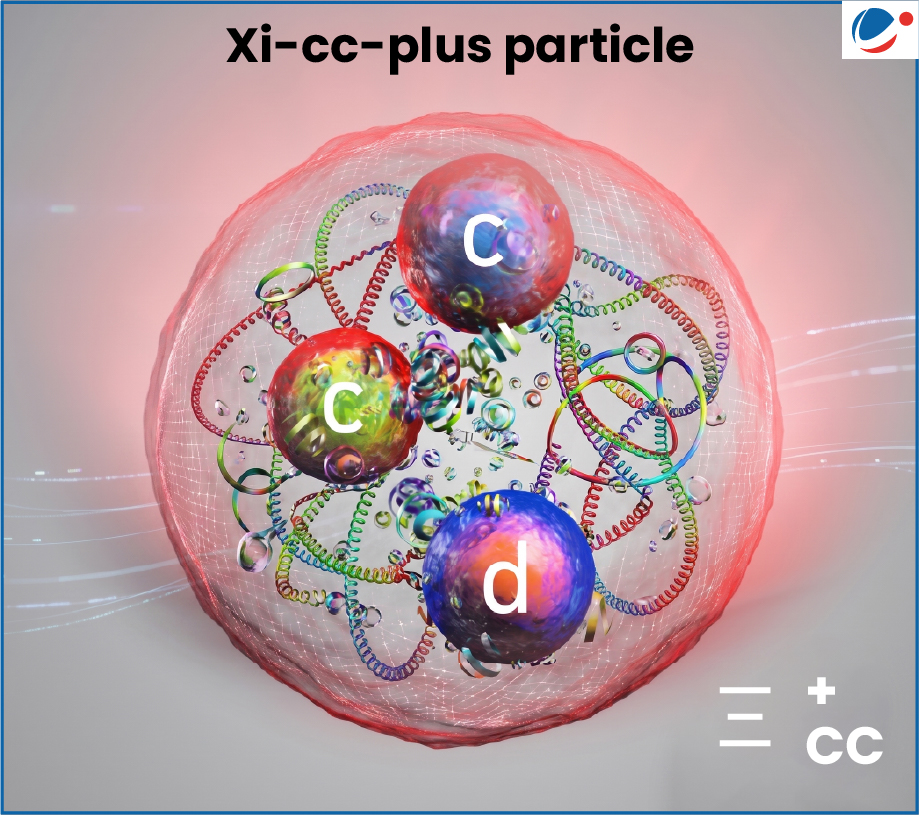
The Large Hadron Collider (LHC) at CERN has discovered a new particle named Xi-cc-plus, marking its 80th particle discovery.
About the New Particle Xi-cc-plus
- Structure: It is made up of two charm quarks and one down quark similar to proton (made up of two up quarks and one down quark).
- Mass: The replacement of up quarks with charm quarks makes its mass four times heavier than proton.
- Significance of the Discovery: It will help physicists better understand how the strong force binds protons, neutrons and other composite particles together.
- In 2017, LHC reported the discovery of a very similar particle (like Xi-cc-plus), which consists of two charm quarks and one up quark.
Strong Force
- Type of Force: It is one of the four fundamental forces of nature- strong, weak, electromagnetic and gravitational force.
- Nature: It is attractive force which binds quarks together to form protons and neutrons, thereby holding subatomic particles together.
- Strength: It is about 100 times stronger than electromagnetism and has influence over very, very small distances (about 100,000 times smaller than the diameter of an atom).
Quarks
|
Large Hadron Collider
- It is the world's largest and most powerful particle accelerator which operates in a tunnel 100 metres underground at CERN (European Organization for Nuclear Research).
- Structure: It consists of a 27-kilometre ring of superconducting magnets with a number of accelerating structures to boost the energy of the particles along the way.
- Function: Inside the accelerator, two high-energy particle beams of protons or ions travel at close to the speed of light before they are made to collide.
- Significance: These collisions produce particles and fields necessary for fundamental understanding of nature such as mass, unification of forces, dark energy and dark matter etc.
- Other Discoveries by LHC: Higgs Boson (2012); Exotic hadrons (Particles composed of four or five quarks); Rare B- meson decay; Toponium (Made of top quark and its anti-quark)- most massive composite particle ever observed.
CERN
|
Conclusion
The discovery of Xi-cc-plus at CERN highlights the continuing success of the Large Hadron Collider in advancing fundamental physics. It deepens our understanding of quark interactions and the strong force, thereby contributing to a more comprehensive picture of the building blocks of matter and the fundamental laws governing the universe.
