
Regional Connectivity Scheme (RCS) – Modified UDAN | Current Affairs | Vision IAS

Upgrade to Premium Today

Start Now
MENU
Home
Quick Links

High-quality MCQs and Mains Answer Writing to sharpen skills and reinforce learning every day.

Watch explainer and thematic concept-building videos under initiatives like Deep Dive, Master Classes, etc., on important UPSC topics.

A short, intensive, and exam-focused programme, insights from the Economic Survey, Union Budget, and UPSC current affairs.

ESC

Regional Connectivity Scheme (RCS) – Modified UDAN

30 Apr 2026
5 min

In Summary

  • Union Cabinet approved RCS-Modified UDAN for 10 years (FY27-36) with ₹28,840 crore outlay for aerodrome development and O&M support.
  • Scheme focuses on ecosystem approach, challenge mode implementation, and integrating Atmanirbhar Bharat by promoting domestic aerospace.
  • Parliamentary Committee highlighted aviation safety concerns, route sustainability issues, DGCA manpower shortages, and lack of passenger rights framework.

In Summary

Why in the News?

The Union Cabinet recently approved the Regional Connectivity Scheme (RCS) – Modified UDAN for a 10-year period from FY 2026-27 to FY 2035-36.

Components of the RCS-Modified UDAN

Total outlay of ₹28,840 crore, backed entirely by government budgetary support.

  • Development of Aerodromes (CAPEX): Development of 100 airports from existing unserved airstrips over the next eight years.
  • Operation & Maintenance (O&M) Support: Provision of O&M support for three years to ~ 441 aerodromes, capped at ₹3.06 crore per annum per airport and ₹0.90 crore per annum per heliport/water aerodrome.
  • Development of Modern Helipads: Construction of 200 modern helipads in hilly, remote, island, and aspirational regions at ₹15 crore each.
  • Viability Gap Funding (VGF): Recognising the need for longer market development, VGF support to airline operators is proposed over 10 years.
    • Under the Scheme, airline operators receive financial support in the form of VGF for operating awarded routes.
  • Atmanirbhar Bharat and Indigenous Aviation Capacity: Procurement of two HAL Dhruv helicopters for Pawan Hans and two HAL Dornier aircraft for Alliance Air to address aircraft shortages in difficult terrains and promote Atmanirbhar Bharat vision.

Key features of the scheme

  • Comprehensive Intervention: Designed as an upgrade to the original scheme to address persistent infrastructure and operational bottlenecks in regional aviation.
  • Ecosystem Approach: Moves beyond just opening new routes by focusing on stronger airport infrastructure, reliable operational support, and viable ecosystems for airlines.
  • Challenge Mode Implementation: UDAN airports will be developed under a 'Challenge Mode' to ensure timely completion, quality, and sustainability.
  • Indigenous Push: Integrates the Atmanirbhar Bharat vision by promoting the domestic aerospace sector to meet regional flying requirements. 
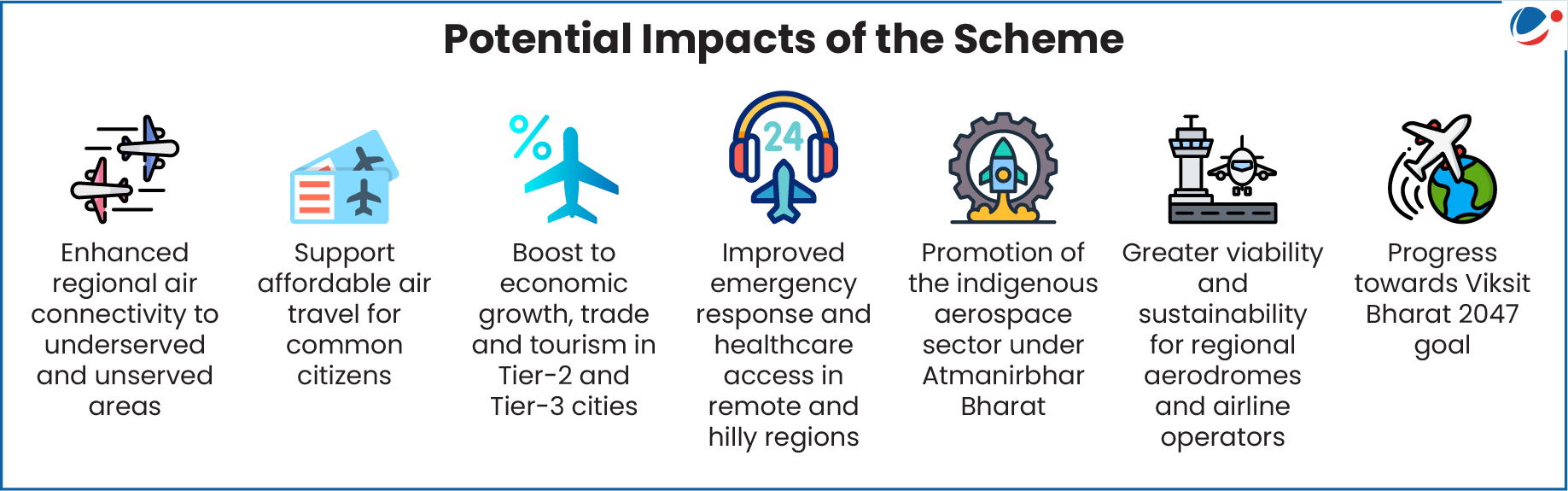
Infographic titled

Issues and Challenges associated with the UDAN

  • Aviation Safety Concerns: A Parliamentary Standing Committee highlighted systemic safety issues, including:
    • 100 safety lapses flagged in a single airline audit and 19 safety violation notices,
    • Recurring technical defects in 377 out of 754 audited aircraft.
      • The recent Ahmedabad crash resulted in 260 fatalities.
  • Route Sustainability: The Ministry has acknowledged the absence of a structured exit strategy for routes that complete their VGF subsidy period.
  • Operational Discontinuations: Out of 925 awarded routes, 327 were discontinued due to factors like the COVID-19 pandemic, aircraft shortages, supply chain disruptions, maintenance issues, and low passenger demand.
    • Over 150 awarded routes remain uncommenced.
  • Manpower Shortages: The Directorate General of Civil Aviation (DGCA) faces a severe staff crunch with a vacancy rate of 48.3%, operating with only 843 incumbents against 1,630 sanctioned posts.
  • Passenger Rights: Despite carrying over 350 million passengers annually, India lacks a comprehensive statutory passenger rights framework to govern compensation and delay management.

Way Forward

Recommendations of the Parliamentary Standing Committee

  • Independent Safety Review: Constitute an independent High-Level Committee on Aviation Safety to conduct a comprehensive safety review and perform a root-cause analysis of systemic failures.
  • Formal Impact Assessment: Conduct a formal, independent impact assessment of the UDAN scheme covering cost per passenger, route-wise viability, and the proportion of routes achieving self-sustainability.
  • DGCA Capacity Building: Prepare and execute a comprehensive, time-bound recruitment and deputation schedule to resolve DGCA manpower vacancies.
  • Passenger Rights Charter: Develop a formal Passenger Rights Charter under the Bharatiya Vayuyan Adhiniyam 2024 to address compensation, delay management, and accountability standards.
  • Enhanced Transparency: Improve parliamentary visibility of the Airports Authority of India's (AAI) capital investment programmes.

About UDAN (Ude Desh ka Aam Nagrik) Scheme

  • Launch: Conceptualised under the National Civil Aviation Policy (NCAP) 2016 and officially launched on October 21, 2016. 
  • Type: Central Sector Scheme.
  • Ministry: Ministry of Civil Aviation
  • Implementing Agency: The Airports Authority of India (AAI).
  • Objective: Democratize aviation by making flying accessible and affordable for the common citizen through a market-driven, financially supported model.
  • Key Mechanisms: Provides Viability Gap Funding (VGF) to airlines, mandates an airfare cap, and utilizes a collaborative governance model among the Centre, States, and airport operators.
  • Stakeholder Incentives: Includes waived landing and parking charges by airport operators, a 2% cap on ATF excise duty by the Central Government, and VAT reduction to 1% or less on ATF by State Governments.
  • Achievements (as of March 2026): 
    • Phased Expansion (UDAN 1.0 to 5.0 Series): Progressively expanded to cover unserved/underserved airports, helipads (UDAN 2.0), Tourism Routes and Seaplanes (UDAN 3.0), and hilly/island territories (UDAN 4.0), and Diversified last-mile connectivity (UDAN 5.0 to 5.5).
    • Operationalised 663 routes across 95 airports, heliports, and water aerodromes.
    • Disbursed ₹4,593.28 crore as Viability Gap Funding to selected airlines since its inception.
    • Facilitated the expansion of India's overall airport network from 74 in 2014 to 159 in 2024
  • Sector-Specific UDAN Initiatives
    • Krishi UDAN: To assist farmers by facilitating the seamless air transport of perishable agricultural produce
    • International UDAN (IACS): The International Air Connectivity Scheme aims to directly link Indian state capitals and Tier-2 cities with key international destinations to boost local trade, tourism, and economic growth.
    • UDAN Yatri Cafes: Launched to make air travel more inclusive by offering quality food at highly accessible prices (e.g., tea for ₹10, samosas for ₹20). It is now operational at 17 airports in India.
    • Seaplane Operations: UDAN Round 5.5 was specifically launched to invite bids for over 50 identified water bodies 
    • Lifeline UDAN: Initiated during the COVID-19 lockdown, this initiative operated hundreds of flights to transport critical medical cargo, vaccines, and essential supplies to remote regions and island territories.

Explore Related Content

Discover more articles, videos, and terms related to this topic

RELATED VIDEOS

3
Circularity in Textile Structure

Circularity in Textile Structure

YouTube HD
The Contribution of Indian Cinema to the Creative Economy

The Contribution of Indian Cinema to the Creative Economy

YouTube HD
Impact Investments

Impact Investments

YouTube HD

RELATED TERMS

3

Lifeline UDAN

An initiative launched during the COVID-19 pandemic to transport critical medical supplies, vaccines, and essential goods to remote and island regions, ensuring the continuity of essential services.

International Air Connectivity Scheme (IACS)

An initiative under UDAN aimed at connecting Indian state capitals and Tier-2 cities with international destinations, intended to boost trade, tourism, and economic engagement.

Krishi UDAN

A scheme specifically designed to assist farmers by facilitating the air transport of perishable agricultural produce, aiming to reduce wastage and improve market access for their products.

Title is required. Maximum 500 characters.

Search Notes

Filter Notes

Loading your notes...
Searching your notes...
Loading more notes...
You've reached the end of your notes

No notes yet

Create your first note to get started.

No notes found

Try adjusting your search criteria or clear the search.

Saving...
Saved

Please select a subject.

Referenced Articles

linked

No references added yet
