


Why in News
Data centre capacity in India has increased from about 375 MW in 2020 to around 1500 MW by 2025.
About Data Centres
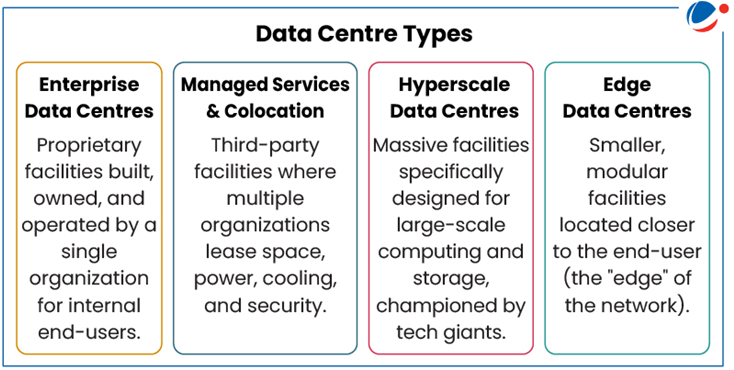
- A Data Centre is a dedicated secure space within a centralized location where computing and networking equipment is concentrated for the purpose of collecting, storing, processing, distributing or allowing access to large amounts of data.

- India's Status:
- Data centre capacity: Projected to grow four to five times by 2030.
- Data centre market value: Expected to increase from US$ 4.5 billion in 2023 to a projected US$ 11.6 billion by 2032.
- Investment: Between 2019 and 2025, the commitment investment reached approximately USD ~95 billion from both global and domestic investors.
Factors facilitating Growth of Data Centres in India
- Initiatives announced in Budget 2026–27:
- Tax incentives: Tax holiday till 2047 for eligible foreign companies providing cloud services to customers globally using data centre services from India.
- Safe harbour: A safe harbour of 15% on cost where the Indian data centre is a related entity of the foreign company (operating as a cost-plus centre).
- Enhancing core electronics manufacturing capabilities: A provision of ₹1,000 crore for India Semiconductor Mission (ISM) 2.0; outlay for the Electronics Components Manufacturing Scheme (ECMS) increased to ₹40,000 crore.
- Infrastructure Status for Data Centres (2022): Centres with an IT load above 5 MW can get easier access to institutional credit at lower rates and attract foreign investments.
- Data Localisation and Sovereignty:
- Reserve Bank of India's (RBI) directive to store payment systems data locally, requires data to remain within Indian borders for national security and privacy reasons.
- Digital Personal Data Protection (DPDP) Act, 2023 strengthens the governance framework for data security and responsible data use.
- AI Data Centre Focus: Under the IndiaAI Mission, the government is fostering AI-optimized facilities, offering subsidized compute access, and supporting the development of sovereign AI models.
- Draft Data Centre Policy (2020):Recommended setting up Data Centre Economic Zones (DCEZs) and a single-window clearance mechanism.
- E-Governance: The national cloud infrastructure GI Cloud (MeghRaj) has been established to provides secure, scalable, and elastic cloud facilities for delivery of e-Governance services through the National Informatics Centre (NIC).
- Foundational digital initiatives like Aadhaar (supporting over 1.36 billion users), Unified Payments Interface (UPI), and the Open Network for Digital Commerce (ONDC) rely heavily on robust data centres.
- Other enabling factors:
- Global data boom in Artificial Intelligence (AI) driven digital economy;
- Rapidly growing SaaS (Software as a Service) market (expected to reach $35 billion by 2025);
- Rapid digitalisation across sectors under the Digital India initiative;
- Widespread enterprise cloud adoption by India's booming start-up ecosystem;
- Reliable power solutions through expansion of renewable energy capacity, Sustainable Harnessing and Advancement of Nuclear Energy for Transforming India (SHANTI) Act etc.
Challenges in Expanding Data Centre Capacity in India
- Water requirements: Cooling a 100 MW hyperscale facility can consume up to 2 million litres of water per day, which can lead to severe water crisis in already water stressed cities like Chennai and Bengaluru.
- High electricity demand: Electricity demand from data centres is projected to nearly double by 2030, according to International Energy Agency (IEA) estimates.
- It necessitates stable uninterrupted 24/7 electricity supply and upgradation of India's grid capacity, especially to facilitate ultra-high-density load required by AI data centres.
- Infrastructure Risks: Building data centres in India without climate-resilient planning risks severe operational and financial losses, as the majority of districts in India face extreme floods (72%) and extreme heat (57%).
- Geographical Concentration: Over 70% of India's operational capacity is concentrated in major financial and technological hubs primarily Mumbai, Chennai, Bengaluru, and Hyderabad.
- Complex Regulations: Establishing a Data centre capacity requires a complex web of approvals (such as land conversion, fire safety, environmental clearance, and building codes) raising project risk and costs.
- Talent Gap: Shortage of highly specialized professionals required for modern data centres including critical infrastructure cybersecurity experts and Infrastructure Management (DCIM) specialists.
Way Forward to make India global data centre hub
- Single-window clearance: Particularly for land acquisition, building approvals, grid connectivity, and fire safety clearances to fast-track deployment timelines.
- Integrated Land-Water-Energy Nexus Planning: Siting for new data centres can be decided through a resource-first master plan that evaluates grid readiness, local groundwater stress, and climate-hazard vulnerability prior to land allocation.
- Promote Advanced cooling technologies: Alternatives such as direct-to-chip cooling, dielectric plate cooling, and immersion cooling can significantly reduce water and power usage.
- Mandatory Green Standards: Shifting from voluntary compliance to enforceable sustainability benchmarks.
- The government can promote global certifications like LEED (Leadership in Energy and Environmental Design).
- Bridging the Skill Deficit: Establishing dedicated curricula in universities and ITIs (Industrial Training Institutes) to train the next generation of specialized data centre engineers and operators.
Conclusion
India's rapidly expanding data centre ecosystem reflects its emergence as a global digital hub, driven by policy support, rising data demand, and technological advancements. However, challenges related to energy, water, infrastructure, and skills must be addressed to ensure sustainable growth. A coordinated approach focusing on green technologies, streamlined regulations, and capacity building will be crucial to position India as a resilient and competitive global data centre destination.
