


Why in News?
Government has temporarily discontinued rice fortification scheme under the Pradhan Mantri Garib Kalyan Anna Yojana (PMGKAY) citing findings from an IIT Kharagpur study on nutrient stability.
What is Food Fortification?
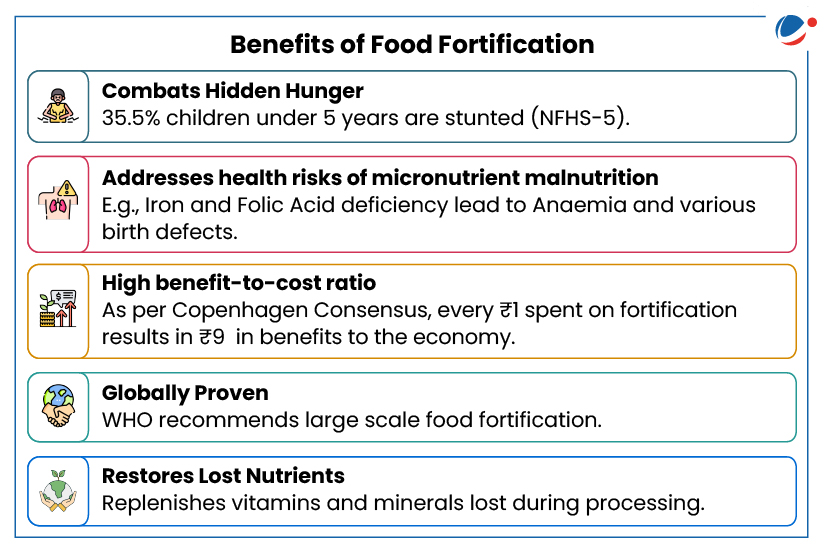
- It is deliberately increasing the content of essential micronutrients in a food to improve the nutritional quality of food and to provide public health benefit with minimal risk to health.
- E.g., Fortified Rice Kernels (FRK) is produced by blending rice flour with micronutrients such as Iron, Folic Acid (Vitamin B9) and Vitamin B12 and shaping it to resemble rice grains.
- Regulatory Framework in India: Food Safety and Standards (Fortification of Food) Regulation, 2018 outlines the standards and quality parameters for fortified foods.
- Food Safety and Standards Authority of India (FSSAI) has operationalized standards for fortifying five staple foods: Rice, Wheat Flour, Edible Oil, Milk, and Salt.
- Methods of Food Fortification:
- Bio-fortification: Enhancing the nutritional value of crops while they are being grown, either through conventional plant breeding or genetic modification.
- E.g., Vitamin A-rich orange sweet potato.
- Industrial Fortification: Adding micronutrients to staple foods (like flour, oil, and salt) during the manufacturing or processing stage.
- E.g., Spraying iodine on salt, or mixing custom-made FRKs into regular rice at a 1:100 ratio.
- Home Fortification: The easiest and most direct method, where individuals manually add micronutrients to their meals.
- E.g., Mixing iron sprinkles, powdered nutrient sachets, or tablets directly into food while it is being cooked or right before eating.
- Bio-fortification: Enhancing the nutritional value of crops while they are being grown, either through conventional plant breeding or genetic modification.
Concerns Associated with Fortification
- Lower Bioavailability: Nutrients supplemented into processed foods generally have lower bioavailability, meaning a smaller proportion is actually absorbed and utilized by the body.
- Lack of Immune Support: Unlike natural, whole foods, artificially fortified foods do not contain inherent immune-boosting compounds.
- Shelf-life Degradation: E.g., as per the study, factors such as moisture content, storage conditions, temperature, relative humidity and packaging material critically influence the stability and shelf life of FRK and Fortified Rice (FR).
- Risks of Over-Nutrition: Excessive intake through fortified foods can potentially interfere with prescription medications, causing reduced absorption of other vital nutrients, treatment failure, or increased health risks.
Way Ahead
- Dietary diversification to tackle both under-nutrition and obesity by encouraging the consumption of a wider variety of nutrient-dense food groups like Millets.
- FSSAI mandatory labelling and warning: Food Safety and Standards (Labelling and Display) Regulations, 2020 helps to improve transparency and assist consumers in making healthier choices through enhanced labelling.
- Address concerns about shelf life by improving packaging, making supply chains shorter and investing in creating more stabilized formulations.
Conclusion
Food fortification is an important tool to address micronutrient deficiencies, but its effectiveness depends on proper implementation and scientific validation. The pause under Pradhan Mantri Garib Kalyan Anna Yojana underscores the need for better storage, monitoring, and a balanced approach combining fortification with dietary diversification.

