


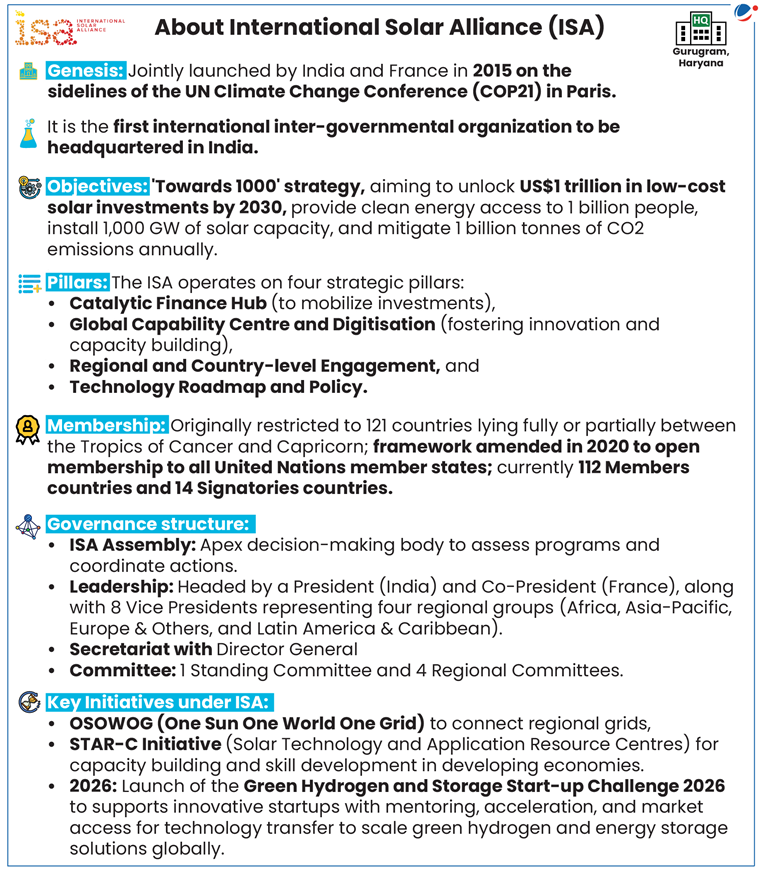
Why in the News?
On March 11, 2026, the International Solar Alliance (ISA) celebrated its 10th Foundation Day.
Significances of ISA
- Alternative Energy Architecture: Indian PM envisioned the ISA as an "alternative OPEC," offering a platform for the equitable production and distribution of energy, breaking the monopoly of fossil-fuel-rich nations.
- Climate Change Mitigation: Plays a critical role in achieving Sustainable Development Goals (SDG 7 for clean energy and SDG 13 for climate action).
- South-South Cooperation: Serves as a vital diplomatic tool to give a voice to developing, energy-deficient nations (Global South) on the international stage, easing their reliance on fossil fuel imports.
- Financial & Tech Aggregation: Aggregates global demand to significantly reduce the cost of solar finance and technologies for Least Developed Countries (LDCs) and Small Island Developing States (SIDS).
Challenges before ISA
The ICIMOD Report (Hindu Kush Himalaya Glacier Melting)
|
- Funding Constraints: Raising large sum cannot be generated purely from public resources, and unlocking private commercial capital remains difficult due to perceived risks in developing nations.
- Trade and Tariff Barriers: High Most Favoured Nation (MFN) tariffs on solar photovoltaic (PV) cells and modules, especially in African and Pacific island nations, severely hinder cost-effective solar deployment.
- Technological & Intermittency Issues: The "Solar Constancy Problem" (lack of sunlight at night or during bad weather/pollution) necessitates advanced, expensive energy storage technologies which many member states lack.
- Lack of Domestic Manufacturing: Many developing countries lack the technical capacities, quality infrastructure, and policies required to manufacture solar equipment independently.
Conclusion
ISA represents a transformative movement toward a sustainable and democratic global energy future, firmly rooted in the Indian philosophy of Vasudhaiva Kutumbakam (the world is one family).
For India, sustaining domestic solar growth while actively transforming its "solar soft power" into tangible international partnerships will be crucial in ensuring an equitable, carbon-neutral energy regime for the 21st century.


