


Why in the News?
Recently, Pakistan-Afghanistan have been in a state of open war causing continuous deterioration in relations.
Background
- Between 2021 and 2025, Tehrik-e-Taliban Pakistan (TTP), also known as Pakistani Taliban, an ideological offshoot of Afghan Taliban, carried out a number of attacks in Pakistan.
- TTP emerged in 2007 and is distinct from Afghanistan Taliban but shares a deep ideological, social and linguistic ties with Taliban.
- Pakistan launched Operation 'Ghazab Lil-Haq' and Afghanistan launched operation 'Radd al-Zulm' in response to artillery fire, ground-level attacks, air and drone strikes, targeting critical military infrastructure.
- Qatar and Turkey helped broker a temporary peace between the Taliban and Pakistani governments, but later negotiations mediated by Saudi Arabia dissolved toward the end of 2025.
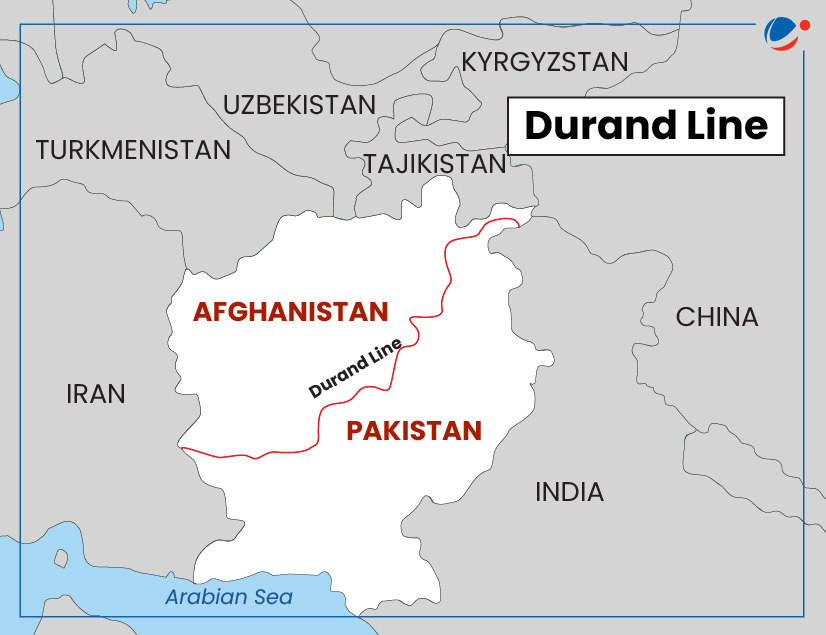
- India's response: Condemned air strikes by Pakistan in Afghanistan's territory causing loss of lives and civilian infrastructure reiterating support for Afghanistan's sovereignty and territorial integrity.
Key Reasons for the Afghanistan-Pakistan Conflict
- Issue of TTP: Since returning to power in 2021, Taliban faced repeated accusations for harbouring TTP militants on Afghan soil which Afghanistan denies.
- Unresolved Border Dispute concerning Durand Line: It is 2,600-kilometre boundary drawn in 1893 between British India and Afghanistan, that Afghanistan sees as an imposed colonial demarcation while Pakistan recognizes as its sovereign boundary.
- Pashtun Nationalism: Afghanistan demanded creation of Pashtun state that would link Pushtun tribes living in Afghanistan with those in North-West Frontier Province (NWFP) and Baluchistan.
- For Pakistan, Afghanistan claims were clearly unacceptable and amounted to demanding greater part of Pakistan's territory.
Implications of the Conflict
- Shifting Power Dynamics: Internal divisions within Taliban and their conflicts with Pakistan could influence their stance toward India, impacting India's long-term strategic interests in the country.
- Security Threats to South Asia: Given the history of cross-border terrorism linked to Pakistan, the conflict increases risk of cross-border militancy and proxy rivalries for India.
- Also, Pakistan is a nuclear powered state with both China and Russia being its major defence partners raises concerns about nuclear proliferation.
- Further deterioration in India- Pakistan relations: Indian influence in Kabul is perceived as an attempt to "encircle" Pakistan and a threat.
- Other concerns: Adverse impact on Regional Trade and Connectivity Projects; Rise in refugees; etc.
Way forward for India
- Leverage soft-power diplomacy: India has long standing humanitarian and infrastructural presence in Afghanistan to address security concerns.
- E.g. India has strong presence through humanitarian projects like maintaining Salma Dam (Afghan-India Friendship Dam).
- Strengthen intelligence gathering: India needs to periodically examine scope of its engagement based on actionable intelligence and evolving geopolitical to shield itself from radicalisation spillovers or entanglement in proxy rivalries within its neighbourhood.
- Realpolitik Approach: Continued engagement with Taliban leaders for safeguarding national interests in preventing radicalisation or terrorism spillover from western front.
- Connectivity Initiatives: Through closer engagement with Taliban, India can resume and expand India-Afghan Air Freight corridor and Chabahar Port Project.
- New alignments: As divergences between old allies (Afghan Taliban and Pakistan) and convergences between new partners (India and Afghan Taliban) require countries to realign their posture with both Pakistan and Afghanistan.
Conclusion
India must strengthen its intelligence gathering and response mechanisms to expand its regional strategic footprint, benefit from connectivity projects through Afghanistan, and shield itself from radicalisation spillovers or entanglement in proxy rivalries.


