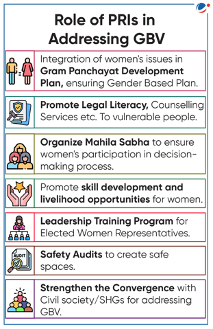
- National Workshop on Role of Panchayati Raj Institutions (PRIs) in Addressing Gender-Based Violence Organised.
- During workshop “Panchayats Free From Gender-Based Violence (GBV) – A Handbook for Elected Representatives” was released.
- Need to address GBV in rural India
- Wide prevalence of sensitive issues like Child Marriage, Human Trafficking, Domestic Violence etc. in rural areas.
- Commitments under International Conventions like Convention on Elimination of All forms of Discrimination against Women and Convention on Rights of Child.
- Promote SDG 5: Gender-based plan addressing GBV will promote gender equality.
- Localization of Sustainable Development Goals (LSDGs) Theme 9 aims Women Friendly Villages, ensuring protection, economic & inclusive growth etc. of women.
- India announced a new alliance for Global Good, Gender Equity and Equality at the World Economic Forum (WEF) Annual Meeting in Davos, Switzerland.
- It aims to bring together global best practices, foster knowledge sharing, and attract investments in key areas such as women’s health, education, and enterprise.
- It builds on commitments of G20 Leaders’ Declaration and India’s dedication to women-led development.
- Supported by Bill and Melinda Gates Foundation, and anchored by Confederation of Indian Industry Centre for Women Leadership.
- WEF will be a ‘Network Partner’ and Invest India an ‘Institutional Partner’.
- Ministry of Education (MoE) launched the “Prerana: An Experiential Learning program” to empower participants with leadership qualities
- It is a week-long residential program for selected students of class IX-XII.
- 20 Students are selected for each batch (10 boys and 10 girls)
- It is to run from a Vernacular School, established in 1888, in Vadnagar (Gujarat)
- The curriculum was prepared by IIT Gandhi Nagar based on nine value-based themes.
- It aims to embody the spirit of "Vasudhaiva Kutumbakam" and foster unity in diversity.
Tags:
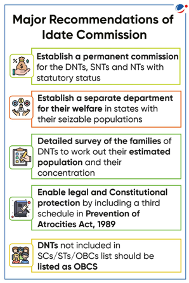
- National Human Rights Commission stresses on the need for implementation of Idate Commission report.
- Idate Commission or the National Commission for Denotified, Nomadic and Semi-Nomadic Tribes was constituted in 2014 under Bhiku Ramji Idate.
- The commission was mandated to compile a state-wise list of Denotified Nomadic and Semi-Nomadic Tribes (DNTs), identify DNTs not included in SCs/STs or OBC lists, recommend measures for their welfare, etc.
- About DNTs
- These communities were notified as criminals under the Criminal Tribes Act 1871 by British to prevent their future engagement with criminal activities.
- They were forcibly alienated from their traditional occupations and habitations through other subsequent legislation.
- The act was repealed by the Indian Government in 1952 and they were declared DNTs.
- These communities were notified as criminals under the Criminal Tribes Act 1871 by British to prevent their future engagement with criminal activities.
- Challenges faced by DNTS
- There is no Central list for these communities neither are they recognised as a separate group (like SC/STs) under the Constitution.
- They are mostly outside the purview of government welfare initiatives.
- They are mostly uneducated and suffer form lack of basic infrastructure facilities like drinking water, shelter, healthcare.
- Welfare initiatives:
- Development and Welfare Board for DNTs established in 2021 for a period of 3 years (extendable up to 5 years).
- Scheme for Economic Empowerment of DNTs (SEED) for educational empowerment, health insurance, livelihoods and housing.