


Why in the News?
At the 9th Indian Ocean Conference, India's External Affairs Minister emphasized the need for greater regional cooperation in the Indian Ocean Region amid growing global uncertainty and the ongoing West Asia conflict.
About Indian Ocean Conference (IOC)
- It was started in 2016 by India Foundation in association with think tanks and institutions from the region, with participation from 30 countries.
- India Foundation is an independent research centre focussed on the issues, challenges and opportunities of the Indian polity.
- IOC 2026 was held in Mauritius centered on the theme, "Collective Stewardship for Indian Ocean Governance".
- The Conference brings together principal maritime partners on a common platform to deliberate upon regional cooperation for Security and Growth for All in the Region (SAGAR).
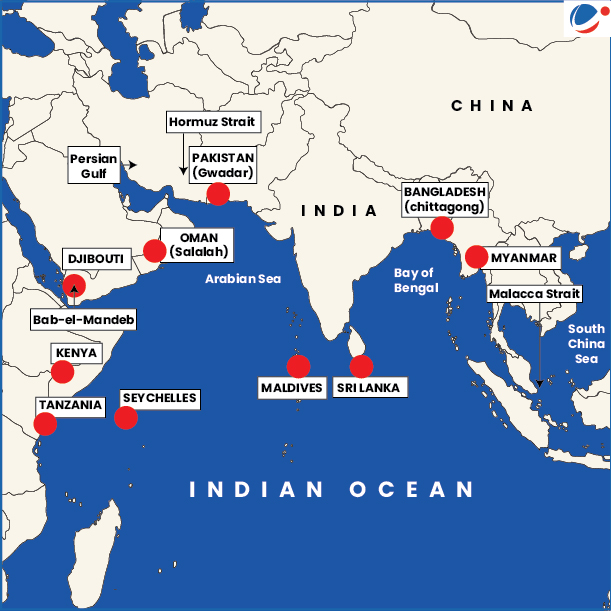
About Indian Ocean Region (IOR)
- IOR is bordered by Africa to the west, the Straits of Malacca and Australia to the east, India to the north, and Antarctica to the south.
- It comprises ~36 countries and accounts for 35% of the global population and 40%of the world's coastline.
- Significance of the region:
- Economic & Trade Importance: Currently, nearly 95% of India's trade by volume and 68% by value moves via Sea (Ministry of Ports, Shipping and Waterways).
- Blue Economy Potential: India has a 2.4 million sq. km Exclusive Economic Zone (EEZ) in the IOR which offers opportunities in sustainable fisheries, renewable ocean energy, eco-tourism, and marine biodiversity conservation.
- Strategic & Geopolitical Value: Vital due to critical sea lanes and chokepoints (e.g., Strait of Hormuz) and central to India's security architecture with its 11,098.81 Kms coastline.
Changing geopolitical dynamics of Indian Ocean Region
- Vulnerability of Critical Chokepoints: Conflicts in West Asia (E.g., escalation of violence in the Red Sea during Israel and Hamas war, Hormuz blockade during U.S.-Iran war etc.) have increased tensions around key chokepoints like the Strait of Hormuz and Bab-el-Mandeb, threatening global oil shipments and maritime trade.
- IOR accounts for ~30% of worldwide container traffic and transports 42% of crude oil, petroleum products.
- Militarisation of the IOR: E.g., United States uses Diego Garcia as a key military hub; France's presence through Réunion and Mayotte; China expanding its footprint via port infrastructure and access agreements; Australia developing the Cocos (Keeling) Islands to enhance its strategic role etc.
- Vulnerability of Critical Infrastructure: E.g., In the digital age, a critical new vulnerability is the threat to undersea communication cables, which transmit over 95% of global data.
- Disruptions to these cables could impact military communications, financial transactions, cloud computing, and digital services like e-commerce, social media etc.
- Non-Traditional Security threats: Emerging threats like piracy, maritime terrorism, illegal fishing, cyber threats, and climate change have added further complexity.
India's approach in the IOR
- Unified Indian Ocean strategy: SAGAR focuses on countering threats such as terrorism, piracy, and other illegal activities and MAHASAGAR (Mutual and Holistic Advancement for Security and Growth Across Regions) expands the scope of SAGAR, by also focusing on security, growth, and development goals beyond the region.
- Maritime Domain Awareness (MDA): Information Fusion Centre-Indian Ocean Region (IFC-IOR) enables real-time maritime information sharing, enhancing domain awareness and operational coordination among partner countries.
- Bilateral and multilateral diplomacy: India actively participates in regional platforms such as the Indian Ocean Rim Association (IORA), the Indo-Pacific Oceans Initiative (IPOI), BIMSTEC, Colombo Security Conclave, and the Indian Ocean Naval Symposium (IONS), all provides structured avenues for dialogue, for cooperation, and for capacity building.
- 'First Responder': Whether in humanitarian crises or natural disasters, India have stepped forward with speed and with reliability. E.g., 'Operation Sagarbandhu' in Sri Lanka after the devastating Cyclone Ditwah.
- Joint exercise like AIKEYME (Africa India Key Maritime Engagement), Dosti or MILAN, India builds interoperability and trust to combat threats collectively for a safer and more prosperous Indian Ocean region.
- Integration with the Indo-Pacific: E.g., through engagement with Quad partners (Australia, India, Japan and the United States) in areas like Logistics Network, infrastructure, Maritime Domain Awareness etc.
Way Forward for India amid New Geopolitics in IOR
- Capability Development: The Indian Navy's Maritime Security Strategy, released in April 2026, focuses on multi-domain integration (land, sea, air, cyber, space) and on preparing for grey-zone warfare.
- Grey zone warfare refers to hostile actions that fall between peaceful competition and direct conventional war.
- Island Development: India must prioritise the integrated development of the Andaman and Nicobar Islands, with the Andaman and Nicobar Command (ANC) serving as a vital forward operating base to enhance surveillance and maintain control over critical maritime chokepoints, particularly the approaches to the Malacca Strait.
- Maritime Governance: It should actively promote freedom of navigation and ensure adherence to international law, particularly the United Nations Convention on the Law of the Sea (UNCLOS).
- Diversify Energy Sources: Reduce excessive dependence on West Asian oil by expanding energy imports from alternative suppliers' countries such as Brazil, Norway, Canada, Malaysia, and Indonesia.
Conclusion
The convergence of economic, technological, and strategic interests has made the Indian Ocean a zone of growing vulnerability and competition. Major powers are increasingly seeking to secure influence over critical maritime routes, ports, and infrastructure. As a result, the Indian Ocean has shifted from a passive transit corridor to an active strategic domain where economic and military interests closely intersect.


