


Why in the News?
Recently, the Parliamentary Standing Committee on Energy recommended a slew of measures concerning solar projects to expedite India's energy transition.
India's Solar Energy Profile
- Present Capacity: Around 129 GW (2025). Target: 292 GW by 2030.
- Non-fossil electricity capacity crossed 259 GW, accounting for over 50 % of total installed power capacity (as of October 2025).
- Global Status: India ranks 3rd globally in solar energy (as per IRENA Renewable Energy Statistics 2025).
Key Challenges and Recommendations in adoption of Solar Energy as per Parliamentary Committee
Key Challenges | Key Committee Recommendations |
Regional Imbalance | Aiding States/Union Territories (UTs) with low solar capacity € potential through supportive policies, timely Central Financial Assistance (CFA) release, regular monitoring, etc. |
Land Acquisition related Issues | Creation of a 'single window clearance mechanism', comprising all stakeholders of Centre and State level. |
Slow Progress in Solar Schemes | Close coordination with States and solar project developers for timely identification and resolution of issues. |
Right of Way Compensation Issue in Transmission Projects | The Committee urged states to adopt the Centre's recent RoW guidelines, which mandate compensation at market rates specifically 200 per cent for tower-base land and 30 per cent for corridor areas to minimize disputes |
Delays in Forest and Wildlife related Clearances | A dedicated portal, exclusively for all transmission related matters, onboarding all authorities involved in forest and wildlife related clearances. |
Inadequate Storage Capacity With regard to indigenization of storage technology | Premier research institutions to undertake storage related research & development by making provision for dedicated capital grants for the same. |
Domestic Manufacturing in Solar Sector | Formulating a dedicated scheme/programme for polysilicon, ingots & wafers and solar glass to encourage domestic manufacturers. |
Lack of Domestic Capability in HVDC (High Voltage Direct Current) | Detailed plan and providing adequate capital for HVDC related research & development as well as training of manpower in HVDC related technology. |
Need for Skilled Manpower | Increasing the number of training institutions, developing public-private mode of training, industry-aligned training, etc. |
Key measures/initiatives taken towards adoption of Solar Energy
- PM Surya Ghar: Launched in 2024, it aims to provide rooftop solar systems to one crore households.
- Nearly 24 lakh households have adopted rooftop solar until December 2025.
- National Solar Mission: Launched in 2010 as India's flagship initiative towards large-scale deployment of solar energy.
- Production-Linked Incentive (PLI) Scheme for Solar PV: Implemented by Ministry of New and Renewable Energy (MNRE), under National Programme on High Efficiency Solar PV Modules to achieve Giga Watt (GW)-scale manufacturing capacity in solar PV modules.
- Pradhan Mantri Kisan Urja Suraksha Evam Utthaan Mahabhiyan (PM-KUSUM) scheme: Comprises of three components including installation of standalone solar pumps in areas with limited grid access.
- Solar Parks & Ultra-Mega Solar Power Projects: As of 31st October 2025, 55 solar parks with a combined sanctioned capacity of around 40, 000 MW have been approved across 13 states.
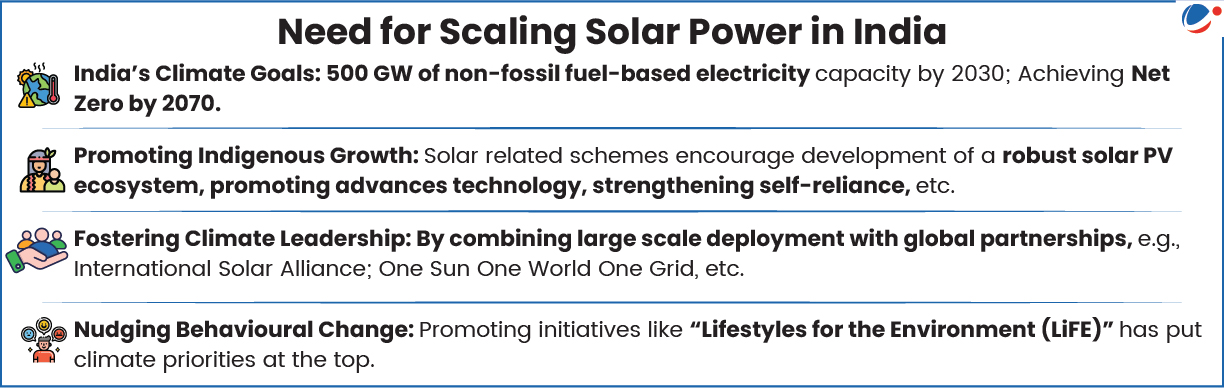
- International Solar Alliance (ISA): Co-founded by India with France as an inter-governmental organization dedicated to mobilizing global investments in solar energy.
- One Sun, One World, One Grid (OSOWOG): Focuses on interconnecting renewable energy grids across countries.
Conclusion
With continued innovation in technology, supportive policies, and investments in grid infrastructure, India can overcome hurdles associated with solar energy projects and emerge as a global leader in renewable energy.


