Prepared by IIM Bangalore’s Center for Digital Public Goods, the report argues that India has built a “middle-path” digital model balancing public and private sector serving as a template for Global South.
About DPI
- An infrastructure-based approach using technology to achieve societal goals through an ecosystem comprising technology, markets and governance.
- It involves shared digital systems built on open standards and specifications in public interest.
- Condition for an Initiative to Operate as DPI:
- Reach and Scale: Third parties should be able to utilise the infrastructure as a building block to innovate and offer diverse final services.
- Principle of non-exclusivity: Infrastructure to be non-discriminatory in nature and inclusive by design.
- Significance: Financial Inclusion (Jan Dhan- Aadhar- Mobile Trinity); Public Service Delivery (E.g., DPI enabled Direct Benefit Transfer); Innovation; Empowerment of Citizens, etc.
Key Highlights of India’s DPI (Report)
- Co-creation Model: Government-driven, and private-sector-energized. E.g. UIDAl's Aadhaar partners with Private enrolment agencies, biometric device manufacturers, etc.
- Building Blocks Approach: Integrating DPI and DPG offering speed and scale of services.
- E.g., Digiyatra (DPG or technological assets/open-source software) using Aadhar (DPI) offers paperless travel experience.
- Expansion into Diverse Sectors: Acting as a key pillar of India’s Growth Strategy. E.g., agriculture (Agri-stack), logistics (ULIP), and education (DIKSHA).
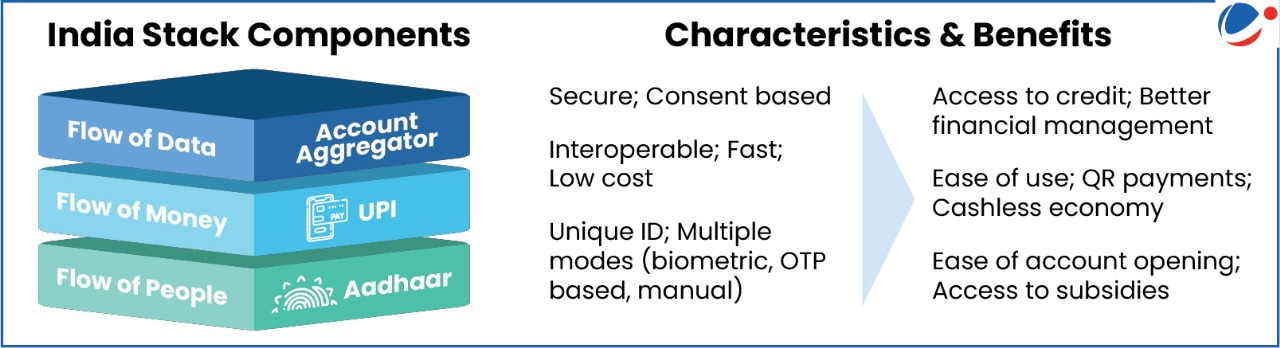
India’s DPI Ecosystem: India Stack
- It comprises three core public utilities - identity, payments, and data.