
Ministry of Home Affairs reviews implementation of three new criminal laws in ICJS 2.0 | Current Affairs | Vision IAS
MENU
Home

Periodically curated articles and updates on national and international developments relevant for UPSC Civil Services Examination.

Quick Links

High-quality MCQs and Mains Answer Writing to sharpen skills and reinforce learning every day.

Watch explainer and thematic concept-building videos under initiatives like Deep Dive, Master Classes, etc., on important UPSC topics.

ESC

Ministry asked National Crime Records Bureau (NCRB) to facilitate complete implementation of three new criminal laws in the ICJS 2.0 (Inter-operable Criminal Justice System 2.0).

  • Emphasis should be placed on using of applications like eSakshya (assists in managing evidence), Nyaya Shruti (electronic judicial proceedings), eSign and eSummons in every state/UT.
  • Alerts should be generated for all criminal cases at predefined stages and timelines, expediting the investigation process
  • NCRB should create a data rich platform to benefit the Investigation Officers and other stakeholder of Criminal Justice System.

About ICJS
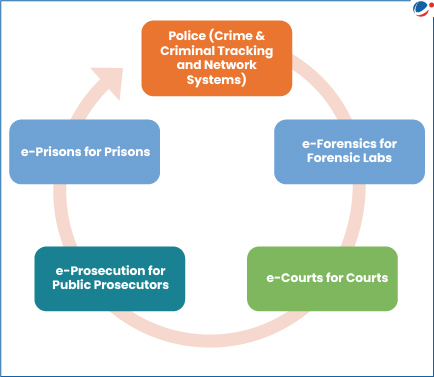
An infographic depicting different pillars of criminal justice system

ICJS was conceptualised by the e-Committee of Supreme Court of India and is being implemented as a project under the Ministry of Home Affairs.

  • Objective: Enable seamless transfer of data and information among different pillars of the criminal justice system (see infographic). 
  • Focus: Integration of Crime and Criminal Tracking Networks and Systems (CCTNS) with e-Courts and e-Prisons database, and with other pillars of judiciary like Forensic Labs, Fingerprints and Prosecution.
    • It aims to achieve “one data once entry” across all the pillars.
  • Implementation: By NCRB in association with National Informatics Centre (NIC). 
  • Timeline: Phase-I (2018-2022), Phase-II (2022-23 to 2025-26).

Other Initiatives for leveraging Technology in Criminal Justice System

  • Safe City Project sanctioned in first phase in 8 cities to aid smart policing.
  • National Automated Fingerprint Identification System (NAFIS) to facilitate rapid and accurate identification of individuals.
  • Strengthening of DNA Analysis Units in Central and State Forensic Science Laboratories.
  • Common Integrated Police Application (CIPA)  to automate processes at police stations.
Watch Video News Today

Explore Related Content

Discover more articles, videos, and terms related to this topic

RELATED VIDEOS

2
News Today (Dec 25-26, 2024)

News Today (Dec 25-26, 2024)

YouTube HD
Lateral Entry

Lateral Entry

YouTube HD
Title is required. Maximum 500 characters.

Search Notes

Filter Notes

Loading your notes...
Searching your notes...
Loading more notes...
You've reached the end of your notes

No notes yet

Create your first note to get started.

No notes found

Try adjusting your search criteria or clear the search.

Saving...
Saved

Please select a subject.

Referenced Articles

linked

No references added yet

Subscribe for Premium Features
