


Why in the news?
WTO's ministerial conference ended with no decision on finding a permanent solution curbing fisheries subsidies that lead to over-capacity and over-fishing.
WTO Agreement on Fisheries Subsidies
- Geneva Package: The Agreement was adopted during the 12th Ministerial Conference of WTO in 2022 held in Geneva, Switzerland under the 'Geneva Package'.
- Aim: To curb harmful subsidies, which are seen as a key factor in the widespread depletion of the world's fish stocks.
- Not accepted yet: Acceptance from two-thirds of WTO members is needed for the Agreement to come into effect. The agreement is still short of 39 countries (March 2024).
- India is not part of the agreement.
- Benefits: It will have positive effects on the sustainability of marine fish stocks and fisheries –
- By curbing subsidies to illegal, unreported and unregulated fishing
- By prohibiting subsidies to fishing on overfished stocks
- By prohibiting subsidies to fishing on the unregulated high seas
- Special and Differential Treatment (S&DT): Under S&DT, Developing Countries and Least Developed Countries (LDCs) have been allowed a transition period of 2 years from the date of entry into force of this Agreement.
India's Demands
- PPP and CBDR- RC: Countries that have provided huge subsidies in the past and are responsible for the depletion of fish stocks, should take more obligations to prohibit subsidies based on the 'polluter pay principle' (PPP) and 'common but differentiated responsibilities and respective capabilities' (CBDR-RC).
- The agreement must also incorporate special and differential treatment (S&DT) to protect the livelihood and growth needs of the fishing community in developing countries.
- Moratorium on Distant Water Fishing Nations: India urged the Members to introduce a moratorium on subsidies by Distant Water Fishing Nations for fishing or fishing related activities beyond their EEZs for a period of at least 25 years.
- Exception for Developing countries and small economies: They should be free to provide subsidies for the fisheries sector.
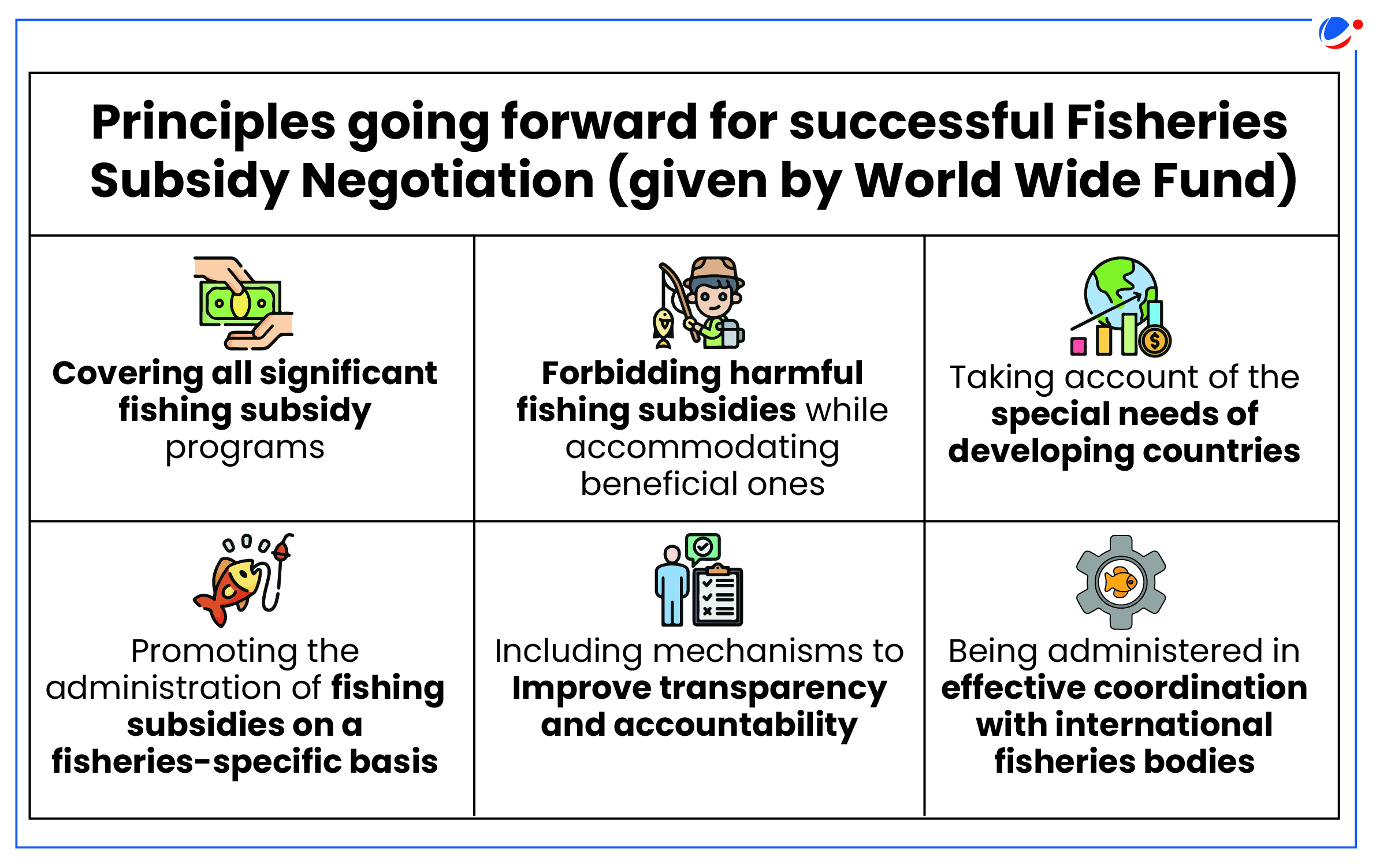
Rationale for India's Stand
- Subsidies are vital to develop and diversify their fisheries sector as well as to protect the food security and livelihood security of their fishermen.
- Significant population depends on the fishing sector: For example, in India, there are more than 100 million fishers and approximately 61 % are still living below the poverty line.
- Low per capita subsidy of developing countries: For instance, India is one of the lowest fisheries subsidizers despite such a large population.
- Also, India alongside most developing and small countries does not exploit the resources indiscriminately like other advanced fishing nations.


