


Why in the news?
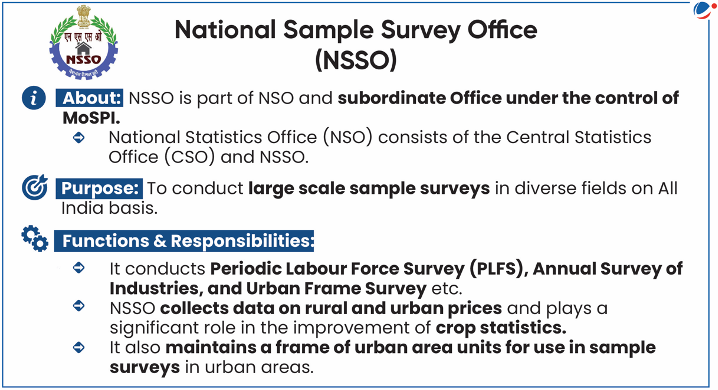
The National Sample Survey Office (NSSO) released the HCES 2022-23, after a gap of over 10 years since the last survey in 2011-12.
About Household Consumption Expenditure Survey (HCES)
- Objective: It is designed to collect information on the consumption of goods and services by households.
- Conducted by: NSSO under the Ministry of Statistics and Programme Implementation (MoSPI) has been conducting HCES at regular intervals.
- Initially, the NSSO was conducted HCES every year (starting 1950-51). However, since its 26th round, the survey has been conducted roughly every 5 years. (The 2017-18 Survey was discarded by the government citing ‘Data Quality’ issues.)
- Utility of HCES: The data is useful for understanding consumption and expenditure patterns, standard of living and well-being of households.
- It can play a key role in reviewing critical economic indicators, including GDP, poverty levels, and Consumer Price Inflation.
Key Findings of HCES 2022-23
- Overall Trend: Average Monthly Per Capita Consumption Expenditure (MPCE) has been increasing since 1999-2000. It has increased around 2.6 times in rural areas and 2.5 times in urban areas since the last survey.
- Rural-urban Divide: Average MPCE has been Rs. 3,773 in rural India and Rs. 6,459 in urban India.
- Rich-Poor Divide: Richest 5 % of rural and urban areas spend nearly 8 times and 10 times more than the bottom 5 % respectively.
- State-wise Variation: Among the states, MPCE is the highest in Sikkim and lowest in Chhattisgarh. Among the UTs, MPCE is the highest in Chandigarh and lowest in Ladakh.
- 9 states lagged behind the national average: Uttar Pradesh, West Bengal, Odisha, Jharkhand, Bihar, Meghalaya, Madhya Pradesh, Chhattisgarh and Assam.
- MPCE of Agriculture Households: Consumption expenditure of agricultural households (Rs 3,702) falls below the rural average (Rs 3,773) for the first time.
- However, the gap between the MPCE of agricultural families and the overall average of rural households has been narrowing over the years.
- Consumption Expenditure among Disadvantaged Sections: In rural areas, Scheduled Tribes (ST) reported the lowest MPCE, followed by Scheduled Castes both less than the rural average.
- In urban areas, SCs reported the lowest MPCE, followed by STs and OBCs, all less than the average MPCE in urban areas.
- Expenditure on Food: Share of expenditure on food has gradually declined while the share of non-food items has increased for both urban and rural households, since the 1999-2000 survey.
- Further, expenditure has shifted to high-value and nutritious animal and horticulture products from cereals and pulses.
Please note that the HCES 2022-23 also includes a separate provision for the collection of information on the quantity of consumption for several items, received and consumed by the households free of cost through various social welfare programmes.



