


Why in the News
Union Budget 2026-27 outlines government initiatives to strengthen textiles, support weavers and artisans, boost exports, and create employment.
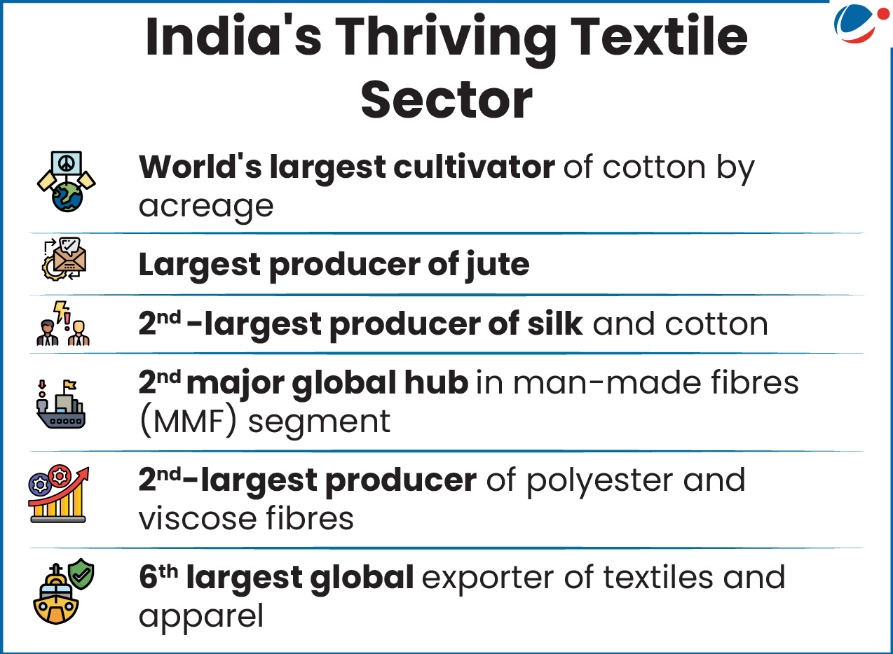
Textile Sector in India
- GDP Contribution: ~2% to total GDP of the Country
- Manufacturing Sector Contribution: 11% of total manufacturing GVA
- Export: 6th largest exporter of Textiles & Apparel in the world.
- USA and EU together account for about 47% of India's textile and apparel exports.
- Employment: 2nd largest employment generator in the country.
- Support MSME ecosystem: ~80% of the industry's capacity is spread across MSMEs.
Key Announcements in Budget 2026-27
Other Government Initiatives
|
- Integrated Programme for the Textile Sector: It is structured around five key sub-components-
- National Fibre Scheme for domestic fibre self-reliance
- Textile Expansion and Employment Scheme to modernize traditional clusters
- National Handloom and Handicraft Programme to unify artisan support
- Tex-Eco Initiative for sustainable manufacturing
- Samarth 2.0 skilling program.
- Mega Textile Parks and Technical Textiles: Setup of Mega Textile Parks in challenge mode to provide integrated infrastructure and scale efficiencies.
- Mahatma Gandhi Gram Swaraj Initiative: It aims to strengthen the khadi, handloom and handicraft sectors by improving global market linkages, modernising processes and supporting the One District One Product (ODOP) initiative.
- Export Promotion Measures: The export obligation period was extended from 6 to 12 months to provide greater flexibility to exporters of textile garments, footwear and leather products made using duty-free imported inputs.
- Liquidity Support for MSMEs through TReDS:
- The government enhanced the Trade Receivables Discounting System (TReDS) by mandating its use by Central Public Sector Enterprises (CPSEs)
- Providing credit guarantee support through Credit Guarantee Fund Trust for Micro and Small Enterprises (CGTMSE) for invoice discounting on TReDS;
- Linking Government e-Marketplace (GeM) with TReDS.
- SME Growth Fund: A ₹10,000 crore SME Growth Fund has been created to support micro-enterprises and develop future "Champion SMEs" in the textile ecosystem.
Challenges with textile industry
- Raw Material Constraints: poor cotton quality, climate-hit cotton yields, and import-dependence for synthetic fibres.
- Intense Global Competition: competition from Bangladesh and Vietnam, dumping of cheap man-made fibre (MMF) fabrics from China.
- Recent geopolitical challenges: for e.g. steep 50% US tariff on Indian goods.
- Lack of Automation: heavy reliance on manual labour leading to error and reduced productivity.
- Skill Shortages: and highly fragmented nature, with over 90% of weaving units in the unorganised sector.
- Complex Regulatory Frameworks: DGFT red tape, inconsistent GST rates, and costly Quality Control Orders (QCOs) impede competitiveness.
Way Forward
- Adopt Advanced Automation: Integrate smart looms, AI-driven demand forecasting, and RFID traceability.
- Invest in Infrastructure and R&D: Establish Mega Textile Parks equipped with plug-and-play digital infrastructure to enable scale efficiencies.
- Focus on Technical Textiles: Diversify into high-value, specialized segments like technical and performance fabrics to capture new global demand.
- Boost Domestic Man-Made Fibres (MMF): Reduce reliance on imported synthetic fibers by encouraging domestic production of MMF and new-age fibers under the National Fibre Scheme.
- Enhance Cotton Supply Chains: Improve transparency and global acceptance of Indian cotton through digital tools like the Kapas Kisan app and branding initiatives like 'Kasturi Cotton Bharat'.
- Leverage Free Trade Agreements: Actively utilize agreements like the India-EU FTA to gain zero-duty access to major international markets.
- Upskill the Workforce: Counter the severe skill shortage by providing vocational training and utilizing the upgraded Samarth 2.0 program.
- Empower Traditional Artisans: Support village industries, handlooms, and khadi through the Mahatma Gandhi Gram Swaraj Initiative, improving global market linkages, branding, and modernizing traditional clusters.
- Sustainability-Linked Finance: Introduce financing models for MSMEs where benefits are tied directly to positive environmental outcomes.


