


Why in the News?
The government has fast tracked the procedures for approval of doubling the credit target for the Agriculture Infrastructure Fund, to ensure safe storage of Food grains.
Food Grain Storage Systems in India
According to the Third Advance Estimates for 2024–25, India achieved a record foodgrain production of 353.96 million tonnes.
- Centralized Storage: Under the centralized procurement system, food grains are procured either directly by Food Corporation of India (FCI) or by State Government Agencies, which later transfer the stocks to the Central Pool.
- FCI procures grains at the Minimum Support Price (MSP) to protect farmers' incomes and maintain adequate buffer stocks.
- As of July 1, 2025, the Storage Capacity available with FCI and State agencies for the storage of Central Pool foodgrains stood at 917.83 Lakh Metric Tonnes (LMT).
- Decentralized Storage: Carried out through rural godowns, Primary Agricultural Credit Societies (PACS), and on farm storage by farmers.
- Around 60-70%, of food grain produced is stored at household level using various indigenous traditional storage structures.
- Decentralized storage through PACS was also recommended by Ashok Dalwai Committee on Doubling Farmers' Income (2018).
Major Schemes to Strengthen storage of Foodgrains
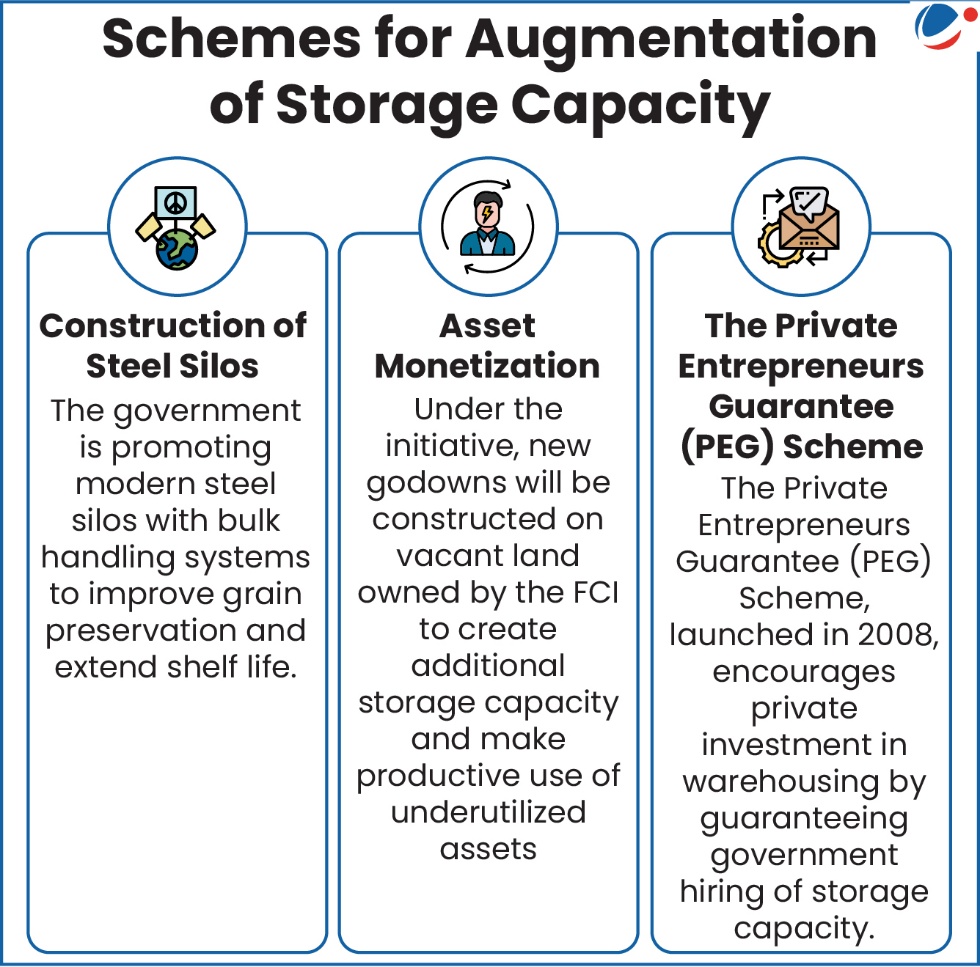
- Agriculture Infrastructure Fund (AIF): The scheme, launched in 2020, supports the development of warehouses, cold storage facilities, sorting and grading units, and logistics infrastructure.
- Agricultural Marketing Infrastructure (AMI): It provides financial assistance for the construction and renovation of warehouses and godowns in rural areas.
- This scheme is a component of the Integrated Scheme for Agricultural Marketing (ISAM).
- Pradhan Mantri Kisan SAMPADA Yojana (PMKSY): It is a comprehensive scheme designed to build modern infrastructure for the food processing sector, creating a smooth and efficient supply chain from the farm gate to retail.
- World's Largest Grain Storage Plan in the Cooperative Sector: It aims to develop storage and other agri-infrastructure at the PACS level through convergence of schemes such as AIF, AMI etc.
Why do we need better storage?
- Losses: According to the World Bank Report, the food grains and perishables wasted due to improper storage could be sufficient to feed one-third of the India's poor population..
- Price Stability: Improved storage allows the government to release stocks during shortages and control price fluctuations.
- Supporting Public Distribution System (PDS): Strong storage infrastructure is required for smooth distribution of grains to millions of beneficiaries under food security programmes.
- Reducing Farmer Distress: Better storage facilities help farmers avoid distress sales by allowing them to store produce and sell later at better prices moving toward Doubling the Farmers Income.
Challenges in Food grain storage in India
- Regional Imbalance in Storage: Storage infrastructure is concentrated in major procurement states such as Punjab and Haryana, while many eastern and northeastern states lack adequate facilities. This creates logistical challenges in transporting and distributing grains.
- Delay in Creation of Storage Infrastructure: Storage projects under schemes like PEG (Private Entrepreneur Guarantee Scheme) faced major delays.
- Example: Contracts for godown construction were awarded late and godowns were completed after delays of 2–7 years.
- Climate Change: Rising temperatures and erratic humidity accelerate spoilage and fungal growth.
- Storage Structures at Farmer Level: The major construction materials for storage structures in rural areas are mud, bamboo, stones, and plant materials. They are neither rodent-proof, nor secure from fungal and insect attack.
Way Forward
- CAG Performance Audit Report (2023)
- Augment Scientific Storage Capacity: The Government should complete the augmentation of storage facilities planned under the National Policy on Handling, Storage and Transportation of Food Grains.
- Phase out CAP (Open) Storage: Covered and Plinth (CAP) storage should be gradually eliminated and replaced with modern storage infrastructure.
- Shanta Kumar Committee (2014)
- Computerization of Storage Management: The committee emphasized the need for real-time digital tracking of food grain stocks across procurement centres, warehouses and distribution points.
- Private Sector Participation: FCI's old conventional storages can be converted to silos with help of private sector and other stocking agencies.
- Promotion of Negotiable Warehouse Receipt System: The committee recommended expanding the Negotiable Warehouse Receipt (NWR) system, under which farmers can store their produce in registered warehouses and obtain bank credit against the stored produce.


